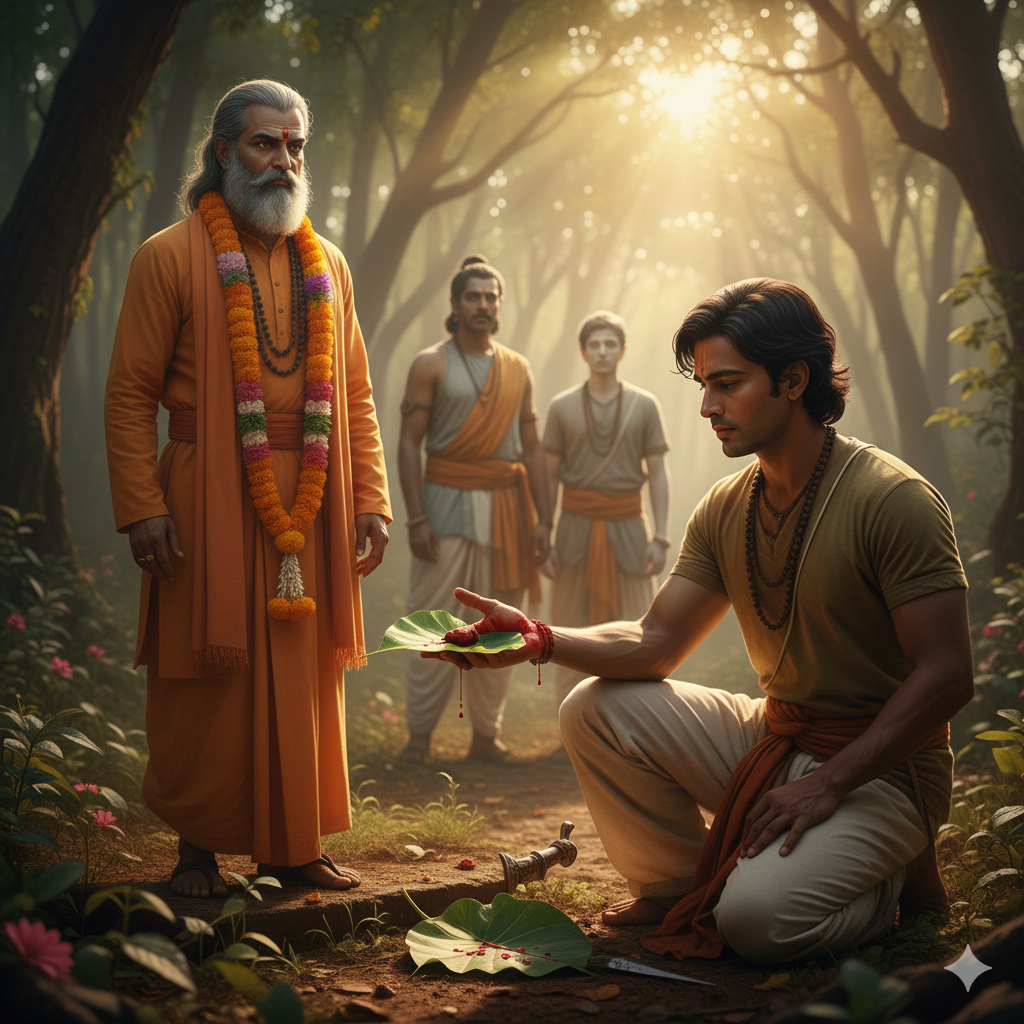
The Significance of Guru Dakshina: Lessons from the Legend of Eklavya
In the rich tapestry of Indian tradition, the bond between a teacher (Guru) and a student (Shishya) is considered sacred. Central to this relationship is the concept of Guru Dakshina. But what exactly is Guru Dakshina, and why does it remain relevant in today’s world?
What is the Meaning of Guru Dakshina?
The word Dakshina literally refers to a gift, fee, or offering. In a spiritual and educational context, Guru Dakshina is the act of showing gratitude to a mentor after the completion of one’s education.
Metaphorically, Dakshina is compared to the process of digestion—just as the body must process food to gain energy, a student must offer Dakshina to “digest” and internalize the knowledge received. It is believed that education only becomes truly fruitful and “auspicious” when the student acknowledges the debt they owe to their guide.
The Ultimate Sacrifice: The Story of Eklavya
The most famous example of Guru Dakshina comes from the ancient Indian epic, the Mahabharata, involving the master archer Guru Dronacharya and a determined young man named Eklavya.
The Rejection
Eklavya, a forest dweller, approached Dronacharya to learn archery. However, Dronacharya, who was the tutor to the royal Kuru princes, refused to teach him, stating he was bound to instruct only royalty. Undeterred, Eklavya returned to the forest with a firm resolve to master the craft on his own.
The Clay Statue and Self-Mastery
Eklavya crafted a clay statue of Dronacharya, treating it as his living Guru. Through unwavering focus and daily practice before the idol, he became a master archer.
His skill was discovered when Dronacharya and the Pandava princes were hunting in the forest. Their dog began barking at Eklavya, who—without harming the animal—fired seven arrows into its mouth to silence it. When Dronacharya saw this incredible feat, he realized he was looking at an archer who surpassed even his favorite pupil, Arjuna.
The Demand for Dakshina
When Dronacharya found Eklavya, the young man bowed and credited the statue of Dronacharya for his success. Realizing that Eklavya’s skill threatened his promise to make Arjuna the greatest archer in the world, Dronacharya tested Eklavya’s loyalty.
He asked, “If I am your Guru, where is my Dakshina?” Eklavya replied that he would give anything. Dronacharya then made a shocking request: the thumb of Eklavya’s right hand. Without a moment’s hesitation, Eklavya took his dagger, cut off his thumb, and placed it at his Guru’s feet. In doing so, he gave up his future as a warrior out of pure devotion.
Why is Guru Dakshina Important Today?
While the story of Eklavya is an extreme example of sacrifice, the essence of the tradition carries deep psychological and spiritual value:
- Acknowledgment of Debt: It reminds us that knowledge is a gift, not a commodity. Paying it forward or giving back ensures the student remains humble.
- The Completion of Learning: In Vedic tradition, learning is considered incomplete until the student offers something back to the source of that knowledge.
- Building Character: It tests a student’s dedication and selflessness, qualities that are essential for long-term success.
Conclusion
The legend of Eklavya remains one of the most poignant stories in history. Though he lost his ability to shoot with his thumb, his name became immortal. Today, Guru Dakshina serves as a reminder that the path to mastery is paved with respect, gratitude, and the willingness to honor those who light our way.
Reference: You may also be interested to read “The Supreme Importance of the Guru in Indian Culture and Literature“