What Is the Concept of Brahma, Vishnu, and Mahesh in Hindu Philosophy?
Introduction to the Hindu Trinitarian Vision
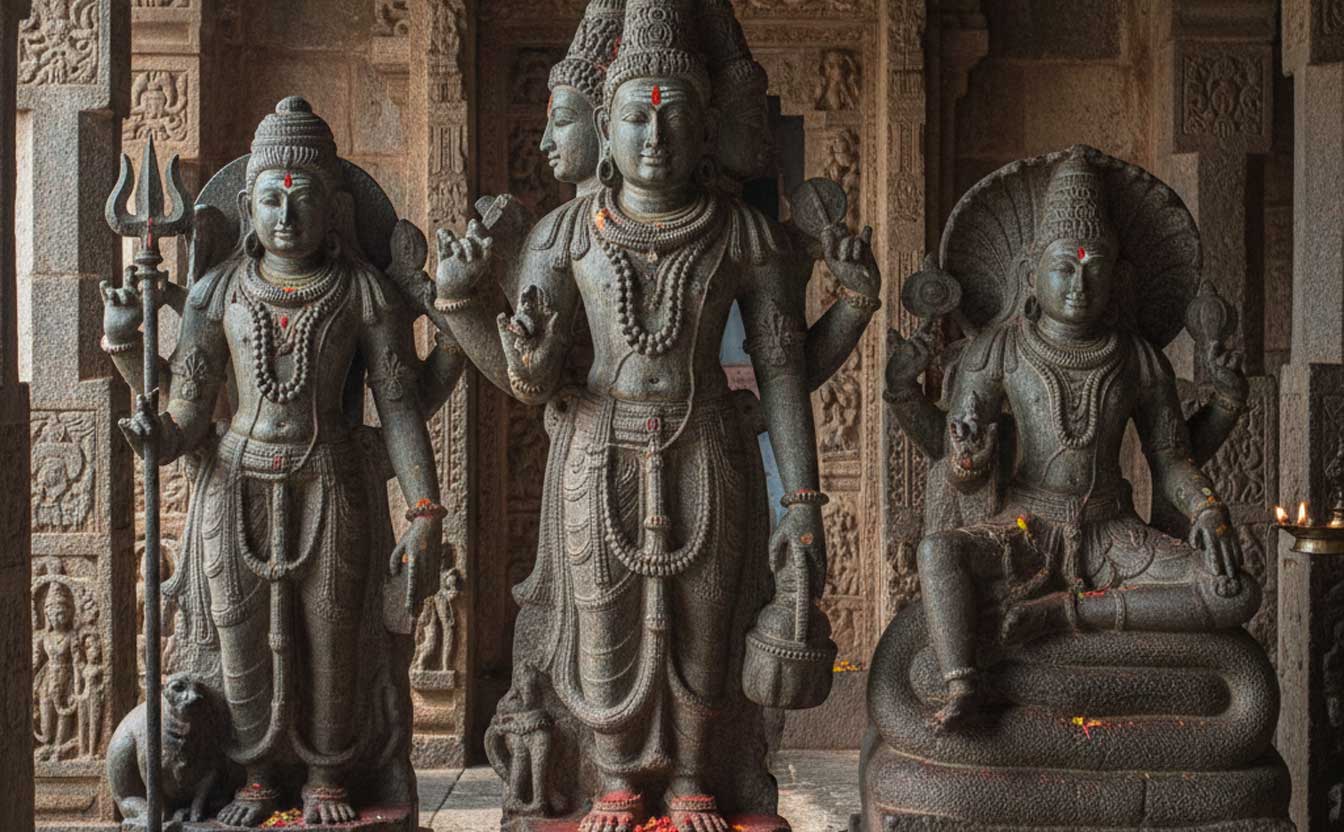
In Hindu philosophy, the universe is not viewed as a static creation but as a dynamic, cyclical, and eternally evolving reality. At the heart of this worldview stands the profound concept of Brahma, Vishnu, and Mahesh (Shiva)—a triadic framework often referred to as the Trimurti. Together, these three divine principles represent the cosmic functions of creation, preservation, and transformation. Rather than depicting three separate gods in competition, Hindu philosophy presents them as complementary expressions of one ultimate reality, working in harmony to sustain the rhythm of existence.
We understand this concept not merely as theology but as a philosophical system that explains the nature of time, consciousness, and cosmic order. Each aspect of the Trimurti symbolizes a fundamental force that governs the universe and mirrors the inner workings of human life itself. By examining Brahma, Vishnu, and Mahesh in depth, we uncover how Hindu thought integrates metaphysics, ethics, and spirituality into a unified vision of reality.
The Philosophical Foundation of the Trimurti
The Trimurti concept emerges from ancient Hindu scriptures such as the Vedas, Upanishads, Puranas, and epics like the Mahabharata. These texts present reality as governed by Rta, the cosmic order, later refined as Dharma. Within this order, the universe undergoes continuous cycles of creation, maintenance, dissolution, and renewal.
We see Brahma, Vishnu, and Mahesh as personifications of universal processes, not arbitrary divine figures. Philosophically, they are manifestations of Brahman, the ultimate, formless, infinite consciousness. While Brahman is beyond attributes, the Trimurti allows the human mind to comprehend cosmic functions through symbolic forms.
This trinitarian structure does not imply hierarchy. Instead, it emphasizes interdependence. Creation without preservation leads to chaos; preservation without transformation leads to stagnation; destruction without creation leads to void. Hindu philosophy resolves this by presenting the Trimurti as a perfectly balanced cosmic mechanism.
Brahma: The Principle of Creation
Brahma as the Cosmic Architect
Brahma represents the principle of creation, the force that brings the universe into existence at the beginning of each cosmic cycle. He is traditionally depicted with four faces, symbolizing the four Vedas and the omnidirectional awareness required for creation. In philosophical terms, Brahma embodies Srishti, the act of manifesting matter, time, space, and life.
We do not view Brahma as a creator ex nihilo. Hindu philosophy asserts that creation is manifestation, not invention. Brahma organizes pre-existing cosmic substance (Prakriti) according to divine intelligence. This view aligns with the idea that the universe is eternal yet periodically expressed.
Symbolism and Spiritual Meaning
Brahma’s attributes—such as the lotus (purity and emergence), the Vedas (knowledge), and the rosary (time)—highlight the belief that creation begins with consciousness and order. Philosophically, Brahma represents the awakening of potential into form, a process mirrored in human creativity, thought, and innovation.
Vishnu: The Principle of Preservation
Vishnu as the Sustainer of Cosmic Order
Vishnu embodies the principle of preservation and balance. He sustains the universe once creation has occurred, ensuring harmony and continuity. In Hindu philosophy, Vishnu is closely associated with Dharma, the moral and cosmic law that upholds existence.
We recognize Vishnu as the active guardian of equilibrium. When chaos threatens the cosmic order, Vishnu descends into the world through avatars such as Rama and Krishna. These incarnations are not mere myths; they symbolize the restoration of balance whenever disorder dominates.
Philosophical Implications of Vishnu’s Role
Vishnu’s preservation is not passive maintenance. It involves constant engagement with the world, adapting to circumstances while maintaining universal principles. This reflects a key Hindu insight: stability requires flexibility. Philosophically, Vishnu teaches that righteousness must evolve with time while remaining rooted in truth.
Mahesh (Shiva): The Principle of Transformation
Shiva as the Power of Dissolution
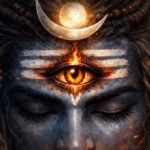
Mahesh, more commonly known as Shiva, represents the principle of destruction and transformation. In Hindu philosophy, destruction is not viewed negatively; it is a necessary process for renewal. Shiva dissolves worn-out forms to make way for regeneration and higher evolution.
We understand Shiva as the force that liberates consciousness from limitation. His dance as Nataraja symbolizes the rhythmic movement of the cosmos—creation arising, preservation continuing, and dissolution clearing the path for rebirth.
Inner Transformation and Spiritual Awakening
Shiva’s symbolism extends deeply into human psychology. He represents detachment, meditation, and inner stillness. Philosophically, Shiva dissolves ignorance (Avidya), allowing realization of the true self (Atman). Thus, Mahesh is not merely the destroyer of worlds but the destroyer of illusion.
Unity Beyond Diversity: One Reality, Three Functions
A common misunderstanding is to see Brahma, Vishnu, and Mahesh as separate gods. Hindu philosophy clearly states that they are three aspects of one supreme reality. This unity is emphasized in Advaita Vedanta, which declares that all multiplicity arises from one consciousness.
We observe that the Trimurti functions similarly to natural processes: birth, life, and death, or beginning, continuity, and change. These are not opposing forces but phases of a single cosmic rhythm. The philosophical brilliance of the Trimurti lies in its ability to reconcile change with permanence.
The Trimurti and the Cyclical Nature of Time
Unlike linear conceptions of time, Hindu philosophy presents time as cyclical (Kala Chakra). Universes are created, sustained, dissolved, and recreated endlessly. Brahma governs creation at the start of a cycle, Vishnu sustains it through vast epochs, and Shiva dissolves it at the end.
We see this cyclical model reflected in nature—seasons, life cycles, and cosmic rhythms. The Trimurti thus provides a cosmic explanation that aligns metaphysics with observable reality, making Hindu philosophy both profound and intuitive.
Relevance of the Trimurti in Human Life
The concept of Brahma, Vishnu, and Mahesh is not confined to theology. It serves as a practical framework for understanding human existence. Creativity, responsibility, and transformation are essential aspects of personal growth.
We apply Brahma when we initiate new ideas, Vishnu when we nurture relationships and values, and Shiva when we let go of outdated beliefs. Hindu philosophy teaches that embracing all three forces leads to balance, wisdom, and spiritual maturity.
Conclusion: The Enduring Wisdom of the Trimurti
The concept of Brahma, Vishnu, and Mahesh stands as one of the most sophisticated philosophical models in world thought. It presents a universe governed not by randomness but by intelligent, harmonious processes. Creation, preservation, and transformation are shown to be interdependent and sacred.
We find in the Trimurti a timeless message: life thrives through balance, consciousness, and renewal. By understanding these principles, we gain insight not only into the cosmos but into our own journey of growth, responsibility, and liberation.