Atman: The Eternal Soul Within
1. Introduction
Have you ever wondered what remains when everything else changes? Your body ages, your mind fluctuates, your circumstances shift — yet something within you remains constant. In Hindu spirituality, this unchanging essence is called Atman (आत्मन्, pronounced “aht-mahn”). This article explores Atman’s nature, its relationship to Brahman (ultimate reality), and how realizing this truth leads to spiritual liberation. You’ll discover practical ways to connect with your eternal soul through meditation, self-inquiry, and ancient wisdom from the Upanishads.
2. What is Atman?
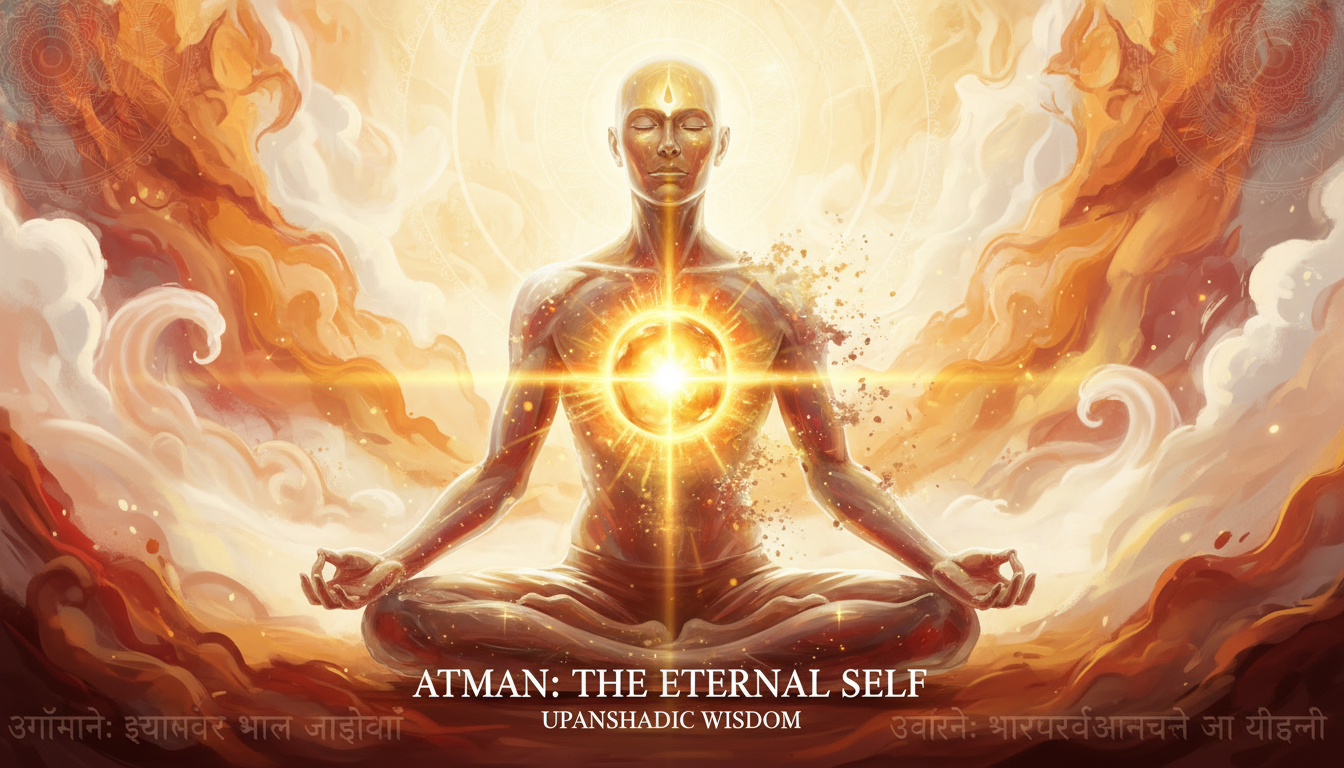
Atman is the eternal, unchanging soul or true Self that exists within every living being. Unlike the physical body (which dies) or the mind (which constantly changes), Atman is immortal and beyond modification. The Sanskrit term “Atman” literally means “breath” or “essence,” pointing to the core of your existence. In the Upanishads, Atman is described as “smaller than a grain of rice, yet larger than the universe” — indicating its subtle yet infinite nature. Understanding Atman is the foundation of Hindu spirituality and the key to moksha (liberation).
3. Atman vs. Body and Mind
A fundamental confusion in spiritual life is mistaking the temporary for the eternal. Your body is born, grows, ages, and dies. Your mind experiences thoughts, emotions, and moods that come and go. Atman, however, remains unchanged through all these transformations. The Bhagavad Gita (2.20) states: “The soul is never born nor dies; it is unborn, eternal, and primeval.” When you identify with your body or mind, you experience suffering. When you identify with Atman, you experience peace. This discrimination (viveka) between the eternal and temporary is the first step on the spiritual path.
4. Atman and Brahman: The Ultimate Truth
The Mahavakya (great saying) “Tat Tvam Asi” — “Thou Art That” — reveals the profound truth that Atman (individual soul) and Brahman (universal reality) are one. Just as a wave is not separate from the ocean, your Atman is not separate from Brahman. The Katha Upanishad explains: “When all desires vanish and the mortal becomes immortal, one attains Brahman here on earth.” This non-dual realization (Advaita) is the pinnacle of Hindu wisdom. Your soul is not a tiny fragment separated from God; it is the infinite reality itself, temporarily appearing as an individual due to ignorance (avidya).
5. The Four States of Atman
The Mandukya Upanishad describes four states through which Atman is experienced:
Jagrat (Waking): Atman identifies with the body, experiencing the external world.
Swapna (Dreaming): Atman identifies with the mind, experiencing dreams.
Sushupti (Deep Sleep): Atman rests in undifferentiated consciousness without objects.
Turiya (Fourth): Transcendental state where Atman is pure consciousness, beyond all three.
Meditation aims to access Turiya — recognizing your true nature as eternal consciousness.
6. Practical Application: Connecting with Atman
To experience Atman directly, incorporate these practices:
Self-Inquiry (Atma Vichara): Ask “Who am I?” repeatedly, rejecting temporary identifications until only pure awareness remains.
Meditation: Sit quietly, observe thoughts without attachment, rest in awareness witnessing all experiences.
Scripture Study: Read the Upanishads, Bhagavad Gita, or Brahma Sutras with contemplation.
Sattvic Living: Maintain pure diet, truthful speech, and ethical conduct to calm the mind.
Guru Guidance: Learn from an authentic teacher who has realized Atman.
7. Benefits of Atman Realization
Realizing your true nature as Atman transforms every aspect of life:
Fearlessness: Death no longer terrifies you when you know you are eternal and beyond birth.
Peace: External circumstances cannot disturb the inner stillness of Atman within you.
Compassion: Seeing the same Atman in all beings dissolves separation and judgment completely.
Purpose: Life becomes a journey of Self-discovery rather than mere material accumulation.
Liberation: Even while living (jivanmukti), you experience freedom from suffering and ignorance.
8. Common Mistakes in Understanding Atman
Avoid these misconceptions:
Intellectualization: Treating Atman as a philosophical concept rather than direct experience.
Escapism: Using “I am Atman” to avoid responsibilities or spiritual practice.
Premature Claims: Declaring Self-realization without genuine transformation in behavior.
Neglecting Practice: Reading about Atman without meditation, self-inquiry, or ethical living.
Dualistic Thinking: Seeing Atman as separate from Brahman or from other beings.
9. Conclusion
Atman is your eternal essence — the unchanging consciousness that witnesses all experiences. By discriminating between the temporary (body, mind) and the eternal (Atman), you discover the peace that surpasses all understanding. The Upanishads declare: “Know your Atman, and be free.” This knowledge is not merely intellectual; it is transformative, liberating, and available to all who seek with sincerity. May your journey to Self-realization be guided by wisdom, practice, and divine grace.
10. FAQ
Q: Is Atman the same as the soul in Christianity?
A: Similar but distinct. Christian soul is often seen as created by God. Atman is eternal, uncreated, and one with Brahman (ultimate reality). Hindu tradition teaches this non-dual truth.
Q: How do I know I’ve realized Atman?
A: Signs include: unshakable peace, loss of fear of death, compassion for all beings, detachment from outcomes, and natural ethical living in daily life.
Q: Can Atman be experienced in daily life?
A: Yes. Atman is always present. Meditation reveals it, but it shines through in moments of deep peace, creativity, or selfless love.
Q: What’s the difference between Atman and ego?
A: Ego (ahamkara) is the false identification with body/mind. Atman is the true Self beyond all identification. Ego says “I am this body.” Atman knows “I am pure consciousness.”
Q: Do I need to renounce the world to realize Atman?
A: Not necessarily. The Bhagavad Gita teaches Karma Yoga — realizing Atman while fulfilling worldly duties with detachment and devotion.