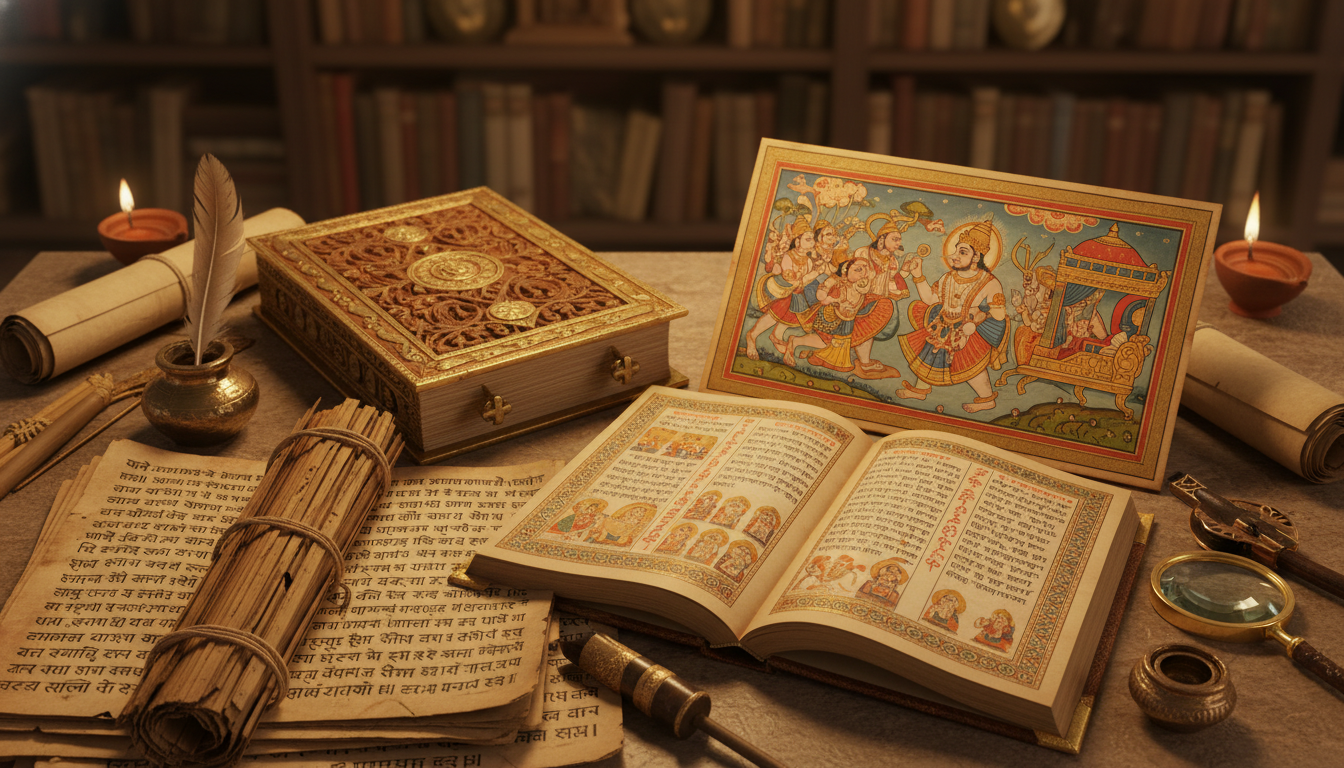
What Are the Main Scriptures of Hinduism? Complete Guide to Sacred Texts
Hinduism possesses one of the world’s oldest and most extensive bodies of sacred literature. But with hundreds of texts spanning thousands of years, newcomers often ask: What are the main scriptures of Hinduism? Which ones matter most? Where should you begin?
Unlike religions with a single holy book, Hinduism offers a vast library of wisdom—each text serving different purposes, audiences, and spiritual goals. Some are philosophical, some devotional, some practical. Some are ancient revelations, others are remembered traditions.
This guide walks you through the essential Hindu scriptures, their hierarchy, their teachings, and how to approach them in modern life.
The Two Categories: Shruti vs Smriti
Hindu scriptures are classified into two fundamental categories:
Shruti (श्रुति) – “That Which Is Heard”
- Meaning: Divinely revealed, eternal truths “heard” by ancient sages
- Authority: Highest spiritual authority, considered apauruṣeya (not of human origin)
- Texts: Vedas, Upanishads
- Analogy: Like divine download—truths discovered, not created
Smriti (स्मृति) – “That Which Is Remembered”
- Meaning: Human compositions remembering and interpreting Shruti
- Authority: Secondary to Shruti, but highly respected
- Texts: Bhagavad Gita, Ramayana, Mahabharata, Puranas, Dharma Shastras
- Analogy: Like commentary—human understanding of divine truths
Key insight: Shruti is eternal truth; Smriti is contextual application. Both are essential.
The Vedas: Four Foundational Texts
The Vedas are Hinduism’s oldest and most authoritative scriptures, composed between 1500-500 BCE.
1. Rig Veda (ऋग्वेद)
- Content: 1,028 hymns (suktas) dedicated to various deities
- Purpose: Praise, invocation, cosmic understanding
- Key deities: Agni (fire), Indra (thunder), Soma (sacred drink), Varuna (cosmic order)
- Famous verse: Gayatri Mantra (3.62.10)
- Relevance: Foundation of Vedic philosophy, ritual, and cosmology
2. Sama Veda (सामवेद)
- Content: Melodic arrangements of Rig Veda hymns
- Purpose: Musical chanting during rituals
- Significance: Birth of Indian classical music
- Relevance: Sound as spiritual practice (Nada Brahma—sound is God)
3. Yajur Veda (यजुर्वेद)
- Content: Ritual formulas, sacrificial procedures
- Purpose: Practical guide for priests conducting yajnas (fire rituals)
- Two versions: Shukla (white—clear) and Krishna (black—mixed with commentary)
- Relevance: Ritual as spiritual technology
4. Atharva Veda (अथर्ववेद)
- Content: Spells, healing mantras, daily life guidance
- Purpose: Protection, health, prosperity, household rituals
- Unique feature: Addresses practical, worldly concerns
- Relevance: Spirituality in everyday life
Vedic Structure:
Each Veda has four layers:
- Samhitas: Core hymns and mantras
- Brahmanas: Ritual explanations
- Aranyakas: Forest texts (transition to philosophy)
- Upanishads: Philosophical essence (Vedanta—end of Vedas)
The Upanishads: Philosophical Essence
The Upanishads (800-200 BCE) represent the philosophical culmination of Vedic thought.
Key Characteristics:
- Number: 108 traditional Upanishads; 10-13 principal (Mukhya)
- Focus: Self-realization, Brahman (ultimate reality), Atman (individual soul)
- Style: Dialogues between teachers and students
- Famous teachings:
- “Tat Tvam Asi” (Thou Art That)—Chandogya Upanishad
- “Aham Brahmasmi” (I Am Brahman)—Brihadaranyaka Upanishad
- “Ayam Atma Brahma” (This Self Is Brahman)—Mandukya Upanishad
Principal Upanishads:
- Isha – Divine immanence
- Kena – Nature of knowledge
- Katha – Death, soul, immortality (story of Nachiketa)
- Prashna – Six philosophical questions
- Mundaka – Higher vs lower knowledge
- Mandukya – Four states of consciousness (includes Om mantra)
- Taittiriya – Five sheaths of existence
- Aitareya – Creation, consciousness
- Chandogya – Famous “Tat Tvam Asi”
- Brihadaranyaka – Largest, most comprehensive
- Shvetashvatara – Theistic, devotion-focused
- Kaushitaki – Life force, breath
- Maitri – Sixfold yoga practice
Relevance: Upanishads form the basis of Vedanta philosophy, influencing thinkers worldwide (Schopenhauer, Emerson, Thoreau).
The Bhagavad Gita: The Song of God
The Bhagavad Gita (200 BCE-200 CE) is Hinduism’s most beloved and accessible scripture.
Context:
- Location: Books 23-40 of Mahabharata’s Bhishma Parva
- Setting: Battlefield of Kurukshetra, before war begins
- Characters: Prince Arjuna (warrior) and Lord Krishna (charioteer, divine teacher)
- Length: 700 verses, 18 chapters
Core Teachings:
- Karma Yoga: Selfless action without attachment to results
- Bhakti Yoga: Devotion and surrender to God
- Jnana Yoga: Knowledge and discrimination between real/unreal
- Dhyana Yoga: Meditation and mind control
- Dharma: Righteous duty, even when difficult
- Immortality of Soul: “The soul is never born nor dies” (2.20)
Famous Verses:
- 2.47: “You have right to action, never to its fruits”
- 4.7-8: “Whenever dharma declines, I manifest Myself”
- 9.26: “Whoever offers Me with devotion—a leaf, flower, fruit, water—I accept”
- 18.66: “Abandon all dharmas, surrender to Me alone. I shall liberate you”
Relevance: Practical spirituality for householders, warriors, leaders—anyone facing life’s battles.
The Epics: Ramayana and Mahabharata
Ramayana (रामायण)
- Author: Sage Valmiki
- Length: 24,000 verses
- Story: Prince Rama’s exile, wife Sita’s abduction by demon-king Ravana, rescue with monkey army
- Teachings: Ideal king, husband, brother, devotee (Rama as Maryada Purushottam—perfect man)
- Cultural impact: Basis for Diwali festival, countless adaptations across Asia
Mahabharata (महाभारत)
- Author: Sage Vyasa
- Length: 100,000 verses (world’s longest epic poem)
- Story: Pandava-Kaurava cousin rivalry, Kurukshetra war
- Includes: Bhagavad Gita, Bhishma’s teachings on dharma
- Teachings: Complexity of dharma, consequences of greed, righteousness triumphs
- Famous quote: “Dharma protects those who protect dharma”
Relevance: Living narratives—Hindus grow up hearing these stories, learning values through characters.
The Puranas: Mythology and Devotion
The Puranas (300-1000 CE) are mythological texts making philosophy accessible through stories.
Key Features:
- Number: 18 major (Maha) Puranas, 18 minor (Upa) Puranas
- Content: Creation myths, genealogies, deity stories, pilgrimages, festivals
- Purpose: Devotional inspiration, cultural preservation, moral education
Major Puranas (grouped by deity):
Vaishnava (Vishnu-focused):
- Vishnu Purana
- Bhagavata Purana (most beloved—Krishna’s childhood stories)
- Garuda Purana (death, afterlife)
Shaiva (Shiva-focused):
- Shiva Purana
- Linga Purana
- Skanda Purana (largest—pilgrimage guides)
Brahma/Brahma-related:
- Brahma Purana
- Brahmanda Purana
- Markandeya Purana (includes Devi Mahatmya—Goddess glory)
Relevance: Festival stories, temple rituals, devotional practices rooted in Puranas.
Other Important Texts
Dharma Shastras (Law Codes)
- Manusmriti: Laws of Manu (controversial but influential)
- Yajnavalkya Smriti: More liberal than Manusmriti
- Purpose: Social duties, legal codes, caste duties (varna-ashrama dharma)
Darshanas (Philosophical Systems)
Six orthodox schools:
- Nyaya: Logic, epistemology
- Vaisheshika: Atomism, metaphysics
- Samkhya: Dualism (Purusha-Prakriti)
- Yoga: Patanjali’s eight-limbed path
- Mimamsa: Ritual interpretation
- Vedanta: Upanishadic philosophy (Advaita, Vishishtadvaita, Dvaita)
Agamas & Tantras
- Focus: Temple construction, deity worship, yoga, meditation techniques
- Traditions: Shaiva, Vaishnava, Shakta (Goddess)
- Relevance: Living temple traditions, ritual practices
How to Approach Hindu Scriptures: Practical Guidance
For Beginners:
- Start with Bhagavad Gita—most accessible, practical
- Read Ramayana or Mahabharata stories (C. Rajagopalachari’s versions excellent)
- Explore selected Upanishads (Katha, Isha, Chandogya)
- Use quality translations (Swami Prabhavananda, Eknath Easwaran, Swami Nikhilananda)
For Serious Students:
- Study with commentary (Shankara, Ramanuja, Madhva for Vedanta)
- Learn Sanskrit basics (many terms untranslatable)
- Find a teacher (guru-shishya tradition remains vital)
- Practice what you learn (shravana—listening, manana—reflection, nididhyasana—meditation)
Avoid These Mistakes:
- ❌ Reading without context (historical, cultural, philosophical)
- ❌ Taking stories literally (many are allegorical)
- ❌ Cherry-picking verses to justify prejudices
- ❌ Ignoring commentary tradition (parampara matters)
Modern Relevance: Why These Texts Matter Today
Ancient? Yes. Irrelevant? Absolutely not.
Contemporary Applications:
Mental Health:
- Upanishadic self-knowledge → Modern therapy’s self-awareness
- Gita’s equanimity → Stress management, emotional regulation
Leadership:
- Rama’s ideal kingship → Ethical leadership
- Krishna’s guidance → Strategic decision-making
Relationships:
- Ramayana’s family values → Modern family dynamics
- Gita’s duty without attachment → Healthy work-life balance
Environmental Ethics:
- Vedic nature reverence → Ecological consciousness
- Vasudhaiva Kutumbakam (“world is one family”) → Global citizenship
Personal Growth:
- Yoga Sutras → Mindfulness, meditation
- Vedanta’s self-inquiry → Identity, purpose exploration
Conclusion: Living Wisdom, Not Ancient Relics
What are the main scriptures of Hinduism? They’re not museum pieces—they’re living wisdom guiding millions daily.
From the eternal truths of the Vedas to the practical guidance of the Gita, from the inspiring stories of Ramayana to the devotional warmth of the Puranas—Hindu scriptures offer something for everyone.
Whether you seek philosophical depth, devotional inspiration, moral guidance, or practical life wisdom, these texts have waited thousands of years to speak to you.
Start where you’re drawn. The scriptures meet you where you are.
As the Upanishads remind us: “The Self is not gained through much study, nor through intellect, nor through hearing many scriptures. The Self reveals Itself to those who seek It with sincerity.” (Katha Upanishad 1.2.23)
FAQ: Hindu Scriptures Answered
Q1: Which Hindu scripture should I read first?
A: Start with the Bhagavad Gita—it’s concise, practical, and covers core Hindu philosophy. Eknath Easwaran’s translation is excellent for beginners.
Q2: Are the Vedas still relevant today?
A: Yes, but indirectly. The Vedas’ ritual portions are less practiced, but their philosophical essence (Upanishads) remains foundational. Modern Hindus engage with Vedic wisdom through Gita, Upanishads, and daily mantras (like Gayatri).
Q3: How many Hindu scriptures exist?
A: Hundreds. The Vedas alone have four collections with multiple layers. Add 108 Upanishads, 18 Puranas, 2 epics, Dharma Shastras, Darshanas, Agamas—the library is vast. But you don’t need to read all—focus on key texts.
Q4: What’s the difference between Shruti and Smriti?
A: Shruti (“heard”) is divinely revealed, eternal truth (Vedas, Upanishads). Smriti (“remembered”) is human interpretation (Gita, Puranas, epics). Shruti has higher authority, but Smriti is more accessible and widely read.
Q5: Is the Bhagavad Gita part of the Vedas?
A: No. The Gita is part of the Mahabharata epic (Smriti), not the Vedas (Shruti). However, it’s called “Gitopanishad” because it captures Upanishadic wisdom in accessible form. Some consider it equal to Shruti in spiritual value.
Q6: Do Hindus believe every word in their scriptures is literally true?
A: Not necessarily. Hindu tradition recognizes multiple levels of meaning—literal, allegorical, philosophical, mystical. Stories may be mythological while conveying deep truths. Critical thinking (vichara) is encouraged.
Q7: Can non-Hindus read Hindu scriptures?
A: Absolutely. Hindu wisdom is universal, not exclusive. The Upanishads influenced Western philosophers (Schopenhauer, Emerson). Many non-Hindus find profound value in Gita, Upanishads, and yoga texts. Approach with respect and openness.
Q8: What’s the best English translation of Hindu scriptures?
A: Depends on the text:
- Gita: Eknath Easwaran, Swami Prabhavananda, or Chinmaya Mission
- Upanishads: Swami Nikhilananda (Ramakrishna Mission) or Patrick Olivelle
- Ramayana/Mahabharata: C. Rajagopalachari (concise) or Bibek Debroy (complete)
- Vedas: Ralph T.H. Griffith or Swami Satya Prakash Saraswati
Q9: Are Hindu scriptures contradictory?
A: Sometimes, yes—and that’s intentional. Different texts address different audiences, contexts, and spiritual levels. The tradition encourages dialogue (shastrartha) and personal discernment (viveka). Unity in diversity is a Hindu hallmark.
Q10: How long does it take to read all Hindu scriptures?
A: A lifetime—and that’s okay. Most Hindus don’t read everything. They focus on family traditions, favorite texts (often Gita or Ramayana), and teachings from gurus. Quality of understanding matters more than quantity of reading.
Related Articles
Continue exploring our Hinduism FAQ series: