Why Do Some Deities Have Blue Skin or Animal Features? Hindu Symbolism Explained
Have you ever wondered why Lord Krishna is depicted with blue skin? Or why Lord Ganesha has an elephant head? These unique features in Hindu deity representations are far from random—they carry profound spiritual symbolism that has been passed down through thousands of years of Vedic wisdom.
Understanding Divine Iconography in Hinduism
Hindu deity iconography (called murti shastra) is a sophisticated symbolic language. Unlike Western religious art that often aims for realistic representation, Hindu sacred art uses symbolism to convey metaphysical truths that transcend ordinary human experience.
When you see a deity with blue skin, multiple arms, or an animal head, these are not fantasy elements—they are visual teachings designed to help devotees contemplate specific aspects of the Divine.
Why Blue Skin? The Symbolism of Divine Color
The Meaning of Blue (Shyama Varna)
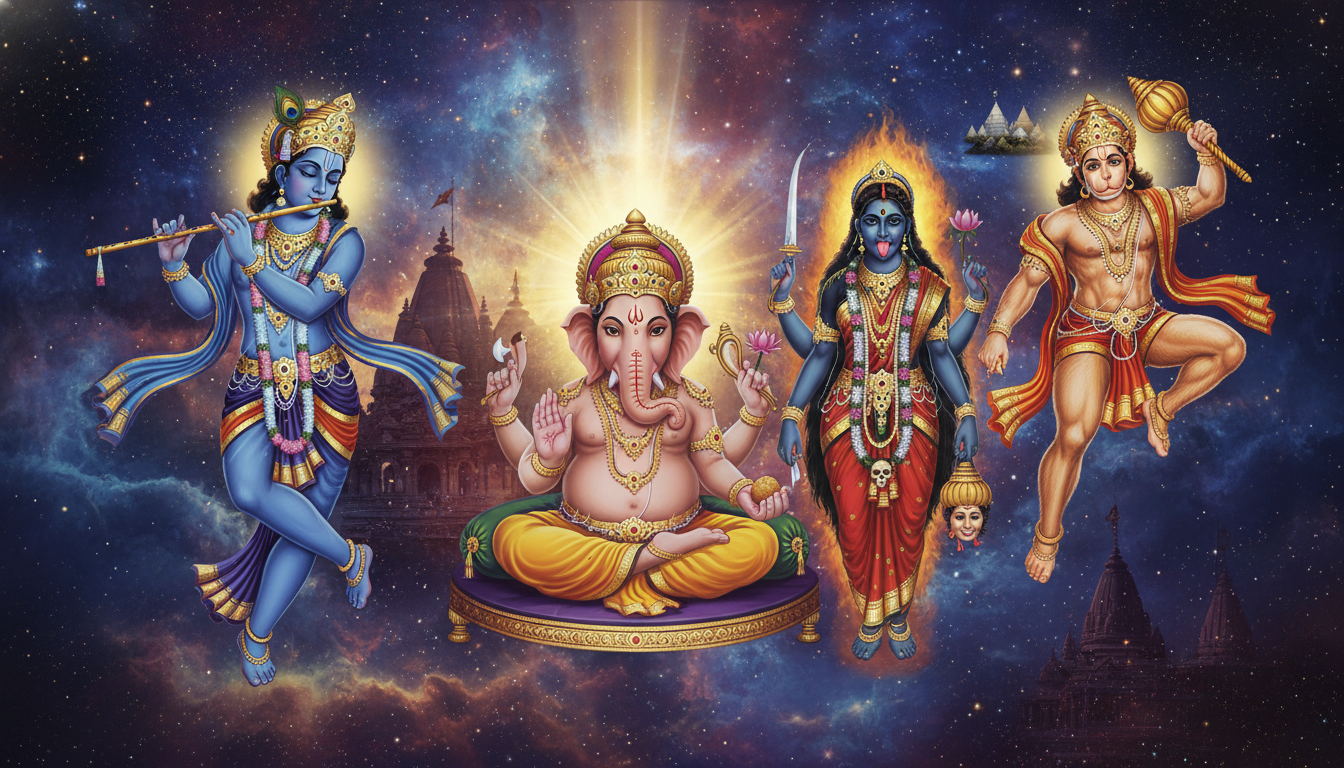
Blue skin in Hindu deities—most famously seen in Lord Krishna, Lord Rama, and Goddess Kali—represents several interconnected spiritual concepts:
1. Infinity and the Cosmic Expanse
Blue is the color of the infinite. The sky appears blue not because it is blue, but because of the vast, limitless atmosphere surrounding Earth. Similarly, the ocean appears blue due to its immeasurable depth.
When deities are depicted with blue skin, it symbolizes their infinite, all-pervading nature. Just as you cannot find the boundaries of the sky or ocean, you cannot limit the Divine. Lord Krishna’s blue form reminds devotees that God is as vast as the cosmos itself.
2. Transcendence Beyond Human Categories
Blue is not a common human skin color. By depicting deities with blue skin, Hindu iconography immediately communicates that these are not ordinary beings. They transcend human limitations, social categories, and physical constraints.
This creates psychological distance from the mundane, helping worshippers approach the deity with appropriate reverence and understanding of divine otherness.
3. Calmness and Serenity
Psychologically, blue is associated with calmness, depth, and stability. The blue complexion of deities like Rama and Krishna represents their emotional equanimity—their ability to remain peaceful and composed regardless of external circumstances.
Lord Rama, despite facing exile, loss, and war, maintained perfect equanimity. His blue form symbolizes this unshakeable inner peace.
4. The Color of Cosmic Energy
In Vedic cosmology, blue is associated with prana (life force) and cosmic energy. The throat chakra (Vishuddha), which governs communication and truth, is depicted as blue. Deities with blue skin represent the embodiment of pure consciousness and divine energy.
Which Deities Have Blue Skin?
- Lord Krishna: The most famous blue deity, representing divine love and cosmic playfulness
- Lord Rama: Blue-skinned avatar of Vishnu, representing righteousness and duty
- Goddess Kali: Dark blue/black, representing transformative power and time
- Lord Vishnu: Often depicted with blue or dark complexion, the preserver of the universe
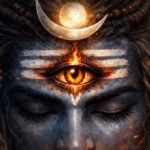
- Lord Shiva: Sometimes shown with blue throat (Neelakantha) from drinking poison to save creation
Why Animal Features? The Symbolism of Hybrid Forms
Lord Ganesha: The Elephant Head
Perhaps the most recognizable animal-feature deity is Lord Ganesha, who has an elephant head on a human body. This is not a mythological accident but rich symbolic teaching:
Elephant Head Symbolism:
- Large Head: Represents big thinking, expansive consciousness, and the ability to contemplate profound truths
- Large Ears: Symbolize deep listening—Ganesha listens to all devotees regardless of their background
- Small Eyes: Represent concentration and focus, the ability to see beyond surface appearances
- Trunk: Highly adaptable (can uproot trees or pick up delicate flowers), representing discrimination and adaptability
- Large Belly: Contains the entire universe, symbolizing the capacity to digest all experiences—good and bad
The Story Behind the Form:
According to Puranic literature, Goddess Parvati created Ganesha from turmeric paste to guard her chamber. When Lord Shiva (her husband) was denied entry by this unknown boy, he beheaded Ganesha in anger. Upon realizing his mistake, Shiva promised to restore Ganesha’s life by attaching the head of the first creature found sleeping with its head facing north—an elephant.
This story symbolizes the transcendence of ego (beheading) and the attainment of wisdom (elephant head). The elephant represents Buddhi (intelligence) and Siddhi (spiritual accomplishment).
Lord Hanuman: The Monkey Form
Lord Hanuman’s monkey form carries equally profound symbolism:
- Monkey Nature: Represents the restless mind (kapiva = monkey-like mind)
- Devotion: Despite having a restless nature, Hanuman exemplifies perfect devotion and selfless service
- Strength + Humility: Immense physical power combined with complete humility before Lord Rama
- Teaching: Even the most restless mind can achieve spiritual perfection through devotion and discipline
Goddess Durga: Riding the Lion/Tiger
While not having animal features herself, Goddess Durga is always depicted riding a lion or tiger, symbolizing:
- Mastery over animal nature: She controls the fierce beast, representing mastery over primal instincts
- Power with compassion: The lion represents raw power, which she channels for righteous purposes
- Fearlessness: Only the truly fearless can ride such fierce animals
Lord Vishnu’s Avatars: Animal Forms
Vishnu’s ten primary avatars (Dashavatara) include animal forms that represent evolution and cosmic preservation:
- Matsya (Fish): Life began in water; represents preservation of knowledge (Vedas) during cosmic dissolution
- Kurma (Tortoise): Stability and endurance; supported the cosmic mountain during churning of the ocean
- Varaha (Boar): Rescued Earth from cosmic ocean; represents lifting consciousness from materialism
- Narasimha (Half-man, half-lion): Transcends both human and animal categories; destroys ego (demon Hiranyakashipu)
- Garuda (Eagle): Vishnu’s mount; represents speed, power, and the Vedas (wings)
The Deeper Philosophical Meaning
1. Breaking Anthropomorphic Limitations
By giving deities non-human features, Hinduism prevents the mistake of thinking God is limited to human form. The Divine transcends all categories—human, animal, or otherwise.
2. Teaching Through Visual Metaphor
In an era when most people were illiterate, visual symbolism was the primary teaching tool. A devotee seeing Ganesha’s elephant head would immediately contemplate wisdom, removing obstacles, and the story of his birth—without reading a single text.
3. Representing Cosmic Principles
Each deity represents specific cosmic functions:
- Blue skin = Infinity, transcendence
- Multiple arms = Omnipotence, ability to perform multiple cosmic functions
- Animal features = Mastery over specific energies or instincts
- Multiple heads = Omniscience, seeing in all directions
4. Psychological Archetypes
Modern psychology recognizes these forms as archetypes—universal symbols that speak to the collective unconscious. The elephant represents wisdom across cultures; the lion represents courage; blue represents the infinite.
Common Misconceptions Addressed
Misconception 1: “Hindus Worship Idols with Fantastical Features”
Reality: Hindus don’t worship the stone or metal image itself. The murti (sacred image) is a focal point for contemplating divine qualities. The blue skin or animal features are reminders of specific spiritual truths, not literal descriptions.
Misconception 2: “These Are Primitive Mythological Creations”
Reality: This iconography is the result of thousands of years of sophisticated philosophical development. The Shilpa Shastras (ancient texts on sacred art) provide precise mathematical and symbolic guidelines for deity representation—far from primitive imagination.
Misconception 3: “Blue Skin Means These Gods Were Aliens or Special Races”
Reality: This is a modern misinterpretation. The blue color is explicitly described in scriptures as symbolic. The Vishnu Sahasranama (thousand names of Vishnu) describes him as “Shyamasundara” (beautiful dark one) and “Meghavarnam” (cloud-colored)—clearly poetic, not literal descriptions.
Scientific and Psychological Perspectives
Color Psychology
Modern color psychology confirms what ancient rishis understood intuitively:
- Blue reduces stress and promotes calmness
- Blue enhances spiritual contemplation
- Blue is associated with trust, depth, and wisdom across cultures
Archetypal Psychology (Carl Jung)
Jung recognized that mythological figures with hybrid forms represent the integration of different aspects of the psyche. The animal represents instinctual nature; the human represents rational consciousness. Deities combining both symbolize wholeness—the integration of all aspects of being.
Practical Applications for Modern Life
1. Meditating on Divine Forms
When you see a blue deity, contemplate:
- How can I expand my consciousness beyond limitations?
- Where am I creating artificial boundaries?
- Can I cultivate the infinite patience of the sky?
2. Learning from Ganesha
When facing obstacles, contemplate:
- Am I listening deeply (large ears)?
- Am I thinking big enough (large head)?
- Can I be both strong and adaptable (trunk)?
3. Emulating Hanuman
When your mind is restless:
- Channel restless energy into devoted service
- Use strength humbly, not arrogantly
- Remember that even a “monkey mind” can achieve perfection
Conclusion: Beyond Literal Interpretation
The blue skin and animal features of Hindu deities are not fantasy elements or primitive mythology. They are a sophisticated symbolic language—a visual scripture that teaches profound spiritual truths through form and color.
When you understand the symbolism:
- Blue skin becomes a reminder of infinity
- Elephant heads become symbols of wisdom
- Monkey forms become teachings about devotion
- Multiple arms become representations of divine omnipotence
Next time you see a depiction of Krishna’s blue form or Ganesha’s elephant head, remember: you’re not looking at a fantastical creature. You’re looking at a visual teaching—a sacred symbol designed to elevate consciousness and remind you of the infinite, transcendental nature of the Divine.
This is the genius of Hindu iconography: making the abstract concrete, making the infinite approachable, and making spiritual truths accessible to everyone—regardless of literacy, education, or background.
FAQ: Deities with Blue Skin and Animal Features
Q1: Why is Krishna specifically shown with blue skin?
A: Krishna’s blue skin represents his infinite, all-pervading nature. The name “Krishna” itself means “dark” or “attractive.” His blue complexion symbolizes that he is as vast as the sky and as deep as the ocean—limitless and incomprehensible to the finite mind.
Q2: Did Krishna actually have blue skin in real life?
A: Scriptural descriptions use poetic language. Some traditions suggest Krishna had a dark complexion (common in South India), which was poetically described as “cloud-like” or “blue.” The artistic blue depiction is symbolic, emphasizing his divine, transcendental nature rather than literal skin color.
Q3: Why does Ganesha have an elephant head?
A: The elephant head symbolizes wisdom, intelligence, and the ability to overcome obstacles. Elephants are revered in India for their memory, strength, and gentle nature. Ganesha’s form teaches that true wisdom combines strength with gentleness, and intelligence with humility.
Q4: Are there any female deities with blue skin?
A: Yes! Goddess Kali is often depicted with dark blue or black skin, representing her role as the transformative power of time and change. Goddess Tara (in Buddhist and Hindu traditions) is also shown with blue skin, symbolizing compassion and protection.
Q5: What does it mean when deities have multiple arms?
A: Multiple arms represent omnipotence—the divine ability to perform multiple cosmic functions simultaneously. Each hand typically holds a symbolic object (conch, discus, lotus, mace) representing different aspects of divine power and protection.
Q6: Why do some deities ride animals?
A: The animal mount (vahana) represents the deity’s mastery over specific energies. For example, Durga’s lion represents mastered power; Vishnu’s Garuda represents controlled speed and pride; Murugan’s peacock represents conquered ego and vanity.
Q7: Is it disrespectful to question these forms?
A: Not at all! Hinduism encourages inquiry (jijnasa). The scriptures themselves contain numerous stories where sages and devotees ask questions about divine forms. Understanding the symbolism deepens devotion rather than diminishing it.
Q8: Do all Hindu traditions depict deities this way?
A: Most mainstream Hindu traditions use symbolic iconography. However, some reform movements (like Arya Samaj) avoid image worship altogether, focusing on formless Divine. Both approaches are respected within Hinduism’s diverse framework.
Q9: What about Buddha? Is he depicted with special features?
A: Buddha is often shown with an ushnisha (cranial bump representing wisdom), elongated earlobes (renunciation of royal jewelry), and sometimes blue-black hair. These features symbolize his enlightened state and renunciation of worldly attachments.
Q10: How should I approach these deity forms as a beginner?
A: Start by appreciating them as symbolic art. Learn one symbol at a time—perhaps start with Ganesha’s elephant head or Krishna’s blue skin. As you understand the meanings, your appreciation will deepen from aesthetic to spiritual. There’s no rush—let understanding unfold naturally.
This article is part of our Hinduism FAQ series, demystifying common questions about Hindu beliefs, practices, and symbolism. Next: Understanding the significance of the bindi/tilak on the forehead.
Related Articles
Continue exploring our Hinduism FAQ series: