Why is Goddess Saraswati the Deity of Knowledge and Wisdom?
The Goddess Saraswati significance in Hindu spirituality is profound, as she represents the bridge between raw information and enlightened wisdom. Known as the “Mother of the Vedas,” she is the divine energy behind every art form, scientific discovery, and spoken word. From the celestial vibrations of her Veena to the discerning grace of her Swan, every aspect of her form carries a lesson for the seeker. Whether through the legend of Sage Valmiki or the celebration of Vasant Panchami, Saraswati remains the ultimate guide for those pursuing intellectual and spiritual brilliance.
The Origin of Sound: Swaratmika and the Seven Notes
Goddess Saraswati is the presiding deity of Sangeet Shastra (the science of music). It is believed that rhythm, melody, and the seven musical notes (Swaras) originated from her.
- She is called Swaratmika, meaning the soul of sound.
- By providing the knowledge of the seven surs, she empowers humanity to express the inexpressible through art.
Symbolism and Significance of Goddess Saraswati’s Icons
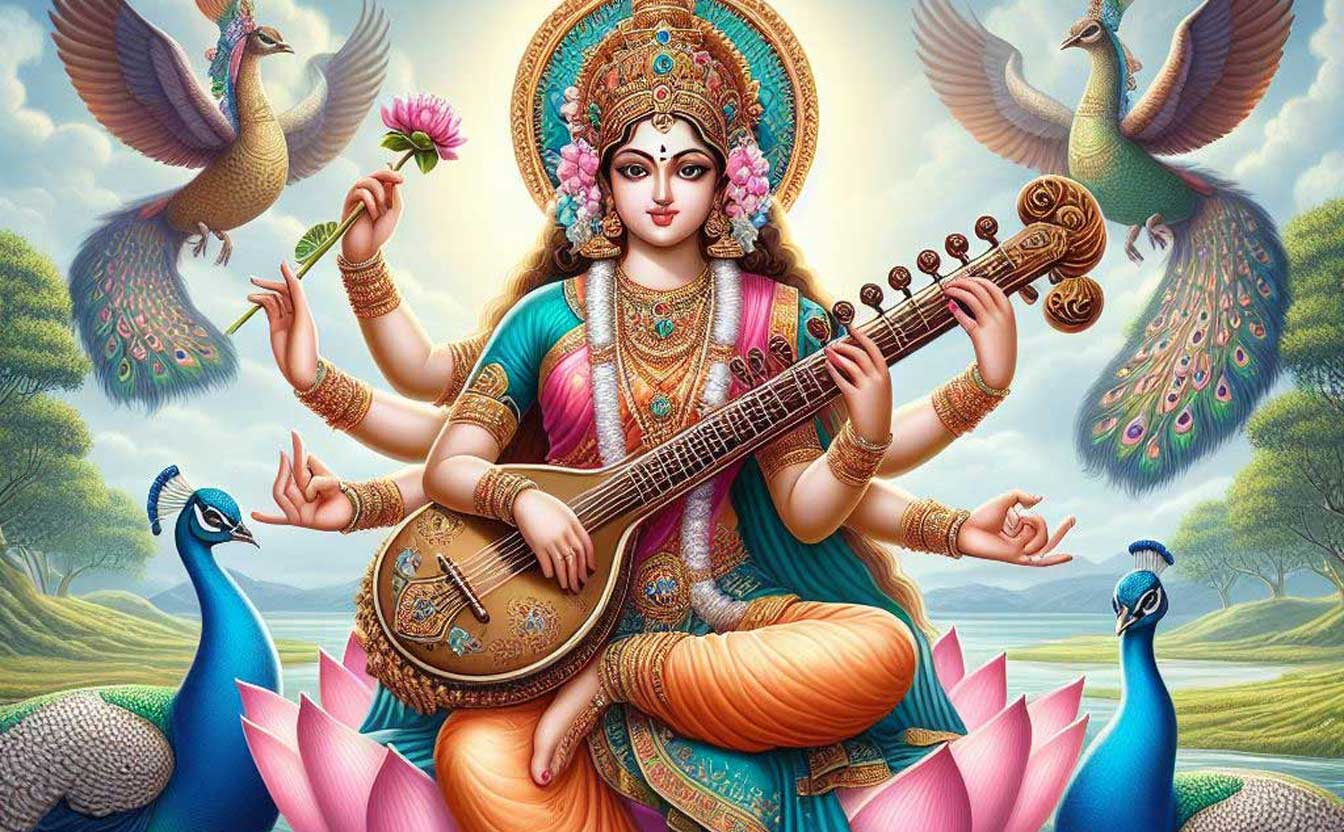
Saraswati is often depicted in white, seated on a white lotus, surrounded by symbolic items that serve as a roadmap for seekers of knowledge:
- The Veena (Lute): Represents the harmony of life. Playing the Veena symbolizes the stabilization of the body and mind. It is said that all Vedic laws are contained within the strings of her Veena.
- The White Lotus: A symbol of detachment and dynamism. Just as a lotus grows in water but remains dry, a seeker should live in the world without being overwhelmed by its illusions.
- The Book (Manuscript): Represents the constant pursuit of learning and the preservation of universal truths.
- The Swan (Hansa): The swan is famous for its ability to separate milk from water (Neer-Ksheer Viveka). It inspires us to use our intellect to distinguish between the eternal truth and the temporary world.
- White Attire: Her white complexion and clothing represent Sattva Guna—purity, peace, and spiritual brilliance.
The Birth of Poetry: The Tale of Sage Valmiki
The transition of a common man into the “Adi Kavi” (First Poet) is a testament to Saraswati’s grace.
As the story goes, Brahma instructed Saraswati to reside in the speech of a deserving soul as the “power of poetry.” While wandering the banks of the Ganga, the sage-to-be Valmiki witnessed a hunter kill a male crane (Krauncha) while it was with its mate. Moved by the intense grief of the surviving bird, Valmiki uttered a spontaneous verse in deep sorrow:
“Mā niṣāda pratiṣṭhāṃ tvamagamaḥ śāśvatī samāḥ…”
Saraswati recognized the purity of his empathy and inhabited his throat, granting him the gift of poetic vision. Through her divine blessing, Valmiki went on to compose the epic Ramayana.
Saraswati as the Protector of Cosmic Intellect: The Legend of Kumbhakarna
Goddess Saraswati does not just grant wisdom; she also protects the universe by controlling the intellect of those with destructive intentions.
When the demon Kumbhakarna performed severe penance to please Lord Brahma, the gods were terrified. They knew that if he asked for power, he would destroy the world. Brahma asked Saraswati to “confuse” the demon’s intellect at the moment he asked for a boon.
Instead of asking for Indrasana (the throne of the King of Gods), Saraswati made his tongue slip, and he asked for Nidrasana (a bed for sleeping). Consequently, Kumbhakarna slept for six months at a time, saving the world from his demonic wrath.
Key Titles of Goddess Saraswati
| Name | Meaning |
| Sharada | The Giver of Essence |
| Veena Pani | She who holds the Veena |
| Vagdevi | The Goddess of Speech |
| Bharati | The Eloquent One |
| Vidyadhari | The Possessor of Knowledge |
Celebrating the Goddess: Vasant Panchami
The festival of Vasant Panchami, held on the fifth day of the bright half of the month of Magh, is dedicated entirely to her worship. Students, artists, and scholars offer their books and instruments at her feet, seeking the “Sattva” quality that leads to a meaningful and enlightened life.
FAQ
The Swan represents Neer-Ksheer Viveka—the ability to separate milk from water. It symbolizes the refined intellect needed to distinguish between eternal truth and worldly illusion.
White represents Sattva Guna (purity, peace, and transparency). It signifies that true knowledge should be pure and free from the “colors” of ego or passion.
The Veena represents the harmony of the mind and body. It signifies that all Vedic knowledge and cosmic laws are tuned to a divine rhythm.
Similar Article: “What is the Gayatri Mantra? Meaning, Benefits, and Spiritual Significance“