Pancha Mahayajna: Meaning and Significance in Hinduism
In the Dharma Shastras, every householder is instructed to perform the Pancha Mahayajnas (the Five Great Daily Sacrifices) without fail. Describing these five sacred duties, Maharaja Manu states in the Manusmriti:
Teaching and studying the Vedas is Brahma Yajna; offerings made through tarpan, pind-daan, and shraddha constitute Pitru Yajna; fire offerings such as homa and havan are Deva Yajna; offerings made to living beings are Bhuta Yajna; and honoring guests through respectful hospitality is Atithi Yajna, also known as Nri Yajna.
In simple terms, the Pancha Mahayajnas consist of Brahma Yajna, Pitru Yajna, Deva Yajna, Bhuta Yajna, and Atithi (or Nri) Yajna.
A brief explanation of these five great daily duties is as follows:
Brahma Yajna refers to the study and teaching of the Vedas and other sacred scriptures. Regular and extensive study of religious texts not only increases knowledge but also fills the mind with pure and elevated thoughts. For this reason, the tradition of reading sacred scriptures after the daily Sandhya worship was established. Chanting the Gayatri Mantra is also considered a completion of Brahma Yajna.
Pitru Yajna involves offerings made to one’s ancestors through rituals such as pind-daan, tarpan, and shraddha. The Yajnavalkya Smriti explains that the ancestors become fully satisfied by the offerings of food and water made by their descendants. Pleased ancestors bless the performers of Pitru Yajna with long life, progeny, growth in knowledge, happiness, prosperity, heavenly pleasures, and ultimately liberation.
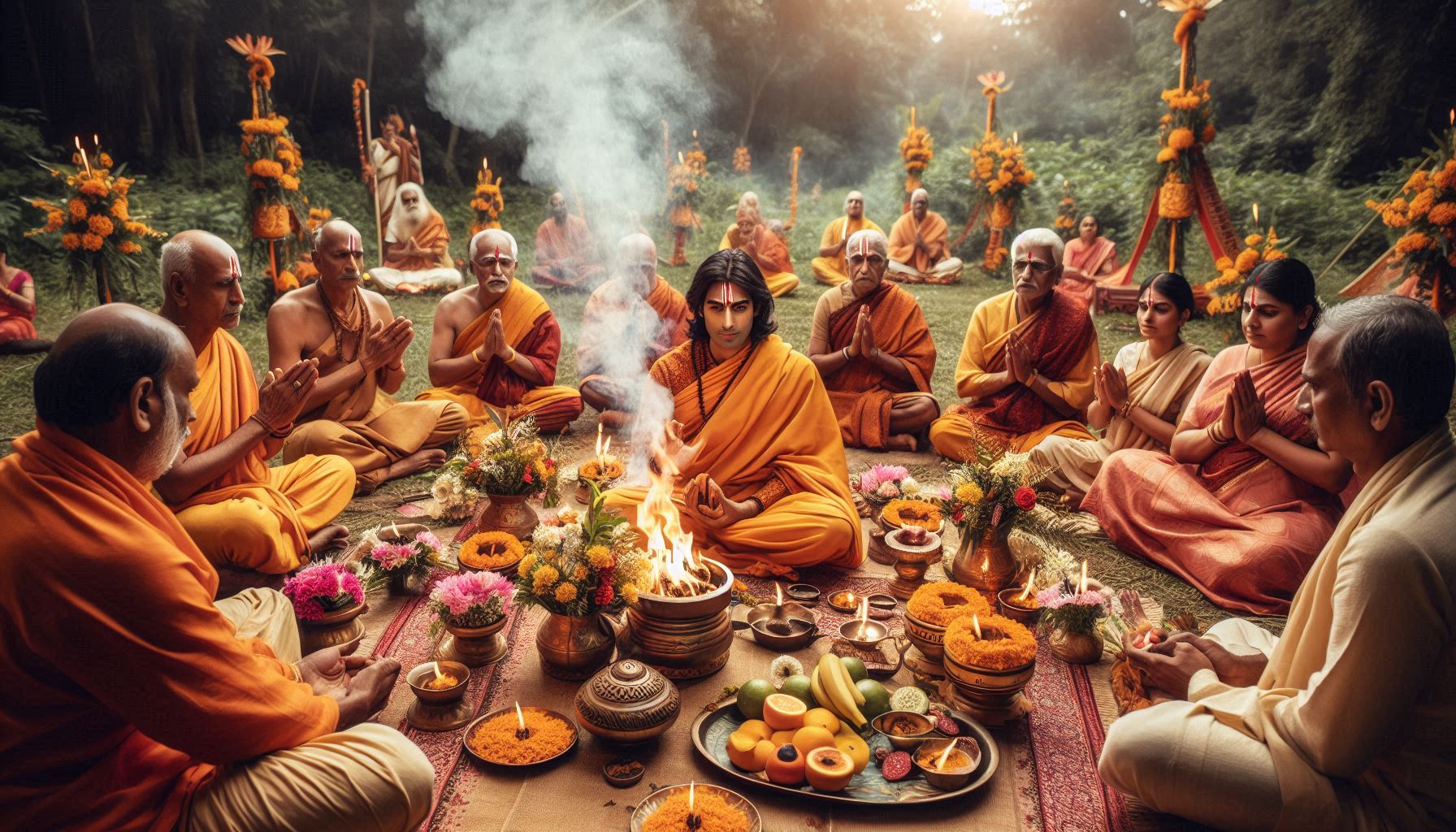
Deva Yajna consists of worship, fire offerings, and sacred rituals such as havan and homa. The deities are regarded as the destroyers of illness, sorrow, and suffering. Through regular worship of the gods, one can be freed from various physical, mental, and spiritual afflictions. An additional benefit of performing havan is the purification of the environment, which also contributes to better health.
Bhuta Yajna means setting aside a portion of one’s daily food for the welfare of other living beings. According to the Manusmriti, food should be offered on clean ground for animals such as dogs, as well as for birds like crows, insects such as ants, and even for individuals suffering from severe illnesses or social neglect. Offering food to cows, known as go-gras, is considered especially virtuous and highly meritorious.
Atithi Yajna, also known as Nri Yajna, refers to lovingly and respectfully serving guests. The scriptures regard a guest as equivalent to God. Therefore, a householder should always serve food to a guest before eating themselves. In the Shanti Parva of the Mahabharata, it is stated that a household from which a guest departs disappointed, hungry, or thirsty is destined for destruction. Such a household faces many hardships because a disappointed guest leaves behind their sins while taking away the accumulated merits of the host. For this reason, a guest should never be turned away with disrespect.
Emphasizing the importance of performing these five great sacrifices daily and at their prescribed times, Maharshi Vishwamitra states in the Vishwamitra Smriti:
The householder who faithfully performs all daily duties at the proper time transcends all worlds and ultimately attains the supreme abode of Lord Vishnu.
Therefore, all householders should perform the Pancha Mahayajnas every day with faith and devotion. Only by doing so can one live a life that is truly happy, prosperous, balanced, and peaceful.
Note: You may also be interested in “Benefits of Worshiping Hindu Gods for Spiritual Growth“