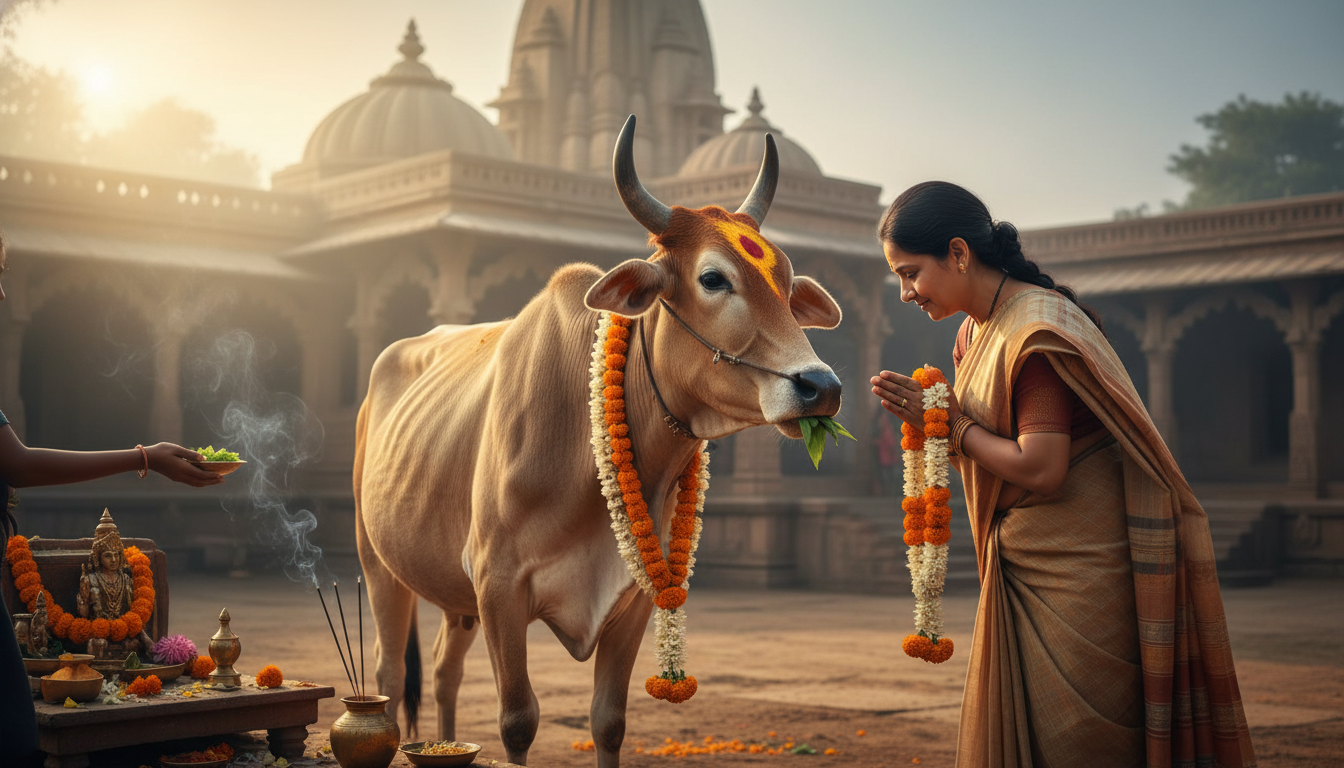
Why is the Cow Sacred in Hinduism? The Spiritual and Practical Reasons
To many outside observers, the reverence Hindus show for cows can seem puzzling or even extreme. Images of cows wandering freely through Indian streets, receiving offerings from devotees, and being protected from slaughter have led to stereotypes and misunderstandings. However, the sacred status of cows in Hinduism is deeply rooted in spiritual philosophy, practical wisdom, and ecological consciousness that extends far beyond mere “animal worship.”
This article explores the multifaceted reasons behind cow veneration in Hindu tradition. We’ll examine scriptural foundations, historical context, practical benefits, and the philosophical principles that make the cow not just an animal, but “Gau Mata” (Mother Cow) in Hindu consciousness.
Gau Mata: The Cow as Mother in Hindu Tradition
In Hinduism, the cow is affectionately called “Gau Mata” (Mother Cow). This isn’t merely poetic language but reflects a profound philosophical view. Just as a human mother provides milk to nourish her child, the cow provides milk that nourishes human society. This maternal relationship establishes the cow as a giver of life-sustaining nourishment, earning her the title “mother.”
This maternal connection extends beyond nutrition. In traditional Hindu households, cows were—and in many rural areas still are—treated as family members. They are bathed, decorated, fed before the family eats, and cared for in old age. This treatment reflects the Hindu principle of treating all life with respect, but particularly those beings that contribute to human wellbeing.
The concept of “motherhood” in Hinduism isn’t limited to biological mothers. The earth is “Bhumi Mata” (Mother Earth), the river Ganga is “Ganga Mata” (Mother Ganga), and the nation is “Bharat Mata” (Mother India). The cow occupies a similar sacred space as a nurturing, life-giving entity worthy of reverence and protection.
Scriptural Foundations: What Hindu Texts Say About Cows
Hindu scriptures provide clear guidance on the importance of cows:
The Vedas (1500-500 BCE), Hinduism’s oldest texts, frequently mention cows as symbols of wealth, nourishment, and divinity. The Rig Veda refers to the cow as “Aghnya” (not to be killed) and describes her as the mother of the Rudras, the daughter of the Vasus, and the sister of the Adityas—associating her with divine beings.
The Puranas contain numerous stories highlighting the cow’s sacred status. The Bhagavata Purana tells how Krishna, as a young cowherd, protected cows from demons and natural disasters, emphasizing his special relationship with them. The Matsya Purana states that the cow is the residence of all gods, and serving her pleases all deities.
The Mahabharata (c. 400 BCE-400 CE) declares: “The cow is the mother of the universe. She is as holy as the scriptures. All that the cow gives is pure and of benefit to humans.” The epic also contains the story of King Dilip, who served a cow (Kamadhenu) for 21 days to earn her blessing to have children.
The Manusmriti (c. 200 BCE-200 CE), while controversial in modern times, emphasizes cow protection, prescribing severe punishments for harming cows. It states: “The cow is the mother of the world. She gives milk, ghee, and curd. She is sacred, and her protection is the duty of every Hindu.”
These scriptural injunctions established the cow’s sacred status thousands of years ago, creating a cultural tradition that continues today.
The Practical Benefits: Why Cows Were Valued in Ancient India
Beyond spiritual reasons, practical considerations made cows invaluable in traditional agricultural societies:
1. Sustainable Agriculture: Before chemical fertilizers, cow dung was (and remains) an excellent natural fertilizer. Mixed with straw, it creates nutrient-rich compost that improves soil fertility without environmental damage. Cow urine has pesticidal properties and is used in organic farming.
2. Renewable Energy Source: Dried cow dung cakes serve as efficient, slow-burning fuel for cooking and heating in rural areas. This provided (and still provides) a sustainable energy source that doesn’t require deforestation.
3. Nutritional Source: Cow’s milk, ghee (clarified butter), curd, and buttermilk formed (and form) essential components of the Indian diet, providing protein, fats, and probiotics. These products were especially important in vegetarian communities.
4. Medical Applications: Ayurveda, India’s traditional medical system, uses panchagavya (five cow products: milk, ghee, curd, urine, and dung) in various treatments. Cow urine, in particular, is mentioned in ancient texts for its medicinal properties.
5. Economic Security: In agrarian societies, cows represented living capital. They reproduced, providing calves that could be raised for milk or agricultural work. Unlike stored grain that could spoil or be stolen, cows were “living savings accounts.”
6. Drought Resilience: During famines or droughts when crops failed, families could survive on milk products when grain wasn’t available. The cow’s ability to convert inedible grasses into nutritious milk made her a lifesaver.
These practical benefits created a symbiotic relationship where protecting cows wasn’t just religious duty but economic and ecological wisdom.
Cow Protection as an Extension of Ahimsa (Non-Violence)
Ahimsa (non-violence) is a fundamental principle in Hinduism, Jainism, and Buddhism. Cow protection represents a practical application of this principle. By refusing to kill an animal that provides so much benefit, Hindus practice ahimsa toward a being that gives life.
This connection is beautifully expressed in the Yoga Sutras of Patanjali (c. 400 CE), which lists ahimsa as the first yama (ethical restraint). Protecting cows extends this principle from abstract philosophy to daily practice.
The cow’s gentle, non-aggressive nature makes her an ideal symbol of ahimsa. Unlike predators, she doesn’t harm other beings to survive. She gives milk willingly (when treated properly) and asks only for grass and water in return. This gentle disposition aligns perfectly with ahimsa values.
Mahatma Gandhi, though not speaking exclusively from Hindu scripture, captured this connection when he said: “The central fact of Hinduism is cow protection. She is the mother to millions of Indian mankind. Protection of the cow means protection of the whole dumb creation of God.”
Krishna and Cows: The Divine Connection
For many Hindus, the most compelling association between cows and divinity comes through Krishna, one of Hinduism’s most beloved deities. Krishna’s childhood and youth were spent as a cowherd in Vrindavan, where he is often depicted playing his flute surrounded by adoring cows.
Krishna’s names reflect this connection: “Govinda” (one who brings satisfaction to cows), “Gopala” (protector of cows), and “Bala Gopala” (child cowherd). His relationship with cows symbolizes the divine caring for creation and creation responding with love.
[29-03-2026 08:46 AM] Jarvis:
The Bhagavata Purana describes Krishna’s “Raas Leela” (divine dance) occurring in moonlit pastures where cows rest nearby. His stealing butter (Makhan Chor) stories often involve cows. This imagery establishes cows not merely as animals but as participants in divine play.
For devotees, serving cows becomes a way to connect with Krishna. Many temples maintain goshalas (cow shelters) where retired or injured cows are cared for as spiritual service. Feeding a cow is considered equivalent to feeding a guest, a sacred duty in Hindu tradition.
Panchagavya: The Five Sacred Cow Products
Panchagavya (“five cow products”) holds special significance in Hindu ritual and Ayurvedic medicine:
1. Milk (Dugdha): Considered sattvic (pure, harmonious), cow milk is used in worship, given as prasad (blessed food), and consumed for physical and spiritual purity. It’s believed to promote ojas (vital energy) and calm the mind.
2. Ghee (Clarified Butter): Used in yajnas (fire rituals), ghee is offered to sacred fires with mantras. Its purity symbolizes the transformation of base matter (milk) into refined spiritual offering. Ghee lamps are used in temple worship.
3. Curd (Dahi): Representing prosperity and abundance, curd is used in rituals and as prasad. Its fermentation process symbolizes transformation and growth.
4. Urine (Gomutra): In Ayurveda, cow urine is considered to have medicinal properties—antiseptic, antipyretic, and detoxifying. It’s used in panchakarma treatments and as a base for herbal preparations.
5. Dung (Gomaya): Cow dung is used to purify ritual spaces before worship. Mixed with water, it becomes “gau jal” (cow water) used for sprinkling purification. Dung cakes fuel ritual fires and household cooking.
The holistic use of all cow products—with nothing wasted—reflects Hinduism’s ecological consciousness and reverence for life cycles.
Common Misconceptions About Cow Worship in Hinduism
Misconception 1: Hindus worship cows as gods.
Truth: Hindus revere cows as sacred beings and symbols of divine qualities, but they don’t worship them as deities. The reverence is similar to how some cultures respect national flags or sacred texts—as symbols of higher principles.
Misconception 2: All Hindus are vegetarian because of cows.
Truth: While many Hindus are vegetarian, dietary practices vary by region, caste, and personal choice. Cow protection influences vegetarianism, but it’s not universally practiced.
Misconception 3: Cow reverence is unique to Hinduism.
Truth: Many ancient cultures revered cattle. Egyptians worshipped the bull Apis, Greeks had the Minotaur myth, and cattle were sacred in various Mediterranean and African traditions. Hinduism maintained this reverence longer than most.
Misconception 4: Cow protection laws are modern political tools.
Truth: While modern laws have political dimensions, cow protection has scriptural foundations dating back thousands of years. Ashoka’s edicts (3rd century BCE) already prohibited cow slaughter.
Misconception 5: Cow reverence prevents economic utilization.
Truth: Traditional Hindu practice utilizes cows extensively—for milk, dung, urine, and labor—but draws the line at slaughter. The cow is protected during her productive years and cared for in retirement.
Misconception 6: All cows in India are treated well.
Truth: While the ideal is compassionate care, reality often falls short. Stray cows face challenges in urban areas, and gaushalas struggle with funding. The gap between principle and practice is acknowledged by reformers.
Modern Relevance: Cow Protection in Contemporary Hinduism
In contemporary India, cow protection takes various forms:
Gaushalas (Cow Shelters): Thousands of gaushalas across India care for old, injured, or abandoned cows. Many are run by religious organizations, providing veterinary care, food, and shelter.
Cow Protection Legislation: Several Indian states have laws restricting or banning cow slaughter, reflecting the continued cultural and religious significance of cows.
Organic Farming Movement: The revival of natural farming methods has renewed interest in cow-based agriculture, using panchagavya preparations as fertilizers and pesticides.
Ethical Consumerism: Growing awareness of factory farming has led some Hindus to seek out ethically sourced dairy products from well-treated cows.
Environmental Consciousness: The ecological benefits of cow-based farming—natural fertilizers, renewable energy, closed-loop systems—align with modern sustainability values.
For diaspora Hindus, cow reverence often manifests as dietary choices (vegetarianism), supporting gaushalas through donations, or explaining the tradition to non-Hindu friends.
Conclusion: Beyond Symbolism to Sustainable Living
The sacred status of cows in Hinduism represents far more than religious dogma. It embodies:
– Practical wisdom from an agricultural society that recognized the cow’s multifaceted value
– Ecological consciousness that saw the interconnectedness of all life
– Ethical principle of ahimsa (non-violence) applied to a beneficent creature
– Spiritual symbolism connecting the earthly and divine through Krishna
– Cultural identity maintained across millennia despite changing circumstances
When understood in its full context, cow reverence appears not as primitive superstition but as sophisticated ecological and ethical wisdom encoded in religious tradition. The cow serves as a living reminder of interdependence, non-violence, and gratitude—values increasingly relevant in our disconnected, consumption-driven world.
As environmental challenges mount, Hinduism’s cow protection tradition offers insights into sustainable living: seeing “waste” as resource (dung, urine), valuing life beyond utility, and recognizing our debt to creatures that sustain us. The cow’s sacredness, ultimately, reminds us that true civilization protects its nurturers.
FAQ
Do Hindus believe cows are gods?
No, Hindus don’t worship cows as deities. They revere cows as sacred symbols of life, motherhood, and divine qualities. The cow represents nurturing abundance (like the earth), selfless giving (like a mother), and gentleness (like ahimsa). This reverence is similar to how some cultures respect national flags or sacred texts—as symbols of important principles, not as gods themselves.
Why don’t Hindus eat beef?
Most Hindus avoid beef due to cow veneration rooted in scriptural teachings, the principle of ahimsa (non-violence), and cultural tradition. The cow is seen as “Gau Mata” (Mother Cow), and consuming her flesh is considered equivalent to harming one’s mother. Additionally, many Hindus extend vegetarianism to all meat as part of ahimsa practice.
Is cow worship mentioned in all Hindu scriptures?
Cow reverence appears in most major Hindu scriptures but with varying emphasis. The Vedas frequently mention cows as symbols of wealth and divinity. The Puranas contain stories connecting cows with deities like Krishna. The Mahabharata and Manusmriti explicitly advocate cow protection. However, different Hindu traditions emphasize this practice differently, and it’s more central to some sects than others.
What is panchagavya and why is it important?
Panchagavya refers to the five products of the cow: milk, ghee, curd, urine, and dung. These are used in Hindu rituals and Ayurvedic medicine. Milk and ghee are offered in worship; curd represents prosperity; urine has medicinal applications; dung purifies spaces and fuels fires. Using all products with nothing wasted reflects holistic thinking and respect for the cow’s complete contribution.
How do modern Hindus practice cow reverence today?
Contemporary practices include: supporting gaushalas (cow shelters), choosing vegetarianism or ethical dairy, using cow dung/urine in organic farming, explaining the tradition to others, and advocating for humane treatment of all animals. In diaspora communities, it often manifests as dietary choices and cultural education.
Are there historical reasons beyond religion for cow protection?
Yes, practical factors were significant: cows provided milk during famines; dung fertilized crops and fueled fires; oxen plowed fields; urine had medicinal uses. Protecting cows ensured food security, sustainable agriculture, and economic stability in agrarian societies. The religious and practical reasons reinforced each other.
What’s the difference between cow protection and cow worship?
Protection involves caring for cows’ wellbeing—providing shelter, food, and medical care. Worship involves ritual offerings, prayers, and treating cows as sacred beings. Most Hindu practice involves both: practical care grounded in reverence. The distinction matters because critics sometimes claim Hindus “worship” cows while neglecting their welfare, but numerous gaushalas demonstrate ongoing protective efforts.
Related Articles
Continue exploring our Hinduism FAQ series: