Why Do Married Women Wear Mangalsutra? Sacred Meaning, History & Regional Names
If you have ever spent an evening at a Hindu wedding, you have almost certainly watched a moment that looks small but feels enormous: the groom lifting a black-beaded necklace with a gold pendant and tying it around the bride’s neck while the priest chants in Sanskrit. That single gesture is the mangalsutra ceremony, and the necklace that remains on a married woman’s neckline for the rest of her life carries meaning far heavier than ornament. It is, in a single piece of jewelry, an entire theology of marriage, energy, protection, and remembrance.
The Sanskrit word mangalsutra literally means “an auspicious thread” (from mangala, auspicious, and sutra, thread/yarn). In Tamil it is called Thaali (தாலி), in Telugu and Kannada Mangalyam (మంగళ్యం / ಮಂಗಳ್ಯ), in Malayalam Thaali or Minnu, and in Marathi and Hindi it is simply the mangalsutra or mangalsutram (मंगळसूत्र). Whatever the regional name, the idea is the same: a sacred thread that binds a husband and wife, signals her married status to the world, and acts as a quiet spiritual companion through every season of life.
What Exactly Is a Mangalsutra?
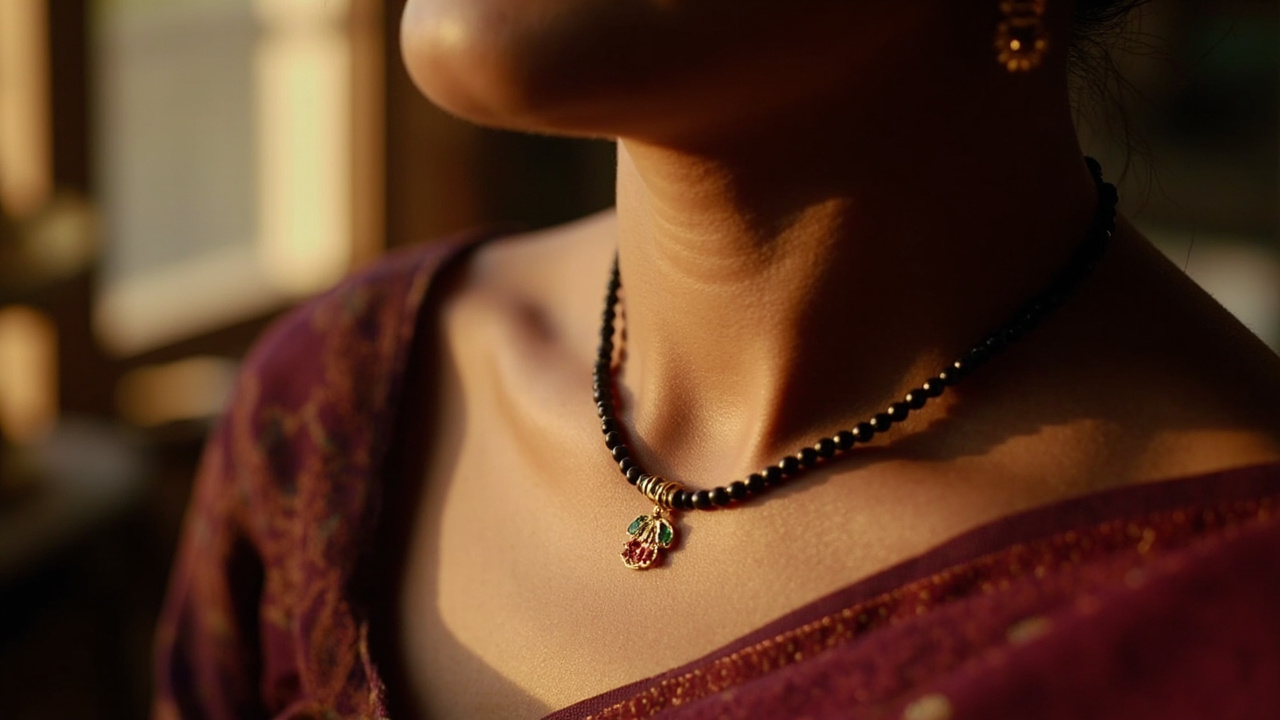
A traditional mangalsutra is a necklace, but it is built to a very deliberate design. Three elements are almost always present:
1. The Black Beads
The most recognizable feature is a string of small black beads, usually made of onyx or glass, strung on a yellow or gold thread. In South India the focus is the pendant, but the black beads are still considered essential. They are not chosen for fashion. Black is the colour of Saturn (Shani) and of Rahu, two planetary influences that Vedic astrology associates with tests, longevity, and protection. The beads are believed to absorb the negative vibrations aimed at the marriage and to shield the husband’s life force.
2. The Gold Pendant (Vati or Mana)
Hanging at the center of the black beads is a gold pendant. Its shape varies by region: a small cup (vati) in Maharashtra, a paisley (mango) in Gujarat and Rajasthan, a thali coin in Tamil Nadu, or a galsari pendant in the North. The pendant is the visual anchor of the necklace and often the only part that catches the light.
3. The Yellow or Turmeric-Dyed Thread
The string holding the beads together is traditionally dyed with turmeric, a sacred and purifying substance in Hindu ritual. The yellow thread marks the necklace as a religious object, not ordinary jewelry. Even when modern versions use gold chains instead of thread, the symbolism is preserved.
The Spiritual Meaning of the Mangalsutra
The mangalsutra is not decoration. It is a wearable yantra, a small sacred diagram that a woman wears against her heart and throat, the two energy centers (anahata and vishuddha chakras) connected to love, devotion, and expression.
A Bond of Two Souls, Not a Chain
In the Brihadaranyaka Upanishad (1.4.17), marriage is described as a unity in which “the husband becomes one with the wife.” The mangalsutra is the visible sign of that invisible unity. When the groom ties it during the wedding, he is not “owning” his bride in any modern sense. He is making a public promise that his life and her life are now threaded together like two strands of the same sutra.
Protection and the Fulfillment of the Husband’s Life
Many Hindu traditions teach that the mangalsutra directly affects the husband’s wellbeing. “Mangal” here also connects to Mangala (Mars), the planet traditionally associated with vitality and marriage. The black beads are believed to ward off evil eye (drishti) and ill omens that could shorten a husband’s life. The wife, by wearing the necklace constantly, is seen as an active spiritual guardian of her marriage, not just a passive wearer of a symbol.
Energy and the Chakra System
In yogic thinking, the area of the chest where the mangalsutra rests is the seat of bhakti, loving devotion. Wearing a sacred object at this spot is believed to keep the heart energy of the marriage open and aligned. Many women report that the moment they remove the mangalsutra after widowhood, they feel a tangible emotional shift, which speaks to how deeply the symbolism is internalized.
A Brief History of the Mangalsutra
The custom of a sacred thread tied around a wife’s neck predates written Hindu history. References appear in the Mahabharata, where Draupadi wears an eternal thread tied by Lord Shiva, and in several Puranas where the mangala sutra is described as one of the fourteen precious objects a virtuous wife wears (sumangali tradition).
Vedic Roots
In early Vedic marriage rites (vivaha samskara), the bride was given a yajnopavita-like sacred thread. Over centuries this evolved into a neck ornament specific to married women. The black beads became standard after the 6th century CE, partly under the influence of South Indian temple jewelry traditions where similar bead-and-pendant necklaces were offered to goddesses.
Regional Evolution
Over time, every region of India developed its own version:
- North India (Hindi belt): Mangalsutra with black beads and a gold vati or pendant.
- Maharashtra: Two pendants called vaati and dhale, often featuring goddess motifs.
- Gujarat and Rajasthan: Five-strand mangalsutra (panchnu) with a mango-shaped pendant for the first wedding and additional bichiya for each child.
- Tamil Nadu: Thaali, a yellow thread tied around the neck with a gold coin or thali pendant, central to the wedding ritual.
- Andhra Pradesh and Telangana: Mangalyam, often a small gold disc with Lakshmi engraved.
- Kerala: Minnu, a small leaf-shaped pendant on a thin gold chain.
- Bengal: Loa or Shakha Pola, the conch-shell and red-coral bangles that serve a similar symbolic role for Bengali brides.
These variations confirm a single principle: every Hindu community marks the bride’s married status with a sacred neck adornment that is tied, not clipped or pinned.
The Tying Ceremony: When and How It Happens
The mangalsutra is tied during the kanyadaan and saptapadi phases of a Hindu wedding. The groom holds the thread in his right hand, often with a betel leaf, while the priest chants mangala mantras. The groom then ties three knots, and in some South Indian traditions, the bride’s brother ties the second knot for the longevity of her husband.
What the Three Knots Mean
- First knot: Commitment to dharma, the righteous path of married life.
- Second knot: Commitment to artha and kaama, the material and emotional flourishing of the couple.
- Third knot: Commitment to moksha, the spiritual liberation the couple will support each other toward.
The three knots echo the three aims of married life described in the concept of the four purusharthas, the classical Hindu goals of human life. Once tied, the necklace is worn continuously, including during sleep and bathing, until the husband passes away.
Mangalsutra vs. Other Married Women’s Symbols
The mangalsutra is one of several sacred symbols that mark a Hindu wife. Together they form a complete visual language of marriage.
Sindoor (Vermilion)
The red powder applied in the parting of the hair. Like the mangalsutra, it is associated with the husband’s longevity. Both are removed during widowhood. Read more about why married Hindu women apply sindoor.
Bindi
The dot at the forehead, traditionally red for married women. It marks the ajna chakra, the seat of wisdom. See the significance of bindi and tilak.
Bangles (Chooda and Shakha Pola)
The red and ivory bangles worn especially by North Indian and Bengali brides. Like the mangalsutra, their sound is believed to ward off evil.
Toe Ring (Bichiya)
The silver ring on the second toe of both feet, tied to the swadhisthana chakra and to feminine energy flow.
None of these symbols is more important than the mangalsutra, but together they form what tradition calls sumangali, the complete adornment of a married woman whose husband is alive and whose family is blessed.
What Happens When the Mangalsutra Is Removed
The mangalsutra is worn until the husband passes away. In nearly all Hindu traditions, the widow removes the mangalsutra, sindoor, and bangles as part of the mourning rituals. This act is not a punishment. It is a recognition that the marital role has transitioned into a different spiritual stage. In a few liberal and reform-minded Hindu communities today, women choose to keep the mangalsutra as a keepsake, but the traditional view is that the necklace has completed its sacred function.
Modern Variations and Reinterpretations
Contemporary Hindu women wear a wide spectrum of mangalsutras, from ultra-traditional black-bead designs to diamond-studded versions that look almost like Western jewelry. The thread is often replaced with a thin gold chain, and the pendant is personalized with the couple’s initials or a modern symbol.
Why the Core Design Persists
Even with these modernizations, the core elements almost always remain: black beads, a central gold pendant, and the act of tying. The reason is that the symbolism is what carries the meaning, not the materials. A diamond mangalsutra without the tying ceremony and the mantras is just a necklace. A simple yellow thread tied at a wedding with the proper intention carries the full weight of the tradition.
The Mangalsutra in Diaspora
Hindu women living outside India often wear the mangalsutra as a quiet but powerful anchor to their culture and faith. In countries where Hindu marriage traditions are unfamiliar, the necklace becomes an instant conversation starter and a daily reminder of identity, family, and the promises made on the wedding day.
Common Questions About the Mangalsutra
Is the mangalsutra a religious symbol or just a cultural one?
Both. The act of tying it is a Vedic ritual with specific mantras, but the necklace itself is also a cultural marker of Hindu marriage. In law and in society, it functions as a signal of married status similar to a wedding ring in the West.
Can a non-Hindu woman wear a mangalsutra?
There is no scriptural restriction on who may wear a similar design, but the tying ceremony is specifically a Hindu rite. Women who marry into Hindu families sometimes wear the mangalsutra out of respect for the tradition.
Is the mangalsutra mentioned in the Vedas?
Not by name in the Rigveda, but the concept of a sacred thread tied around the bride’s neck during vivaha appears in the Grihya Sutras and later in the Brihadaranyaka Upanishad, the Mahabharata, and various Puranas. The modern name “mangalsutra” is a later Sanskrit compound but the practice is ancient.
Why are the beads black?
Black beads are linked to Rahu and Shani, two planetary forces associated in Vedic astrology with tests, longevity, and protection. The black colour is believed to absorb negative energy that might otherwise harm the marriage or the husband.
What is the difference between mangalsutra and thaali?
They are the same tradition with regional names. Mangalsutra is the Sanskrit and Hindi name, thaali is Tamil, and mangalyam is Telugu. The black beads are more central in the North Indian design, while the gold pendant is more prominent in the South Indian thaali.
Can the mangalsutra be worn during exercise or while cooking?
Traditionally it is worn at all times, including during sleep and bathing. Modern women sometimes remove it during heavy physical work to protect it from damage, but the cultural expectation is to wear it continuously while the husband is alive.
The Mangalsutra as a Living Thread of Marriage
The mangalsutra is one of the few sacred objects in any world religion that a person wears against their body, all day, every day, for decades. It survives moves, jobs, illnesses, children, and the slow ordinary wear of a long marriage. It is, in the most literal sense, a thread of vows.
To understand why married Hindu women wear the mangalsutra is to understand that marriage in the Hindu view is not a contract but a samskara, a sacred rite of passage that changes the spiritual status of both partners. The necklace is the daily reminder of that change. It says, simply and beautifully: I am married, my husband lives, and the gods have tied our lives together with a knot that is meant to last.
Related Articles on Sattvic Gyaan
- Why Do Married Hindu Women Apply Sindoor (Vermilion)? — A companion symbol of marriage and the husband’s longevity.
- Hindu Wedding Rituals Explained — A complete guide to the Vivaha ceremony where the mangalsutra is tied.
- What Is the Status of Women in Hinduism? — The cultural context for Hindu women’s sacred symbols.
- Bindi & Tilak: Meaning of the Forehead Mark — Another symbol with deep spiritual meaning for married women.
- The 4 Purusharthas: Dharma, Artha, Kama, Moksha — The three knot meanings of the mangalsutra come from these goals.
- What is the Bhagavad Gita? — The Hindu scripture that frames marriage as a path of dharma.