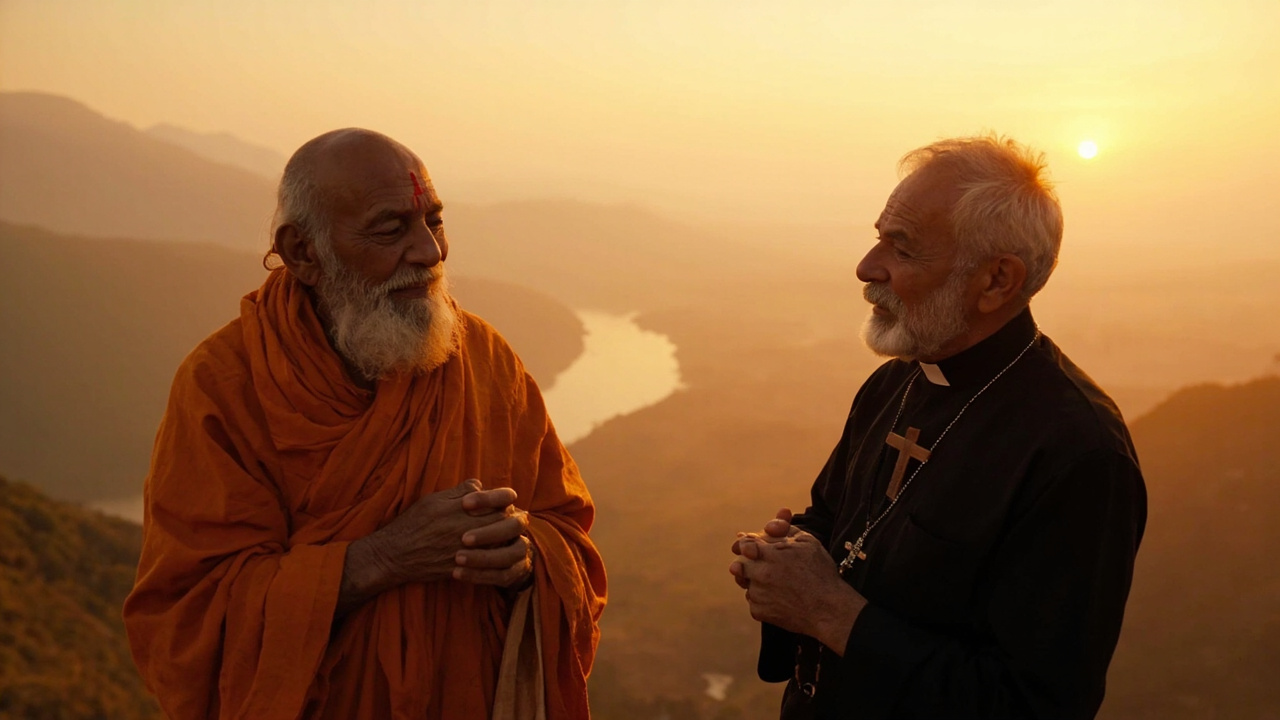
Hinduism vs Christianity: Common Ground and Key Differences Explained
When two of the world’s largest faiths sit down at the same table, the conversation often goes better than people expect. Hinduism (हिन्दू धर्म, Hindu Dharma) and Christianity represent two very different ways of answering the same human questions — Who is God? What is a good life? What happens after death? — and yet their ethical core is closer than most headlines suggest. This guide walks through where the two traditions genuinely agree, where they clearly diverge, and how to think about the differences with respect and clarity.
The comparison matters because both faiths are global. Hinduism is the world’s third-largest religion with roughly 1.2 billion adherents, almost entirely in India, Nepal, Bali, and the Hindu diaspora. Christianity is the largest, with about 2.4 billion followers spread across every continent. They have met — sometimes peacefully, sometimes painfully — for nearly two thousand years, from the Syrian Christians of ancient Kerala to the Jesuit scholars of Goa, and from the British Raj to today’s interfaith prayer meetings.
A Brief Snapshot of Each Faith
Hinduism, in the form most Westerners encounter, is a family of traditions rooted in the Vedas, Upanishads, Bhagavad Gita, and a vast body of Puranas and local literature. It has no single founder and no central doctrinal authority. A Hindu may describe the divine as one (Brahman), many (gods like Vishnu, Shiva, Devi), or both at once (a position called Smartism). Sacred geography includes the Ganga, the Himalayas, seven holy cities, and millions of local shrines.
Christianity is rooted in the life, teachings, death, and resurrection of Jesus of Nazareth, called the Christ. Its scripture is the Bible — Old and New Testaments — and its core doctrines were defined in the early ecumenical councils (Nicaea, Chalcedon). A Christian is monotheistic, holds that Jesus is both fully God and fully human, and that salvation comes through faith in him. Christianity’s three largest branches are Roman Catholicism, Eastern Orthodoxy, and Protestantism, alongside Oriental Orthodox churches (Coptic, Syriac, Armenian) that predate and never accepted the Council of Chalcedon.
Common Ground — Where the Two Traditions Agree
Despite centuries of distance, the two faiths share an unusually thick ethical core. The overlap is rarely accidental; it is the common inheritance of late-ancient Mediterranean and Indian religious culture.
The Golden Rule
Both faiths treat compassion as the heart of moral life. Jesus summarized the Law and the Prophets in two commandments — love God, love your neighbor — and told his followers, “Do unto others as you would have them do unto you” (Matthew 7:12). Hinduism states the same principle in the Mahabharata: “This is the sum of all righteousness: treat others as you yourself would be treated” (Anushasana Parva 5,1517). The Mahabharata calls this dharma’s entire teaching in a single verse.
Charity, Hospitality, and Care for the Poor
Hinduism elevates daan (दान, charity) as one of the highest duties, taught in every Purana and practiced daily through annadana (अन्नदान, feeding the hungry) and temple offerings. Christianity’s counterpart is the corporal works of mercy — feed the hungry, shelter the stranger, visit the sick — taught by Jesus in Matthew 25 and institutionalized through monastic hospitals, soup kitchens, and modern Catholic Charities. Both faiths treat giving not as a transaction but as a form of spiritual purification.
Monasticism, Renunciation, and the Call to a Holy Life
Christianity has monks and nuns (Benedictines, Franciscans, Carmelites) who renounce marriage, wealth, and worldly status to pursue prayer and service. Hinduism has sannyasins (संन्यासिन्), sadhus, and forest-dwelling hermits who similarly renounce the householder life to seek moksha. The structural parallels — celibacy, simple dress, communal chanting, separation from ordinary society, dependence on lay almsgivers — are striking. A Benedictine monk chanting the Psalms in a stone cloister and a sadhu chanting the Vishnu sahasranama in a Himalayan cave are recognizably doing the same thing.
Mysticism, Contemplation, and the Inner Path
Christian mystics like Meister Eckhart, Teresa of Ávila, and John of the Cross wrote about darkness, surrender, and union with God in language that reads almost like Advaita Vedanta. Hindu mystics like Ramakrishna, Ramana Maharshi, and Anandamayi Ma taught that God is found within, accessible through silence, breath, and love. Both traditions hold that ultimate truth is not primarily propositional — it is experiential.
A High View of Scripture
For most Hindus, the Vedas are shruti (श्रुति, “that which is heard”) — eternal, authorless, and authoritative in matters of dharma. For most Christians, the Bible is the inspired Word of God, the highest rule of faith. The exact status differs (see below), but both traditions treat their sacred text as more than literature; it is revelation.
Devotion, Saints, and Holy Figures
Hinduism has its saints — Mirabai, Tukaram, Andal, Kabir, Ramakrishna — whose songs and lives are venerated. Christianity has its saints — Francis of Assisi, Teresa of Ávila, the martyrs, the desert fathers — whose stories inspire prayer and imitation. Both traditions believe holiness is contagious and that humans can be transformed by association with the divine.
Core Differences — Where the Two Diverge
Common ground is real, but the differences are equally real. Naming them clearly is the beginning of mutual respect, not the end of dialogue.
One God or Many Paths to the One?
Christianity is strictly monotheistic. God is one in three Persons — Father, Son, and Holy Spirit — a doctrine called the Trinity, formalized at the Council of Nicaea in 325 CE. Idolatry is explicitly forbidden by the Ten Commandments.
Hinduism does not fit neatly into Western categories of monotheism, polytheism, or pantheism. Most Hindus are henotheistic in practice — they worship one form of the divine (Shiva, Vishnu, Devi, Rama, Krishna, Ganesha) while accepting that other forms are valid for other devotees. Philosophically, the Vedanta tradition holds that the personal gods are all names and forms of the one formless Brahman (Ekam sat vipra bahudha vadanti — “Truth is one, the wise call it by many names,” Rigveda 1.164.46).
The practical difference: a Christian typically cannot affirm that Allah, Krishna, and Shiva are all true names of God without abandoning Christian identity. A Hindu typically can affirm that Christ is a true teacher of divine truth without abandoning Hindu identity. The boundary is drawn in different places.
The Person and Work of Christ
For Christians, Jesus Christ is not just a teacher or saint — he is the incarnate Son of God, the second Person of the Trinity, who died for the sins of humanity and rose bodily on the third day. Salvation comes through faith in him. Rejecting this is, for orthodox Christianity, a serious doctrinal error.
For most Hindus, Jesus is venerated as a satpurusha (सत्पुरुष, a holy person), a great teacher, and sometimes an avatar or a saint. Some Hindus — particularly those influenced by Swami Vivekananda or the Ramakrishna Mission — see Christ as one expression of the universal Christ-consciousness. But the doctrine of the Trinity and the doctrine of atonement through the cross are not Hindu doctrines.
The Path to Liberation
Christianity has historically held that salvation is by grace through faith, not by works (Ephesians 2:8–9), although works are the fruit of true faith. The Catholic tradition adds the seven sacraments, the communion of saints, and the hope of purgatory.
Hinduism offers a more pluralistic map. The Bhagavad Gita (4.11) famously says, “In whatever way people approach me, I reward them accordingly; all paths lead to me.” The classical paths are jnana yoga (ज्ञान योग, knowledge), bhakti yoga (भक्ति योग, devotion), karma yoga (कर्म योग, selfless action), and raja yoga (राज योग, meditation). The goal is moksha — liberation from the cycle of rebirth.
Afterlife and Rebirth
Christianity teaches a single life followed by eternal destiny — heaven or hell, with some traditions adding purgatory or a temporary state for the dead. Reincarnation is rejected as incompatible with the resurrection of the body.
Hinduism, Buddhism, and Jainism share the doctrine of samsara — the cycle of birth, death, and rebirth — governed by karma. Liberation is escape from this cycle, not entry into an eternal heaven. The two eschatologies are not the same picture painted in different colors; they are genuinely different maps.
Scripture and Authority
Christians recognize a closed canon of 66 (Protestant) or 73 (Catholic and Orthodox) books. Councils of the early church decided what counted as scripture. A Christian cannot add new authoritative scripture.
Hindus have an open canon. The Vedas are highest, but the Puranas, Itihasa (Ramayana, Mahabharata), Bhagavad Gita, Yoga Sutras, Dharma Shastras, and Bhakti poetry are all honored to varying degrees. Different communities lean on different texts. There is no central authority that declares which Hindu books are authoritative.
Ritual and Idolatry
Most Protestant churches reject the use of religious images as idolatrous. Catholic and Orthodox Christianity venerate icons, statues of saints, and the consecrated Host, distinguishing veneration (dulia) from worship (latria, reserved for God alone).
Hindu worship is overwhelmingly image-based. The murti (मूर्ति) in a temple is not, in orthodox theology, an idol — it is a consecrated form through which the divine is invoked and encountered. “The image is God; it is not a separate thing” is a common temple inscription. The reform tradition of Smartism and the Arya Samaj reject image worship, but image-based devotion is the dominant Hindu practice.
Historical Encounters Between the Two Faiths
The two religions did not meet only in modern times. The earliest documented Christian community in India — the St. Thomas Christians of Kerala — claims foundation by the Apostle Thomas in 52 CE. By the time the Portuguese arrived in 1498, these Syriac Christians had been living alongside Hindu neighbors for 1,400 years, sharing language, food, and temple festivals.
The arrival of European missionaries from the 16th century onward was more contested. Jesuit accommodation under Roberto de Nobili (who adopted the saffron robes, sandalwood marks, and Sanskrit language of a Hindu sannyasi) attempted cultural bridge-building. Later missions were often linked to colonialism and produced suspicion on both sides. In the 19th and 20th centuries, Indian Christian thinkers like Keshub Chunder Sen, Brahmabandhab Upadhyay, and Abhishiktananda tried to articulate an Indian Christian theology rooted in Vedanta. Their work remains a touchstone for interfaith dialogue today.
Why This Comparison Matters
For Hindus, comparing the two traditions is a way of clarifying what is distinctively Hindu. For Christians, it is a way of explaining what is distinctively Christian to neighbors and friends who do not share their faith. For interfaith families, seekers, and students, the comparison is a way of navigating questions that arise in mixed cultural settings — which holidays to observe, how to raise children, how to explain a Hindu uncle to a Christian grandmother.
The honest answer, more often than not, is that respectful coexistence works better than either forced uniformity or competitive conversion. Two billion people cannot be persuaded to think alike; they can be persuaded to live alongside each other in peace.
Frequently Asked Questions
Do Hindus believe in Jesus?
Most Hindus regard Jesus as a great saint, a satpurusha, and a teacher of truth. Some Hindu traditions — particularly those influenced by the Ramakrishna Mission — see Christ as a manifestation of divine consciousness, alongside Krishna, Buddha, and Rama. Hindus generally do not accept the Christian claim that Jesus is the only incarnation of God or that salvation depends on faith in him.
Do Christians believe in karma?
No, in the technical Hindu sense. Christianity rejects the doctrine of rebirth and the idea that one’s actions in this life mechanically determine the next life. Christians do affirm that actions have moral consequences and that God is just, but the framework is divine grace and judgment, not karmic accounting.
Can a person be both Hindu and Christian?
Officially, no. The doctrinal claims are too different for formal double belonging. Some Indian thinkers — Sadhu T. L. Vaswani, the Ashram of Rishikesh’s Christian-Hindu retreats, the French Benedictine Henri Le Saux (Abhishiktananda) — have lived in the tension between the two, but they generally identified primarily with one tradition while drawing deeply from the other.
Which religion is older, Hinduism or Christianity?
Christianity is roughly 2,000 years old, dating to the ministry of Jesus (c. 30 CE). Hinduism has no single founding date; its Vedic roots go back at least 3,500 years, and Indus Valley civilization had religious practices older still that may have fed into it. By either reckoning, Hinduism predates Christianity by more than a millennium.
Do Hindus and Christians worship the same God?
Different traditions answer this differently. Catholic and most Protestant theologians would say no — God has revealed himself uniquely in Jesus Christ. Some pluralist theologians (John Hick, Paul Knitter) have argued yes. Many Hindus, particularly in the Advaita and Smart traditions, would say yes, because all gods are forms of the one Brahman. The honest answer depends on which Hindu and which Christian you ask.
What do Hinduism and Christianity agree on about morality?
Both teach the Golden Rule. Both honor compassion, hospitality, charity, chastity, honesty, and care for the poor as core virtues. Both forbid murder, theft, adultery, and false witness. The Ten Commandments and the Yamas (यम, the restraints in Yoga Sutras) overlap substantially. Where they differ is in metaphysics and the path to ultimate liberation, not in everyday ethics.
How do Hindus view the Bible?
Most Hindus treat the Bible with respect, as a sacred scripture of a sister tradition. Some Hindus read the Sermon on the Mount as compatible with the Bhagavad Gita’s teaching of equanimity and selfless action. Hindus do not typically consider the Bible authoritative for their own religious life, but they generally do not reject its spiritual value.
Related Articles on Sattvic Gyaan
- Hinduism vs Buddhism — Similarities and Differences Explained
- Hinduism vs Jainism — Similarities and Differences Explained
- Hinduism vs Sikhism — Similarities and Differences Explained
- Origin of the Word Hindu: How the Indus River Gave India Its Name
- Main Scriptures of Hinduism: Vedas, Upanishads, Bhagavad Gita, Puranas
- Caste System in Hinduism: Varna vs Jati Explained