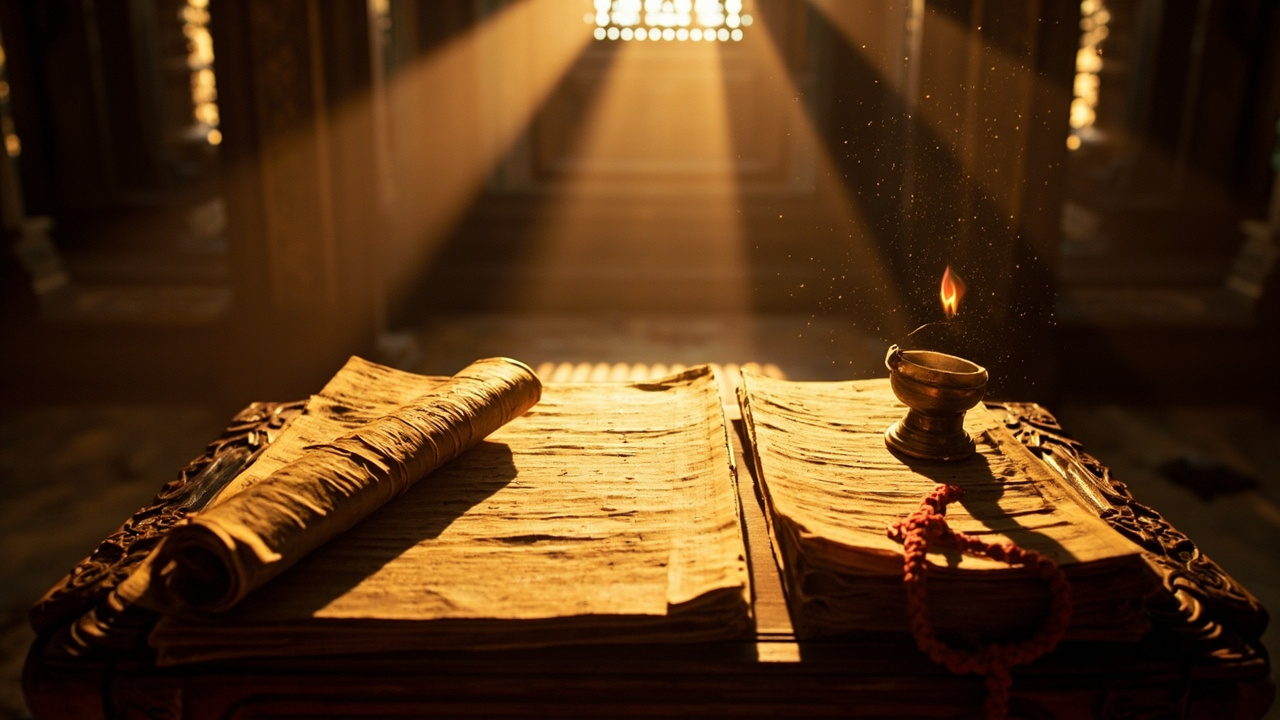
Why is Sanskrit Considered Sacred? The Divine Language of Hinduism Explained
Walk into any Hindu temple in India, close your eyes, and listen. The chants you hear — the Om at the start of a prayer, the priest’s invocation to Lord Ganesha, the wedding mantras — are spoken in Sanskrit. For over three thousand years, this ancient language has carried the prayers, philosophy, science, and poetry of Hinduism. But what makes a language sacred? Why do Hindus call Sanskrit the language of the gods (Deva Bhasha), and why does its precise pronunciation matter so much that a single mispronounced syllable can invalidate a ritual? In this article, we explore the eight reasons why Sanskrit is considered sacred — from the Vedas it preserves, to the perfect grammar of Panini, to the living tradition that still uses it in temples across India today.
1. Sanskrit Is Called the “Deva Bhasha” — The Language of the Gods
The most well-known Sanskrit name for Sanskrit is Deva Bhasha (देवभाषा) — literally “the language of the gods.” In Hindu cosmology, Sanskrit is the tongue in which the devas (celestial beings) speak to one another. The Brihadaranyaka Upanishad (1.3.28) refers to Sanskrit as the very breath of the divine: “asato ma sad gamaya” — “lead me from the unreal to the real.” When Vedic mantras are chanted, Hindus believe they are participating in the same cosmic language the gods themselves use.
This is why Sanskrit is treated differently from every other Indian language. While Hindi, Tamil, Bengali, and Marathi are considered regional tongues — beautiful and culturally rich, but human in origin — Sanskrit is believed to have descended intact from a divine source. The Devi Mahatmya and other Puranic texts describe the goddess Saraswati (goddess of wisdom) as the very embodiment of Sanskrit; her veena is the language’s musical structure, and her four arms represent the four Vedas, all composed in Sanskrit.
2. The Vedas Were Composed and Preserved in Sanskrit
Sanskrit’s sacred status comes largely from one fact: the four Vedas — Rig, Yajur, Sama, and Atharva — were composed in Sanskrit, and they are considered apauruseya (अपौरुषेय), meaning “not of human authorship.” Hindus believe these hymns were heard directly by rishis (seers) in deep meditation, not written or invented by any person. The language they came through was therefore considered timeless and divine.
The Vedas are the oldest religious texts still in active liturgical use anywhere in the world. The Rigveda alone contains over 10,500 verses — hymns to Agni, Indra, Varuna, and other deities — written in a form of Sanskrit so ancient that even modern Sanskrit scholars call it Vedic Sanskrit (distinct from Classical Sanskrit). For over 3,500 years, these hymns have been chanted exactly as composed, syllable by syllable, because the tradition insists that even a single mispronounced sound can change the meaning — and the cosmic effect — of the mantra.
3. Every Sound Has Meaning — The Science of Phonetics
Unlike most modern languages where the same letter combination can produce different sounds in different words, Sanskrit was designed so that every sound is intentional and meaningful. The language has roughly 50 distinct sounds, each mapped to one Devanagari character. The alphabet is organised by place of articulation (throat, palate, teeth, lips) and manner (voiced/unvoiced, aspirated/unaspirated) — making it one of the most phonetically precise languages ever designed.
This matters in mantra practice because of Sabda Brahma (शब्द ब्रह्म) — the Hindu philosophical concept that “sound is God.” The Mandukya Upanishad explains the entire cosmos as a manifestation of the sacred syllable AUM (ओम्). When you chant a mantra in Sanskrit, you are not just saying words — you are activating specific sound vibrations believed to resonate with specific cosmic energies. This is why Sanskrit mantras are not translated before chanting: changing the sound would change the effect.
4. Panini’s Perfect Grammar — The Ashtadhyayi
Around the 4th century BCE, the grammarian Panini wrote the Ashtadhyayi (अष्टाध्यायी), a treatise of about 4,000 grammatical rules (sutras) that describes the entire structure of Sanskrit in a remarkably compact form. Modern linguists call it one of the greatest intellectual achievements in human history — a grammar that is logical, complete, and computationally elegant. Noam Chomsky’s theory of generative grammar was directly inspired by Panini’s work.
For Hindus, the significance of Panini’s grammar is not just academic. Because Sanskrit’s structure is so perfectly described, every word can be derived from a root (dhatu) using predictable rules. This makes the language self-consistent in a way no other language matches. A Vedic priest can chant a 3,500-year-old mantra without ambiguity because the grammar still works exactly as Panini codified it. In this sense, Sanskrit is considered a perfect language — its rules are not arbitrary but reflect the order of the cosmos (rita) itself.
5. Mantras Depend on Exact Pronunciation
In Hindu ritual practice, mantra is not just prayer — it is a precise spiritual technology. A mantra’s power is believed to depend on its exact sound, exact syllable count, and exact intonation. The Vedic tradition has preserved the Varnaveda tradition of pronunciation with such fidelity that priests from different parts of India can chant together in unison, even after centuries of regional separation.
Consider the famous Gayatri Mantra from the Rigveda (3.62.10): “Om bhur bhuvah svah, tat savitur varenyam, bhargo devasya dhimahi, dhiyo yo nah prachodayat”. This 24-syllable mantra is believed to activate the sun’s energy in the chanter’s body. If even one syllable is mispronounced, the effect is lost. This is why Sanskrit mantras are typically learned directly from a guru — written transliterations can never capture the exact nasalisation, breath, and pitch that a teacher transmits in person. The sacredness of Sanskrit is therefore inseparable from the sacredness of how it is spoken.
6. A Living Tradition in Hindu Temples
Unlike Latin (used only academically) or Biblical Hebrew (revived for modern Israel), Sanskrit has never been a dead language in the Hindu world. It has been continuously used in Hindu temples for at least 3,000 years. Even today, priests in temples across India — from the Jagannath Temple in Puri to the Meenakshi Temple in Madurai to the Kashi Vishwanath in Varanasi — perform daily puja and recite Vedic mantras in Sanskrit.
Sanskrit is also the language of Hindu samskaras (sacraments) like Annaprasana (first rice feeding), Upanayanam (sacred thread), and Hindu weddings. When a couple is married with Vedic mantras, when a baby’s naming ceremony (Naamkaran) is performed, when a house is warmed with Griha Pravesh rituals — the priest speaks Sanskrit. This unbroken oral tradition across millennia is itself a strong argument for Sanskrit’s sacredness: a language that priests have kept alive for over three thousand years, with the same pronunciation, is unlike any other.
7. Sanskrit as the Mother of Indo-Aryan Languages
Sanskrit is the linguistic ancestor of most North Indian languages — Hindi, Bengali, Marathi, Gujarati, Punjabi, Assamese, Odia, and Nepali all descend from Sanskrit (or its older Vedic form). Even South Indian languages like Telugu and Kannada have borrowed heavily from Sanskrit vocabulary, especially for religious, scientific, and philosophical terms. This makes Sanskrit the cultural and linguistic backbone of the Indian subcontinent.
This historical centrality is itself a mark of sacredness. Sanskrit was not just one of many languages — it was the language of Indian philosophy, science, mathematics, astronomy, and law for over two thousand years. The grammar of Panini, the mathematics of Aryabhata, the astronomy of Varahamihira, the medical texts of Ayurveda, the philosophy of the Bhagavad Gita, the yoga sutras of Patanjali — all were composed in Sanskrit. When India calls Sanskrit sacred, it is also recognising that an enormous part of its civilisational heritage lives in this language.
8. The Modern Sanskrit Revival Movement
In recent decades, Sanskrit has experienced a quiet revival. The Indian government declared Sanskrit one of the eight Classical Languages of India in 2005. Universities in India, Germany, Japan, and the United States now offer Sanskrit programs. The Bhagavad Gita, the Upanishads, and the Yoga Sutras have become bestsellers in Sanskrit-translation editions worldwide. Mobile apps now teach Sanskrit mantras; YouTube channels stream daily Vedic chanting from Indian temples.
This revival is itself part of why Sanskrit remains sacred in the modern Hindu imagination. Unlike ancient languages that became museum pieces, Sanskrit is still being learned, chanted, and applied by millions of Hindus today — including tech workers in Bangalore who recite the Vishnu Sahasranama before coding, and NRIs in London and New York who teach their children the Sandhyavandanam prayers. The language is sacred not because it is locked in the past, but because it continues to carry the living tradition forward into the future.
Frequently Asked Questions
Is Sanskrit still spoken today?
Yes. While Sanskrit has no native speakers in the modern sense, it is still used as a liturgical, scholarly, and ritual language by millions of Hindus across India. Some villages in Karnataka (like Mattur and Hosahalli) claim Sanskrit as their everyday spoken language. Temples, Vedic schools (pathshalas), and Sanskrit universities keep it alive.
Is Sanskrit older than Latin and Greek?
Sanskrit’s oldest form, Vedic Sanskrit (the language of the Rigveda), is older than classical Latin and ancient Greek. The Rigveda is dated by most scholars to approximately 1500–1200 BCE, while Classical Latin emerged around 100 BCE. However, Sanskrit is a cousin language to Latin and Greek, all descending from Proto-Indo-European.
Why is Sanskrit called the perfect language?
Sanskrit is called “perfect” because of Panini’s Ashtadhyayi, a 4,000-rule grammar treatise from around the 4th century BCE that describes the language with mathematical precision. Every word can be derived from a root using predictable rules, making Sanskrit self-consistent in a way no other natural language matches.
Do Hindus learn Sanskrit to read scriptures?
Many Hindus do learn Sanskrit to read the Vedas, Upanishads, Bhagavad Gita, and other scriptures in their original language. However, for everyday devotional practice, translations and transliterations are widely used. The most learned priests typically spend 7–12 years in Vedic gurukulas mastering Sanskrit chanting and grammar.
What is the difference between Sanskrit and Vedic Sanskrit?
Vedic Sanskrit is the older form of the language used in the Vedas (c. 1500–500 BCE). Classical Sanskrit is the standardised form codified by Panini around the 4th century BCE. Vedic Sanskrit has some archaic features — different verb forms, special vocabulary for ritual — but is fundamentally the same language family.
Why do mantras have to be chanted in Sanskrit?
In Hindu tradition, mantras are believed to work through the precise vibration of their sounds, not just their meaning. Sanskrit’s phonetically precise alphabet (with one character per sound) makes it ideal for this. Changing the language would change the vibration, and therefore the effect. This is why mantras are not translated before chanting.
Should I learn Sanskrit as a Hindu?
Learning Sanskrit is not required for being a Hindu, but many Hindus find it deeply enriching. Even a basic understanding of Sanskrit helps you appreciate the meaning of mantras, temple rituals, festival prayers, and scripture in its original form. There are excellent modern courses, apps, and online resources for beginners.
Related Articles on Sattvicgyaan
- What is the Bhagavad Gita? Summary, Teachings & Significance
- What is the Meaning of Sanatana Dharma?
- What is Karma? The Law of Cause and Effect in Hinduism
- Hindu Wedding Rituals Explained — From Engagement to Saptapadi
- Why Do Hindus Fast? The Meaning of Vrat, Ekadashi & Navratri
- The Status of Women in Hinduism — Ancient to Modern