Sindoor and Chooda: Meaning, Significance & Regional Traditions in Hinduism
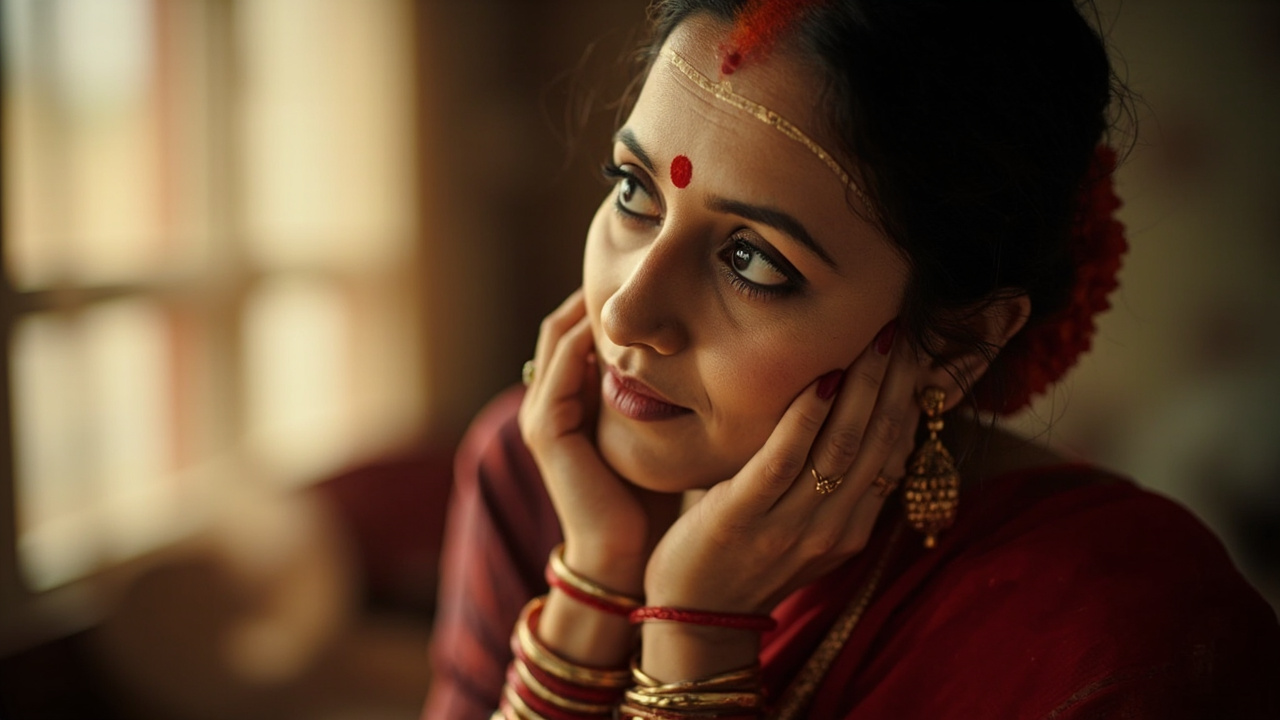
For generations, two small signs have quietly told the world that a Hindu woman is married: the bright red powder in the parting of her hair, and the stack of red (and ivory) bangles on her wrists. Sindoor (सिन्दूर) and Chooda (चूड़ा) are not mere ornaments. They are living symbols of sumangali status, the auspiciousness of marriage, the wellbeing of the husband, and the woman’s own spiritual identity within Sanatana Dharma. This guide explains exactly what they mean, where they come from, how they are worn, and why they still matter today.
What Are Sindoor and Chooda?
Sindoor is the vermilion powder that a married Hindu woman applies along the centre parting (maang) of her hair, from where the hair is drawn back to a small bun or braid. It is traditionally made from red lead (or, in modern times, from turmeric and lime) and is associated with Goddess Parvati, the consort of Lord Shiva.
Chooda is the set of red and ivory (or white) bangles worn by a newly married woman, especially during the first year (or the first saal) of her marriage, and on special occasions for the rest of her life. The red bangles are usually made of lacquer, plastic, or glass; the white or ivory ones are often made of shakha (conch shell) and pola (coral-red resin). In Punjabi, Bengali, and many North Indian traditions, the chooda is a deeply visible marker of a bride.
Together, sindoor and chooda form part of the sholah singaar (sixteen adornments) of a married Hindu woman, along with bindi, mangalsutra, toe rings ( bichwa ), kohl, mehendi, and more.
The Spiritual Meaning of Sindoor
Sindoor is more than red colour. It carries three layers of meaning:
Sindoor as a Symbol of the Goddess
According to the Shiva Purana and various regional Puranic texts, Sati, the first consort of Shiva, immolated herself at her father Daksha’s yajna. In her next birth as Parvati, when she reunited with Shiva, she applied vermilion to her maang, and from that moment sindoor became the mark of the devoted wife. To apply sindoor is, in a sense, to honour Parvati’s bhakti and to invite her energy of fidelity, sacrifice, and shakti into one’s home.
Sindoor as a Prayer for the Husband’s Life
One of the most beautiful legends is found in the Adbhut Ramayana. When young Hanuman asked Sita why she wore sindoor, Sita replied: “I apply this to ensure a long, healthy life for my Lord Sri Rama.” Hanuman, in his childlike devotion, smeared his entire body with sindoor so Rama would live a thousand years. That is why Hanuman’s murtis in temples across India are covered in sindoor. The same belief flows into the household practice: every morning, when a woman fills her maang with vermilion, she is performing a small but living prayer for the long life and wellbeing of her husband.
Sindoor as Energy and Auspiciousness
In tantric and Ayurvedic thought, the point where the hair is parted is the location of the Aajna chakra‘s subtle projection downward — the meeting point of Ida and Pingala nadis. Applying sindoor here is believed to activate feminine energy (shakti), calm the mind, and radiate auspiciousness (mangal) to the household. In many traditions, a woman without sindoor in the maang is considered to be in a state of mourning or impurity.
How Sindoor Is Applied and Worn
The way sindoor is applied varies by region and family, but the core practice is similar.
The Maang
The parting of the hair, from the forehead backward about two to three inches, is filled with vermilion. Some women fill only a small pinch at the front; others fill the entire parting up to the crown. The shape is usually a clean, narrow line — straight, slightly curved, or in a teardrop pattern depending on regional custom.
When Sindoor Is Not Worn
A married Hindu woman traditionally does not wear sindoor:
- During menstruation (in many traditional households, though this varies)
- During the mourning period after the death of a husband or close elder
- On certain fast days, such as during Chhath or some forms of Navratri vrat
- When performing specific austere pujas (e.g., during Pitru Paksha in some traditions)
Forms of Sindoor
Traditionally, sindoor was made from red lead oxide (sindoor of mineral origin). Modern commercial sindoor, especially from the 1980s onward, is often made from turmeric and slaked lime (a safer alternative, since lead-based sindoor can cause skin and health issues). For puja purposes, the mineral sindoor is still preferred. Many women keep both: a lead-free daily version and a traditional mineral one for religious occasions.
The Spiritual Meaning of Chooda
The chooda is not only jewellery — it is a public, almost ceremonial declaration of marriage and of a woman’s transition into grihastha ashrama.
Chooda as a Symbol of Suhaag
The red colour of the chooda echoes the red of sindoor, of the bridal sari, of the alta on the bride’s feet, and of the kumkum applied at the doorstep during griha pravesh. Red, in Hindu tradition, represents Shakti, fertility, auspiciousness, and marital happiness. To wear the chooda is to be visibly marked as sumangali — a woman whose husband is alive and well.
Chooda as a Blessing of Fertility and Longevity
The white or ivory bangles mixed with the red ones represent purity, the moon’s cooling energy, and the blessings of elders. Together, the alternating red and white (or ivory) pattern is believed to balance the fiery, passionate energy of the marriage with the calm, steady energy of longevity and motherhood. In Punjab, the chooda is presented to the bride by her mama (maternal uncle) and is removed only after a fixed period — usually between 40 days and a year — depending on family custom.
Chooda as Community Witness
Unlike the more private sindoor, the chooda is meant to be seen. The bride wears it during visits to family, in temples, at festivals, and at community gatherings. It tells the world, without words, that she is a newly married daughter-in-law, and it invites blessings, advice, and warmth from elder women.
Regional Names and Variations of Sindoor and Chooda
Like most Hindu rituals, the names and customs differ beautifully across regions.
Regional Names of Sindoor
- Sindoor / Sindur (सिन्दूर) — Hindi, Sanskrit, Marathi
- Kumkum (कुंकुम) — the broader term in South India, often referring to the powder itself (distinct from the turmeric-based tilak)
- Kungumam (குங்குமம்) — Tamil
- Kumkuma (కుంకుమ) — Telugu
- Kunku (कुंकू) — Marathi (also used for the powder applied to the forehead or the small dab at the start of the maang)
- Sivappu (சிவப்பு) — sometimes used in Tamil for the red powder itself
Regional Names and Forms of Chooda
- Chooda (ਚੂਹਾ / चूड़ा) — Punjabi, Hindi — the iconic red and ivory bangles of North Indian brides
- Shakha Pola (শাখা পলা) — Bengali — the red and white bangles worn by married Bengali women
- Gajulu (గజులు) — Telugu
- Valayal (வளையல்) — Tamil — though valayal refers to bangles generally, the bridal set has its own ritual
- Bajubandh (बाजूबंद) — sometimes refers to the broader set of bridal arm ornaments
In Bengal, the shakha pola is put on during the Gaye Holud ceremony, while in Punjab, the chooda ceremony is held the morning after the wedding or a day or two later, often at the bride’s maternal home.
The Rituals: How Sindoor and Chooda Are First Applied
Neither sindoor nor chooda is applied casually. Each comes with its own small ceremony.
The Sindoor Ceremony
During the wedding, the sindoor daan (application of vermilion) is one of the most sacred moments. After the saptapadi (seven steps around the fire) in many traditions, the groom applies sindoor in the bride’s maang for the first time. In some communities, this is done by the groom himself; in others, by the bride’s sister or by a married elder woman of the family. From that moment onward, the bride is considered a sumangali.
The Chooda Ceremony
The chooda is typically given to the bride in a ceremony called the chooda ceremony in Punjab or the shakha pola r khao ceremony in Bengal. A set of 21 (or another fixed number) bangles is prepared, often ritually bathed in milk and rose water, then tied onto the bride’s wrists. The bride may wear new white or ivory clothing, and elder women feed her sweets and give her blessings. The chooda is removed after a fixed period (in Punjab, usually after the muklawa ceremony, when the groom comes to take the bride to her new home) or kept for a full year before being replaced with everyday bangles.
What Happens When Sindoor or Chooda Is Removed
Both sindoor and chooda are tied to the husband’s life and wellbeing. Their removal is, therefore, a moment of spiritual significance.
- After the husband’s death: The woman traditionally stops wearing sindoor and chooda, marking her transition to the next stage of life and the period of mourning.
- During certain vrat or rituals: Some women remove sindoor during Pitru Paksha, specific Navratri fasts, or while performing pitru tarpan.
- Daily removal: Many women wash off their sindoor at the end of the day before bathing and reapply fresh the next morning. Some women fill the entire parting only on special occasions and apply a small pinch daily.
Modern Practice: Choice, Simplicity, and Tradition
Like many Hindu practices, the wearing of sindoor and chooda today is a personal choice.
- Many working women prefer a small, clean pinch of sindoor at the front of the parting rather than a long line.
- Some women wear sindoor only on festivals or puja days.
- Others wear it daily without exception, viewing it as a non-negotiable part of their sumangali identity.
- Similarly, the chooda is sometimes worn only for the first 40 days, sometimes for a year, and sometimes on every Teej, Karva Chauth, and wedding anniversary thereafter.
- There are also women — by choice, by circumstance, or by modern sensibility — who do not wear either, and that too is a valid path within the broad river of Hindu practice.
What does not change is the meaning behind the symbols: marital love, devotion, longevity, and the quiet, daily prayer of a wife for her husband’s wellbeing.
Common Questions About Sindoor and Chooda
Is sindoor the same as kumkum?
Not exactly. Sindoor traditionally refers to the vermilion applied in the maang. Kumkum is a broader term, used across India for the bright red powder applied at the bindi, on the forehead, or in the maang. In some South Indian traditions, kumkum is the powder itself (often turmeric-based), while sindoor in North India is more associated with red lead or a turmeric-lime mix.
Can unmarried girls wear sindoor?
Traditionally, no. Sindoor in the maang is a marker of marriage. However, small dots of kumkum on the forehead, or sindoor applied in puja to a deity, are entirely appropriate for unmarried women and girls.
Why is the chooda red and white (or ivory)?
The red represents Shakti, fertility, and the bride’s energy. The white or ivory bangles, often made of conch shell (shakha) and coral resin (pola), represent purity, longevity, and the cooling energy of the moon. Together they balance passion and peace.
How long should a bride wear the chooda?
There is no single answer. In Punjabi tradition, the chooda is worn for at least 40 days to a year. In Bengali tradition, the shakha pola is worn for the rest of the married life on a daily basis, with the bridal set sometimes replaced after a year. Family custom and regional tradition both play a role.
What happens if I forget to apply sindoor one day?
There is no sin in missing a day. Sindoor is a devotional and cultural practice, not a ritual obligation. If you miss it, simply apply it the next day with a clear heart and fresh intention.
Are there health concerns with traditional sindoor?
Yes. Older, mineral-based sindoor can contain red lead, which is toxic if absorbed through the skin over long periods. Modern commercially sold sindoor is usually lead-free. For daily wear, choose a reputed lead-free brand. For puja, you can still use the traditional mineral sindoor sparingly.
Is chooda the same as bangles worn every day?
No. The bridal chooda is a specific ceremonial set with a fixed number of bangles (often 21) in red and ivory, with a ritual application ceremony. After the ceremonial period, the bride switches to regular bangles, though many women continue to wear red and white bangles for the rest of their married life.
Related Articles on Sattvigyaan
- Why Do Married Women Wear Mangalsutra? — the other key symbol of a Hindu wife’s sumangali status, with regional names like Thaali and Mangalyam.
- What is the Significance of Bindi and Tilak on the Forehead? — the third major marker of Hindu marital identity, applied at the ajna chakra.
- Hindu Wedding Rituals Explained — the full context of how sindoor and chooda fit into the Vivaha Samskara.
- Status of Women in Hinduism — a deeper look at the scriptural place of women as partners, not subordinates, in Sanatana Dharma.
- The 4 Purusharthas: Dharma, Artha, Kama, Moksha — Grihastha Ashrama, the householder life, is the foundation of the first two purusharthas.
- Griha Pravesh: Hindu House Warming Ceremony — the welcoming of the bride into her new home, where the red of sindoor and chooda first meets her new threshold.
A Closing Note
Sindoor and chooda are small, daily acts of faith. They connect a married Hindu woman to Parvati’s devotion, to Sita’s prayer for Rama, and to the unbroken chain of sumangalis who have walked before her. Whether you wear them every day, only on festivals, or not at all, understanding their meaning is part of understanding the rich, layered inner world of Sanatana Dharma.