Do Hindus believe in reincarnation?
The Eternal Cycle: Understanding Reincarnation in Hinduism
Reincarnation—the belief that the soul takes birth again and again in different physical bodies—is one of the most distinctive and widely recognized concepts of Hindu philosophy. But what exactly does Hinduism teach about rebirth? Is it a literal belief, a metaphorical concept, or something more profound? This article explores the ancient wisdom behind reincarnation and how it shapes the Hindu worldview.
Unlike many Western religious traditions that speak of a single earthly lifetime followed by eternal heaven or hell, Hinduism presents a cosmic vision of continuous soul evolution through countless lifetimes. This journey isn’t random or arbitrary; it’s governed by precise spiritual laws that offer both justice and opportunity for growth.
What Is Reincarnation Called in Hindu Scriptures?
The Sanskrit term for reincarnation is Punarjanma (पुनर्जन्म), meaning “birth again.” The broader concept is called Samsara (संसार)—the endless cycle of birth, death, and rebirth. According to the Bhagavad Gita (2.22), just as a person discards worn-out clothes and puts on new ones, the soul discards worn-out bodies and enters new ones.
This teaching appears throughout Hindu scriptures:
- Brihadaranyaka Upanishad (4.4.3): “As a caterpillar, having come to the end of a blade of grass, reaches out to another blade, so does the Self, having left this body behind, reach out to another.”
- Bhagavad Gita (2.13): “As the embodied soul continuously passes, in this body, from childhood to youth to old age, the soul similarly passes into another body at death.”
- Katha Upanishad (1.2.6): “One is born again and again through attachment to the material world; but through non-attachment and knowledge, one attains liberation.”
The Mechanics: How Does Reincarnation Work?
Reincarnation isn’t a random lottery. It follows precise spiritual laws centered on three key concepts:
1. The Eternal Soul (Atman)
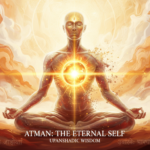
The true self—called Atman—is eternal, unchanging, and indestructible. It’s not the physical body, mind, or personality, but the pure consciousness that animates them. As explained in our article on Atman: The True Self, this eternal essence survives bodily death and takes birth in a new form.
2. The Law of Karma
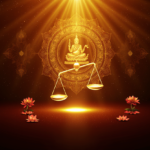
Karma (action and its consequences) determines the circumstances of each rebirth. Good actions create positive karma leading to favorable rebirths; harmful actions create negative karma leading to challenging circumstances. As detailed in our Karma: The Law of Cause and Effect article, karma isn’t punishment but education—teaching the soul through experience.
3. The Goal: Moksha (Liberation)
The ultimate purpose isn’t endless rebirth but freedom from the cycle. Moksha—liberation from Samsara—occurs when the soul realizes its true nature as identical with Brahman (Ultimate Reality). Our article on Moksha: The Final Liberation explores this supreme goal of human life.
Evidence and Experiences of Past Lives
While reincarnation is primarily a matter of faith, many Hindus point to certain phenomena as supporting evidence:
- Childhood Memories: Numerous documented cases of young children remembering specific details of previous lives that can be verified.
- Spontaneous Skills: Prodigies who display extraordinary abilities (like musical talent or language fluency) without training.
- Past-Life Regression: Therapeutic techniques that sometimes reveal memories of apparent previous existences.
- Birthmarks and Phobias: Unexplained birthmarks corresponding to injuries in previous lives or irrational fears with no childhood cause.
While these don’t constitute scientific proof, they resonate with the Hindu understanding that consciousness transcends individual lifetimes.
Different Perspectives Within Hinduism
Not all Hindu traditions interpret reincarnation identically:
Advaita Vedanta (Non-Dualism)
Reincarnation happens until one realizes the fundamental unity of Atman and Brahman. The cycle continues due to ignorance (Avidya) of this truth.
Dvaita Vedanta (Dualism)
The soul remains eternally distinct from God, and rebirth continues as the soul journeys toward divine proximity.
Bhakti Traditions
Devotional paths emphasize that love for God can accelerate spiritual evolution and potentially bypass certain rebirths.
Yogic Schools
Through yogic practices, one can consciously prepare for the next birth or work toward liberation in this lifetime.
Practical Implications: How Reincarnation Shapes Hindu Life
This belief isn’t just philosophical—it influences daily living:
- Acceptance of Diversity: Different life circumstances reflect past karma, fostering compassion rather than judgment.
- Long-Term Perspective: Challenges are seen as temporary lessons in a longer journey.
- Ethical Living: Actions have consequences extending beyond this lifetime.
- Spiritual Priority: Material achievements are secondary to soul evolution.
- Death as Transition: Death isn’t an end but a doorway to the next phase.
Common Questions About Hindu Reincarnation
Do animals reincarnate as humans?
Yes, according to Hindu cosmology, souls can incarnate in various life forms. Human birth is considered precious because only humans have sufficient consciousness to pursue liberation.
How many lifetimes does a soul experience?
Scriptures suggest 8.4 million lifetimes through different species before attaining human birth, but there’s no fixed number for human incarnations.
Can we choose our next birth?
To some extent—our deepest desires at death influence our next birth. The Bhagavad Gita (8.6) states: “Whatever state of being one remembers when he quits his body, that state he will attain without fail.”
Do we reunite with loved ones in future lives?
Karmic connections often bring souls together across lifetimes, but relationships change form as each soul evolves independently.
Is there a “first” lifetime?
Hinduism considers time cyclical rather than linear, so there’s no absolute beginning to the cycle of rebirths.
The Bigger Picture: Reincarnation and Cosmic Justice
Reincarnation addresses profound questions about life’s apparent injustices. Why are some born into privilege while others suffer? Why do good people face tragedy? The karmic explanation provides a framework where every experience—pleasant or painful—has meaning as soul education.
This doesn’t justify social injustice (caste discrimination based on rebirth is a distortion of original teachings) but offers a cosmic perspective on individual soul journeys.
Moving Toward Freedom
The ultimate message isn’t about countless future births but about the opportunity this present birth offers. As the Chandogya Upanishad declares: “You are what your deep, driving desire is. As your desire is, so is your will. As your will is, so is your deed. As your deed is, so is your destiny.”
Whether one accepts reincarnation literally or sees it as metaphorical wisdom about soul evolution, its practical value lies in inspiring conscious living with awareness that our choices echo beyond this momentary existence.
In the words of the Isa Upanishad: “The soul is not born, nor does it die. Unborn, eternal, constant, ancient, it is not killed when the body is killed. How can you kill the immortal?”
Frequently Asked Questions
Is belief in reincarnation mandatory for Hindus?
While central to traditional Hindu philosophy, individuals may interpret it differently. The essential teaching is the eternal nature of consciousness.
How does reincarnation differ from resurrection?
Resurrection implies the same physical body returning, while reincarnation involves consciousness taking a completely new physical form.
Can modern science validate reincarnation?
Some researchers study cases suggestive of past-life memories, but mainstream science remains skeptical due to the difficulty of empirical verification.
Do other religions believe in reincarnation?
Yes—Buddhism, Jainism, Sikhism, and some indigenous traditions share similar concepts, though with different theological frameworks.
How can I learn about my past lives?
Traditional wisdom suggests focusing on present spiritual growth rather than past-life curiosity, as current consciousness transformation affects future evolution.