Why Don’t Hindus Eat Beef? The Scriptural, Cultural, and Legal Roots of the Prohibition
If you have ever wondered why beef sits at the center of so many debates about Hindu practice, you are not alone. Among the world’s major religions, Hinduism’s stance on beef is unusually specific. Many Hindus are vegetarian, but even those who are not often refuse to eat beef. The cow is treated differently from every other animal in the dietary landscape of Sanatana Dharma. To understand why, you have to look past slogans and political noise, and into the scriptural, cultural, and historical roots of the prohibition.
This article traces those roots. We will look at what the Hindu scriptures actually say about cow slaughter, why Krishna’s association with cows matters so much, how the prohibition spread across the subcontinent unevenly, and how modern Indian law has come to codify what was once a religious norm. Along the way, we will also clear up some common misconceptions, because the conversation around beef and Hinduism is often more heated than it is accurate.
A Cow Is Not Just an Animal: The Hindu View
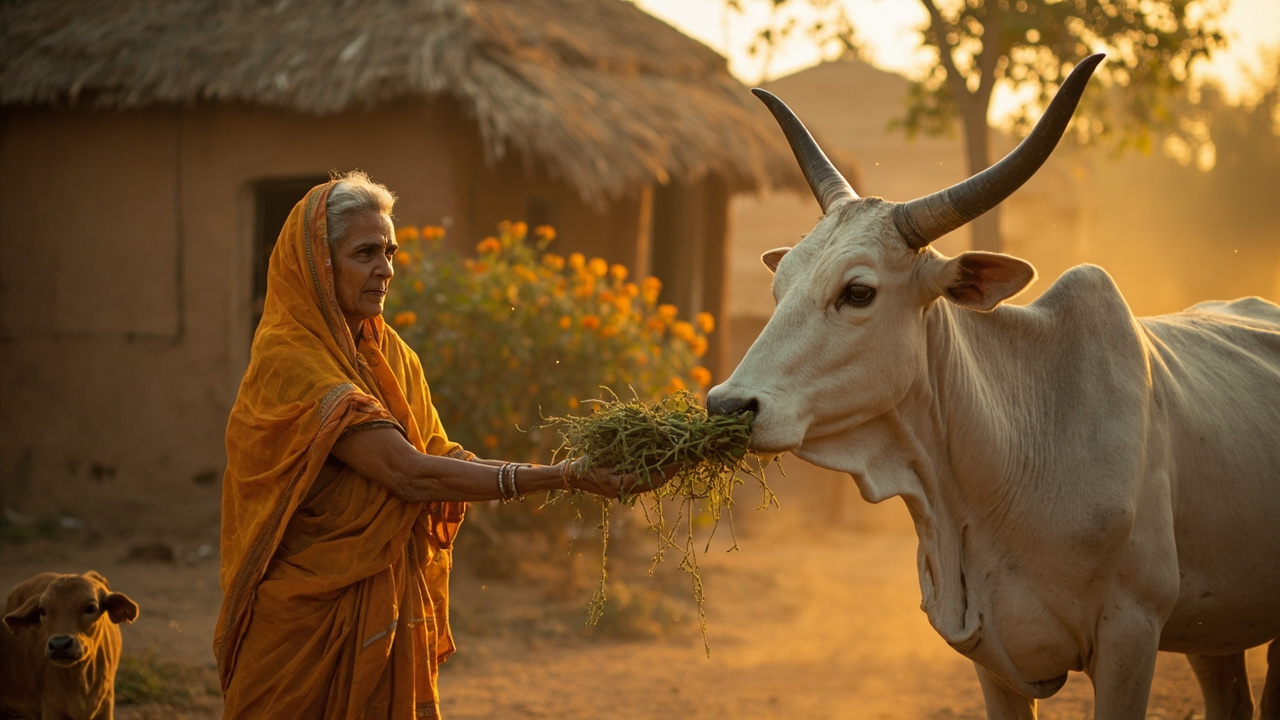
In most Hindu households, the cow is called Gau Mata — Mother Cow. That title is not a poetic flourish. It captures a worldview in which the cow is a giver of life, not a source of meat. She provides milk, ghee, curd, and dung that fuels the hearth and fertilizes the field. She pulls the plough and carries water. In an agrarian civilization, the cow was the most generous animal a family could keep alive.
That practical generosity was woven into religious imagination. Killing such an animal was understood to be cutting off a daily source of nourishment and grace. This is why cow reverence runs deeper than “animal love” in Hindu thought. It is the recognition of a relationship that is both economic and sacred.
Scriptural Foundations — What the Texts Actually Say
The prohibition of beef-eating in Hinduism does not rest on a single verse. It emerges from a layered body of scripture, and the strength of the prohibition varies from text to text. Understanding this is important, because critics and defenders alike sometimes quote selectively.
The Rigveda, the oldest Vedic text, includes hymns that praise the cow and call for her protection, though explicit beef-prohibition verses are not as central as is sometimes claimed. The Atharvaveda and later Brahmanas treat the cow as a divine gift whose killing invites severe sin.
By the time we reach the Manusmriti (Laws of Manu), the prohibition becomes explicit. Go-hatya — the killing of a cow — is listed among the gravest sins, comparable to killing a Brahmin. The text describes the cow as the mother of the gods, the earth, and the sacrificer. The Vishnu Purana, the Bhagavata Purana, and the Garuda Purana repeat and amplify this idea, framing cow-protection as one of the clearest marks of dharma in the current age (Kali Yuga).
The Mahabharata and the Ramayana also contain strong statements against cow slaughter. In the Anushasana Parva of the Mahabharata, Bhishma tells Yudhishthira that harming a cow is worse than harming a hundred other animals. The Skanda Purana goes further, declaring that the killing of a cow destroys a man’s ancestors, descendants, and spiritual merit for generations.
It is worth being honest about the textual evidence too. The Vedic ritual texts include some references to beef in specific sacrificial contexts, but these have been the subject of scholarly debate for over a century. The dominant living tradition, including the Dharma Shastras and Puranas, clearly forbids beef-eating for ordinary lay people. In practice, that is the scriptural inheritance most Hindus inherit today.
Krishna, Govardhan, and the Cow-Protection Tradition
If there is one Hindu deity most associated with cows, it is Krishna. As a child in Vrindavan, he is called Gopala — the protector of cows. He grew up among cowherds, played his flute in forests where cows grazed, and is often depicted with a cow standing beside him. His very name Govinda means “one who gives pleasure to the cows.”
The most celebrated episode is the Govardhan Leela. When the people of Vrindavan were preparing to worship Indra, the rain god, Krishna persuaded them to worship the Govardhan hill and the cows instead. He taught that dharma lay in protecting the cattle and the land that fed them, not in appeasing a distant deity through grand sacrifice. This story is read across India as a foundational moment of Hindu cow-protection ethics.
For Vaishnavas — devotees of Vishnu and Krishna — cow service (go-seva) is a direct expression of devotion. Many Vaishnava temples have goshalas (cow shelters) attached to them, and the day of Go-puja in Kartik month is observed by millions of Hindus.
Why Beef Is Different From Other Meat in Hinduism
Many Hindus who are not strictly vegetarian still avoid beef. This is one of the clearest pieces of evidence that the prohibition is about the cow specifically, not about meat in general. Understanding the distinction is essential.
Several reasons are commonly cited:
- Scriptural weight: The texts that forbid meat-eating are many, but the texts that forbid beef-eating specifically are stronger and more numerous.
- Cultural symbolism: The cow stands for motherhood, abundance, and selfless giving. Killing her carries symbolic weight that killing a goat or fish does not.
- Historical reform movements: Movements such as the Arya Samaj, the Cow Protection Societies of the late 19th century, and the Hindu reform movements of the colonial era emphasized beef-prohibition even more than general vegetarianism.
- Daily domestic presence: Many Hindu families keep cows in their homes or neighborhoods. The emotional closeness of the animal amplifies the prohibition.
So when a Bengali Hindu eats fish, or a Goan Catholic eats pork, or a Rajasthani Rajput eats goat, the line is still drawn firmly at beef. That line is one of the few cultural markers that nearly all Hindu communities, regardless of region or language, recognize.
The Historic Spread of Cow-Protection Laws
Cow-protection in India did not begin with modern politics. It goes back well over a thousand years and is woven into the history of Hindu reform movements.
The Mauryan emperor Ashoka, in his rock edicts from the 3rd century BCE, condemned the killing of animals and called for restraint in meat consumption, with special mention of certain animals including the cow. While Ashoka was a Buddhist, his edicts influenced the wider Indian ethical landscape.
Across the medieval period, several Hindu kings enacted cow-protection laws. The Hoysala kings in Karnataka, the Vijayanagara rulers, and several Rajput kingdoms issued proclamations restricting cow slaughter. In the Mughal period, while the courts often patronized meat-eating, many regional governors and local Hindu communities continued cow-protection at the village level.
The Cow Protection Movement of the late 1800s, led by Swami Dayananda Saraswati and others, turned this ancient norm into a national cause. Lobbies in British India pressed for cow-protection legislation, and several Presidency Towns passed local acts restricting slaughter. After independence in 1947, cow-protection was placed in the Indian Constitution under Directive Principles, and individual states gradually passed their own laws.
Regional Variations — Not All of India Eats the Same Way
It is a mistake to imagine that all of India uniformly prohibits beef. The reality is far more textured.
In North India — Uttar Pradesh, Rajasthan, Haryana, Madhya Pradesh, Gujarat, and Himachal Pradesh — cow slaughter is strongly prohibited by law and widely avoided by custom. These states have largely Hindu populations and active cow-protection movements.
In South India, the picture is more mixed. Tamil Nadu and Karnataka have strong laws against cow slaughter, but Kerala has had a long tradition of beef consumption among Christians, Muslims, and even some Hindu communities. Andhra Pradesh and Telangana also have laws restricting cow slaughter, but enforcement varies.
In the East, Bengal has a complex history. Pre-partition Bengali Hindus, especially in the lower castes and tribal communities, sometimes ate beef. The bhakti poet Chaitanya Mahaprabhu and later reformers discouraged this, but the practice persisted in some rural pockets. Today, West Bengal has no statewide ban on cow slaughter, and the political debate around it remains active.
In the Northeast, beef-eating has been traditional among many tribal and Christian communities. States like Meghalaya, Mizoram, and Nagaland have laws that explicitly permit cow slaughter. Manipur and Assam have stronger restrictions, and the issue remains a delicate federal balance.
In Goa, a long Portuguese colonial history and a sizeable Catholic and Muslim population mean beef remains openly available and consumed.
These regional differences are important. They show that the Hindu prohibition is not a single monolithic rule but a tapestry of laws, customs, and histories.
Cow Slaughter Laws in Modern India
Today, cow slaughter is regulated by a patchwork of state laws, with the central government having passed supporting legislation but leaving primary enforcement to the states.
As of recent years, twenty-four of India’s twenty-eight states have some form of restriction on cow slaughter. The penalties range from fines to multi-year imprisonment. Some states, like Gujarat, also restrict the sale and transport of beef and beef products.
The central government has supported these state laws through several measures, including restrictions on the inter-state transport of cattle for slaughter. These laws are controversial, both inside India and abroad. Critics argue they violate the secular principles of the Constitution and unfairly target religious minorities. Defenders argue that they reflect the deep cultural sentiment of the majority and align with the long historical tradition of cow-protection in India.
For a global reader, the most useful thing to take away is this: in India, the question of whether beef is legal is answered state by state, and the answer often reflects the religious and cultural composition of each region.
Common Misunderstandings About the Beef Taboo
A few misconceptions deserve correction:
- “All Hindus are vegetarian.” Not true. Many Hindus eat meat — fish, chicken, mutton, and in some regions beef too. The prohibition is strongest specifically for beef.
- “The cow is worshipped.” A simplification. The cow is revered, cared for, and protected, but she is not worshipped as a deity. Krishna is worshipped; the cow is honored as a mother.
- “Beef was always forbidden.” The strength of the prohibition grew over time. The earliest Vedic texts contain some sacrificial references, but the strong prohibition emerges clearly in the Dharma Shastras and Puranas.
- “The prohibition is purely religious.” In reality, ecological and economic reasons (dairy is more sustainable than beef production in small-scale farming) reinforced the religious norm over centuries.
- “Eating beef is the worst sin in Hinduism.” It is a major sin, but Hindu ethics treats all forms of violence with weight. The specific gravity of beef-eating comes from the unique status of the cow.
How the Prohibition Shapes Daily Hindu Life
For an observant Hindu family, the prohibition is woven into daily life rather than being a single dramatic rule. Cows are fed before the family eats. They are sheltered in old age. Their dung is used as fuel and fertilizer. They are honored with vermilion and tilak during festivals like Govardhan Puja, Gopashtami, and Pongal (Mattu Pongal in Tamil Nadu).
Many Hindu households also keep a small goshala or contribute regularly to one. Pilgrimages to Vrindavan, Govardhan, and Nathdwara often include feeding cows as part of the ritual. Festivals like Govardhan Puja are essentially cow-worship festivals, where cows are bathed, decorated, and fed sweets before being honored in a small puja.
The prohibition has also shaped the Indian economy. India is the largest milk producer in the world, and the dairy industry — from the small village cow to the cooperative giants like Amul — has grown in the same soil as the cow-protection ethic. Vegetarian and even non-vegetarian Hindus often keep cows for milk, and the protection ethic is partly a recognition of that economic centrality.
Frequently Asked Questions
Did ancient Hindus actually eat beef?
The earliest Vedic texts contain references to beef in some ritual contexts, but the Dharma Shastras, Puranas, and the long living tradition all clearly forbid beef-eating for lay people. Modern scholars continue to debate the earliest Vedic evidence, but the prohibition has been the dominant Hindu position for well over a thousand years.
Why do some Hindus who eat meat still avoid beef?
Because the cow occupies a unique place in Hindu thought. The prohibition is specifically about the cow — her role as a giver of milk, her association with Krishna, and her status as a near-mother figure in the household. Other animals do not carry this layered symbolism.
Is cow slaughter illegal across all of India?
No. Cow slaughter is restricted in most Indian states, but a few — especially in the Northeast and Kerala — have weaker or no specific bans. Enforcement also varies widely by state.
Why is the cow called “Gau Mata”?
Because she nourishes the family just as a human mother does — with milk, dung for fuel, and labor in the fields. Calling her Mata (mother) is a recognition of her life-giving role in an agrarian society.
Are other animals also considered sacred in Hinduism?
Yes. Elephants (Ganesha’s vahana), monkeys (Hanuman), peacocks (Kartikeya’s vahana), snakes (linked to Shiva and Vishnu), and cows are all revered in different ways. But the cow’s daily domestic role gives her a uniquely practical place in the prohibition.
What does the Bhagavad Gita say about eating meat?
Chapter 17 of the Bhagavad Gita classifies food into sattvic (pure), rajasic (stimulating), and tamasic (dull) categories. The text praises sattvic foods and counsels the yogi to prefer them. While the Gita does not single out beef in those verses, traditional commentators read its broader ethical teachings as supporting cow-protection.
Is beef-eating banned in Hinduism globally or only in India?
Only in India (and even there, only in many states) are there formal legal restrictions. Outside India, beef is freely available and eaten by some Hindus, especially in diaspora communities where other religious and cultural influences are present.
Related Articles on Sattvic Gyaan
- Why is the Cow Sacred in Hinduism? The Spiritual and Practical Reasons
- Do Hindus Eat Meat? Understanding Hindu Dietary Practices & Vegetarianism
- What is Ahimsa? The Hindu Principle of Non-Violence Explained
- The 4 Purusharthas of Life (Dharma, Artha, Kama, Moksha)
- What is Karma? The Hindu Law of Cause and Effect Explained
- What is the Bhagavad Gita? Summary, Teachings & Significance