Upanayanam: The Hindu Sacred Thread Ceremony — Meaning, Vidhi & Significance
The Upanayanam (उपनयनम्), also called the Bratabandha in eastern India and Yajnopavita ceremony in the Vedic tradition, is one of the most important samskaras (sacraments) in a Hindu boy’s life. The word Upanayanam comes from Sanskrit — upa (near) + nayanam (leading) — literally meaning “to lead near” or “to bring closer” to the Guru. On this day, the young boy is led by his father to a Guru (teacher), given the sacred thread (called janeu, yajnopavita, or poonool), and formally initiated into the world of Vedic learning. The thread, a thin cord of three twisted cotton strands worn across the torso from the left shoulder to the right hip, becomes a permanent part of the boy’s identity and his lifelong reminder of the three debts every Hindu owes — to the gods (Deva rinam), to the ancestors (Pitru rinam), and to the Guru (Rishi rinam).
For centuries, the Upanayanam ceremony has marked the beginning of a boy’s Brahmacharya Ashrama — the student stage of life, where he leaves home, lives with his Guru, and devotes himself to learning the Vedas, the shastras, and the sacred duties of a dwij (twice-born). Even today, in many traditional Hindu families, the Upanayanam is performed with deep reverence and elaborate ritual, often accompanied by the chanting of Gayatri Mantra, a sacred havan (fire ceremony), and the symbolic gift of a kamandalu (water pot), darbha grass, and a wooden staff (danda). This guide walks you through everything you need to know about the Upanayanam ceremony — its meaning, history, regional variations, the step-by-step vidhi (procedure), and the spiritual significance it holds in modern Hindu life.
What Is Upanayanam? Meaning and Spiritual Significance
The Upanayanam is the eleventh of the sixteen traditional Hindu samskaras described in the Grihya Sutras and the Dharmashastras. The word literally translates to “initiation” or “introduction” — the child is being formally introduced to the Vedic life, to the study of scriptures, and to the disciplined path of brahmacharya.
The Sacred Thread (Yajnopavita) — A Lifelong Symbol
The most visible symbol of the Upanayanam is the sacred thread itself, called the yajnopavita (यज्ञोपवीत) in Sanskrit, janeu (जनेऊ) in Hindi, poonool (பூணூல்) in Tamil, poonal in Malayalam, and jandhyam in Telugu. The thread is made of three cotton strands twisted together, each strand representing a great Vedic debt:
The Three Strands of the Sacred Thread
- First strand — Deva rinam (debt to the gods): The boy is reminded to honor the gods through daily prayer, ritual, and gratitude for the gift of life.
- Second strand — Pitru rinam (debt to ancestors): He is reminded to honor his parents, grandparents, and ancestors, and to one day continue the family lineage.
- Third strand — Rishi rinam (debt to sages and teachers): He is reminded to honor his Guru and the great rishis who preserved the Vedic knowledge through their tapasya and penance.
In some traditions, especially among the three upper varnas (Brahmin, Kshatriya, Vaishya), the number of threads differs: Brahmins wear a six-stranded thread (representing the six Vedangas), Kshatriyas a four-stranded one, and Vaishyas a three-stranded thread. But in modern practice, most families follow a single regional tradition regardless of varna.
Who Performs the Upanayanam and When?
The Upanayanam is traditionally performed for a boy in his 7th, 8th, or 9th year (sometimes up to the 12th year) in the family’s chosen tradition. The exact age varies by region and community:
Traditional Age Guidelines by Region
- North India (Hindi belt): Often between 5 and 9 years, with the 7th year being most common. The thread ceremony is called Janeu Sanskar or Yagyopaveet Sanskar.
- South India (Tamil Nadu, Kerala, Karnataka): Between 7 and 12 years, called Poonool ceremony in Tamil, Poonal in Malayalam, and Upakarma or Yajnopavita in Kannada.
- Eastern India (Bengal, Odisha): Often around 7 to 11 years, called Bratabandha (ব্রতবন্ধ) in Bengal — the ceremony is closely tied to the child’s first upanayan into the guru’s ashram. The Bengali Bratabandha often includes a specific focus on the Sandhyavandanam ritual.
- Western India (Maharashtra, Gujarat): Called Janjuti or Upanayan in Marathi. Performed around 7-9 years. In some Maharashtrian families, both the boy and the girl undergo the Janjuti ceremony.
Choosing an Auspicious Date (Muhurat)
The Upanayanam is performed on an auspicious tithi (lunar day) — typically during the waxing moon (Shukla Paksha), in the months of Vaishakha, Jyeshtha, or Magha, on a day when the boy’s jataka (horoscope) is favorable. Many families also prefer the Hasta, Moola, or Shravana nakshatras for the ceremony. A family priest or a Vedic astrologer is usually consulted to fix the muhurat (auspicious timing).
Materials Needed for the Upanayanam Ceremony
Before the day of the Upanayanam, the family gathers the following materials:
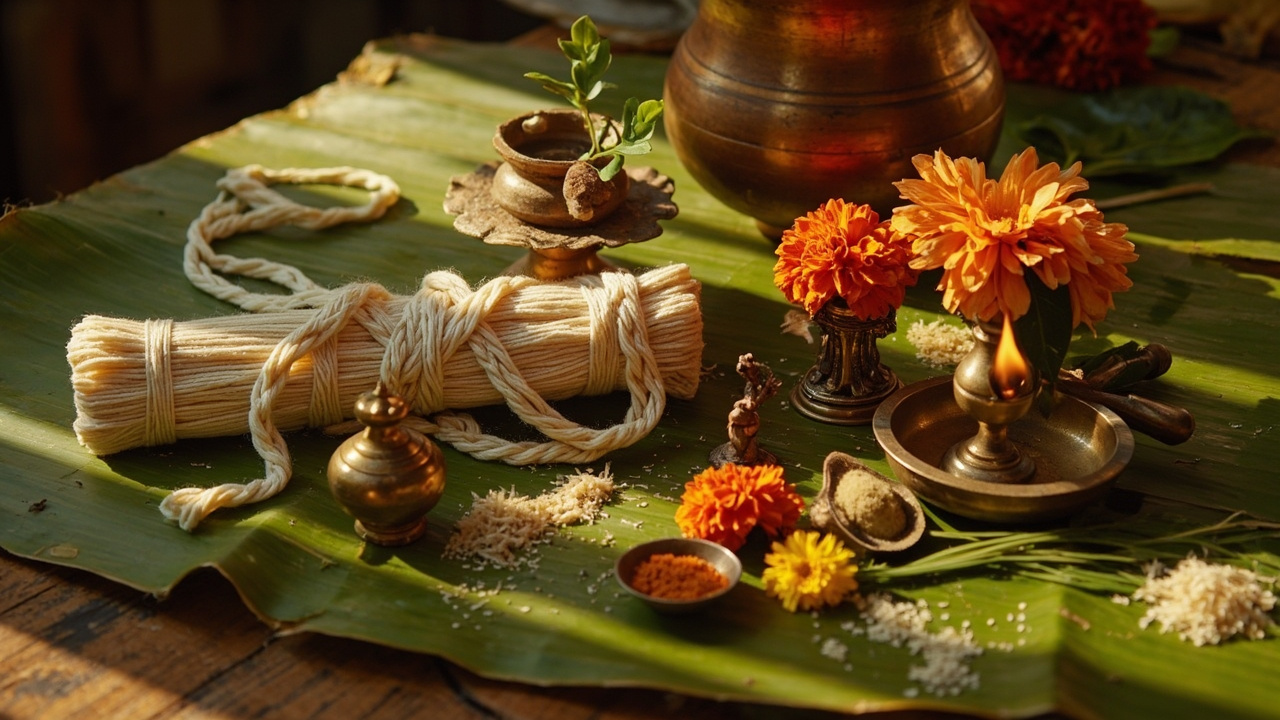
- Three cotton threads for the janeu (or six/four, depending on tradition), preferably hand-spun and unwaxed.
- A small brass or copper kamandalu (water pot) for the boy to carry.
- A wooden danda (staff) — often made of palasha or bamboo.
- A bundle of darbha grass (used in havan and rituals).
- A havan kund (sacred fire pit) and samagri (ghee, samidha, sandalwood, etc.) for the fire ritual.
- A copper or brass kalash topped with mango leaves and a coconut.
- A new set of clothes for the boy — typically a white dhoti and angavastram (in South India, often a veshti and angavastram; in North India, a dhoti-kurta).
- Small idols of Ganesha and Saraswati for the pooja.
- Rice, kumkum, haldi, marigold flowers, and a ghee diya lamp.
- A Bhagavad Gita, a copy of the Gayatri Mantra, or a primer on Sandhyavandanam for the boy.
- The Yajurveda or Samaveda text that the family tradition follows (if applicable).
Step-by-Step Upanayanam Vidhi (Procedure)
The Upanayanam ceremony is performed by a learned purohit (priest) and the boy’s father and Guru. The procedure varies across regions, but the core steps remain the same throughout India.
1. Punyaha Vachanam and Ganesh Pooja
The ceremony begins with the Punyaha Vachanam — a purification ritual where sacred mantras are chanted to sanctify the venue and the participants. Lord Ganesha is invoked first to remove all obstacles, followed by a worship of Vishnu, Lakshmi, and Saraswati.
2. The Boy’s Bath and New Attire
The boy takes a ceremonial bath (often with turmeric and curd mixed in the water) and is dressed in a fresh white dhoti and angavastram. The white color symbolizes purity and the beginning of a new, disciplined phase of life.
3. Surya Arghya and Ganesh Worship
The boy offers water to the Sun (Surya Arghya) while chanting the Gayatri Mantra for the first time in his life. This is followed by a small Ganesh pooja and the breaking of a coconut before the kalash.
4. The Sacred Thread Investiture (Yajnopavita Dharanam)
This is the most important step. The boy sits on a low wooden patla (stool) facing east. The Guru or priest holds the sacred thread and, with the father assisting, ties it around the boy’s torso — from the left shoulder to the right hip, hanging just below the navel. Mantras from the Yajurveda are chanted during this step, including the Upanayana Mantra that formally initiates the boy into Brahmacharya Ashrama.
5. The Gayatri Mantra Upadesa
p>The Guru then whispers the Gayatri Mantra (ॐ भूर्भुवः स्वः, तत्सवितुर्वरेण्यं, भर्गो देवस्य धीमहि, धियो यो नः प्रचोदयात्) into the boy’s right ear. This is called Mantra Upadesa — the formal transmission of the most sacred Vedic mantra. From this day forward, the boy is expected to chant the Gayatri Mantra daily during Sandhyavandanam (morning, noon, and evening prayer).
6. The Havan (Sacred Fire Ceremony)
A small havan is performed with the boy offering ahutis (oblations of ghee, samidha, and grains) into the sacred fire. The fire represents the divine witness and the carrier of all offerings to the gods. The boy makes specific offerings to Agni, Indra, Varuna, and the Ashwini Kumars.
7. Bhikshacharana (Alms-Begging)
The boy is then sent out to beg bhiksha (alms) from the assembled family elders and guests. This step is symbolic — it teaches the boy humility, the importance of aparigraha (non-possessiveness), and the recognition that even the most learned man must depend on the community. The gathered family members place rice, fruits, or money in the boy’s kamandalu.
8. Guru Dakshina and Blessings
The boy offers dakshina (a gift) to the Guru — traditionally a combination of money, clothes, a sacred text, and other useful items. The father, mother, and grandparents then give the boy their blessings. The ceremony concludes with a mangala aarti, the distribution of prasad, and a family feast.
Regional Variations of the Upanayanam Ceremony
While the core meaning remains the same, the Upanayanam has rich regional variations across India.
Upanayanam in Tamil Nadu (Poonool)
In Tamil Nadu, the ceremony is called Poonool (பூணூல்) and is performed in a deeply traditional way. The boy is often made to memorize the Santhana Gopala Mantra and the Gayatri Mantra weeks in advance. The ceremony is followed by the Upakarma — the day when the boy formally begins studying the Vedas and rituals.
Upanayanam in Bengal (Bratabandha)
In Bengal, the ceremony is called Bratabandha (ব্রতবন্ধ) and has a strong Vaishnava flavor. The boy is given the sacred thread, taught the Sandhyavandanam mantra, and is introduced to the study of the Smriti texts. The Bratabandha in many Bengali families is performed on the same day as the child’s first Keshanta (first haircut) — making it a combined ceremony.
Upanayanam in Maharashtra (Janjuti / Janeva)
In Maharashtra, the ceremony is called Janjuti (जानुती) or simply the Janj ceremony. It is performed with great pomp, often in the family temple or a community hall. The Maharashtrian tradition places strong emphasis on the boy’s first Sandhyavandanam after the ceremony, and many families also perform a small Shashtiabda Poorthi (60th birthday) for the father on the same day.
Modern Adaptations and the Upanayanam Today
In the 21st century, the Upanayanam has undergone significant changes. While the traditional families still perform the elaborate Vedic ceremony at home with a priest, many urban families now opt for a simplified version that retains the core rituals but compresses them into a few hours rather than a full day.
Upanayanam for Girls
Historically, the Upanayanam was performed for boys of the three upper varnas. However, in some Smriti traditions (notably the Manusmriti for Brahmin and Kshatriya families), girls also underwent the Upanayanam before marriage. The threads were tied differently — over the left shoulder (rather than from the left shoulder to the right hip). In modern practice, some progressive Hindu families perform an Upanayanam for daughters as well, emphasizing gender equality in Vedic education.
Non-Vedic Traditions
The Upanayanam is not performed in many Shaiva and Smarta traditions, who follow their own initiation rituals. In South India, the Namakarana Samskara (naming ceremony, typically in the 11th or 12th day after birth) is considered a parallel ceremony in some communities. Jain and Buddhist traditions have their own Diksha ceremonies, which are different in meaning but similar in spirit.
Frequently Asked Questions About the Upanayanam
1. What is the right age for Upanayanam?
The traditional age is between 7 and 12 years, with the 7th year being most common in many North Indian and South Indian traditions. The exact age can vary based on the family’s regional tradition, the boy’s horoscope, and the family’s convenience. There is no upper age limit — the Upanayanam can be performed at any age if it was missed in childhood.
2. Is the Upanayanam only for boys?
Traditionally, the Upanayanam was performed for boys of the three upper varnas (Brahmin, Kshatriya, Vaishya). However, in some Smriti traditions, girls also underwent the Upanayanam before marriage. Today, some progressive families perform the Upanayanam for daughters as well, treating it as a celebration of Vedic learning and discipline for all children.
3. What is the difference between Upanayanam and Bratabandha?
The Upanayanam is the pan-Indian name for the sacred thread ceremony, while Bratabandha is the specific Bengali term. The two ceremonies are essentially the same in meaning — both involve the child receiving the sacred thread, being taught the Gayatri Mantra, and being initiated into the Brahmacharya Ashrama. The Bratabandha in Bengal often includes a small first haircut and is closely tied to the Vaishnava tradition.
4. What are the three threads of the janeu for?
The three cotton strands of the sacred thread represent the three great Vedic debts: the debt to the gods (Deva rinam), the debt to the ancestors (Pitru rinam), and the debt to the rishis or teachers (Rishi rinam). Some traditions tie six strands (for Brahmins), four strands (for Kshatriyas), or three strands (for Vaishyas) — each strand carrying its own symbolic meaning.
5. Can the Upanayanam be performed at home?
Yes, the Upanayanam is most commonly performed at home, in a hall, or in a family temple. The key requirements are: a learned priest or Guru, a sacred fire (havan kund), the sacred thread, a clean pooja space, and the presence of family members and guests. Many urban families also perform it in a community hall or a temple.
6. What is the difference between Yajnopavita and Janeu?
Yajnopavita and Janeu are the same sacred thread, just called by different names in different languages. Yajnopavita (यज्ञोपवीत) is the Sanskrit name; Janeu (जनेऊ) is the Hindi name; Poonool (பூணூல்) is the Tamil name; Jandhyam is the Telugu name. The thread itself is identical across regions — a thin cord of three (or more) cotton strands worn across the torso.
7. Does the sacred thread have to be worn for life?
Yes, traditionally the sacred thread is worn for life, and is replaced annually during the Upakarma ceremony. The thread is taken off during specific times — such as bathing, sleeping, using the toilet, or during certain rituals like the cremation of a family member. After the Asoucha (ritual impurity period), the thread is retied.
8. Is the Upanayanam mentioned in the Vedas?
Yes, the Upanayanam is mentioned in many Vedic and post-Vedic texts, including the Grihya Sutras of Asvalayana, Paraskara, and Gobhila, the Manusmriti, the Yajnavalkya Smriti, and the Baudhayana Dharmasutra. The Yajurveda’s Upanayana Sukta contains the mantras chanted during the thread-tying step.
Closing Thoughts
The Upanayanam is much more than a ritual — it is a sacred threshold. On this day, a child crosses from brahmacharya to a life of learning, from a life of dependence to a life of discipline, and from the home to the wider world of Vedic knowledge. The sacred thread tied across his torso is a daily, lifelong reminder of the three debts he carries — to the gods, to his ancestors, and to his teachers.
In a modern world where the Brahmacharya Ashrama may no longer literally mean living in a Guru’s ashram, the essence of the Upanayanam remains timeless — a call to discipline, learning, humility, and devotion. Whether performed in a traditional South Indian home, a Bengali household, or a Marathi village, the Upanayanam is a powerful reminder of the rich Vedic heritage that continues to shape Hindu family life to this day.
If you are planning an Upanayanam for your son, take time to understand the regional traditions of your family, consult a learned priest, and involve the boy in the months of preparation leading up to the day. The Upanayanam is not just a one-day event — it is the foundation of a lifelong relationship with the sacred.
Related Articles
- Annaprasana: The Hindu First Rice Feeding Ceremony — Meaning, Vidhi & Significance
- Naamkaran: The Hindu Baby Naming Ceremony & Its Sacred Meaning
- Griha Pravesh: Hindu House Warming Ceremony — Complete Puja Guide
- Hindu Wedding Rituals Explained: A Complete Guide to the Sacred Vivaha Ceremony
- How to Do Puja at Home: A Complete Step-by-Step Guide for Beginners
- Why Do We Ring Bells in Temples? Hindu Meaning of the Ghanta