Annaprasana: The Hindu First Rice Feeding Ceremony — Meaning, Vidhi & Significance
A baby’s first taste of solid food is a milestone in every culture, but in Hindu households it is far more than a milestone. It is a samskara, a sacred rite of passage that has been observed for thousands of years. The ceremony is called Annaprasana — literally, “feeding of rice” — and it marks the moment a child takes their first spoonful of food other than milk. Across India it goes by many beloved regional names: Muh juthi (मुँह जूठी) in the Hindi belt, Mukhe Bhaat (মুখে ভাত) in Bengal, Annaprashan in Maharashtra, Choroonu in Kerala, and Annaprasadam in the South. For the family, it is the day the baby is formally welcomed into the world of annadata, the giver of food, and the wider community of those who share a meal together.
This guide walks you through everything you need to know about Annaprasana: what it means, when it is performed, how the ritual unfolds step by step, regional variations across India, the spiritual symbolism behind each element, and practical tips for families preparing for the day. Whether you are a parent, a grandparent, or simply a reader curious about Hindu traditions, you will find a clear and complete picture of one of the most heartwarming samskaras in Sanatana Dharma.
What is Annaprasana?
Annaprasana (sometimes spelled Annaprashan, Anna Prashana, or Annaprasha) is a Hindu samskara, a rite of passage, in which a baby is given their first solid food, traditionally a small spoonful of cooked rice. The word comes from Sanskrit: anna means “rice” or “food” more broadly, and prasana means “feeding” or “to feed.” Together the term literally means “the act of feeding rice.”
The ritual belongs to the list of shodasha samskaras, the sixteen classical sacraments described in the Grihya Sutras and the Dharma Shastras for the householder stage of life. While not every family performs all sixteen sacraments today, Annaprasana remains one of the most widely observed because it celebrates a universal moment: a baby growing from pure milk-dependence to sharing in the food of the family and the community.
When is Annaprasana Performed?
Classical texts suggest different timings for boys and girls, and the practice varies widely across regions and families today:
Traditional Timing in the Shastras
- For a baby girl: around the 6th or 7th month after birth.
- For a baby boy: around the 8th or 10th month after birth.
These timings are rooted in ancient pediatric wisdom. By six months, a baby’s digestive system is generally considered ready for simple solid foods, and by eight to ten months the child can sit unsupported and swallow a soft semi-solid. The shastric prescriptions therefore line up well with what modern pediatricians also recommend as the right age to begin weaning.
Choosing an Auspicious Day
Most families do not pick a date purely by the calendar; they consult a family priest or a panchang (Hindu almanac) to choose a day that is shubh, auspicious. Common considerations include:
- Selecting a tithi (lunar day) that is favorable for growth and nourishment, such as Dashami, Ekadashi, or Dwitiya depending on regional tradition.
- Avoiding Rahu Kaal and the dark fortnight (Krishna Paksha) in some traditions.
- Choosing a weekday associated with the child’s nakshatra (birth star) or with a particular deity.
In modern practice, many families simply pick a Sunday or weekend so that relatives from out of town can attend. The ceremony has always been a community event, and a day that brings the family together is itself considered auspicious.
The Spiritual Meaning Behind the First Rice
Why rice, and why such a formal ceremony? A few layers of meaning sit beneath the surface of this simple act.
Rice as the Symbol of Sustenance
Rice is the staple of the Indian subcontinent and the most universal symbol of food itself. By feeding rice, the family symbolically entrusts the child’s body and life to Anna, the goddess of food and nourishment. In the Taittiriya Upanishad, Anna is honored as Brahman itself: “From food all beings are born; by food they grow; into food they finally return.” Giving rice is therefore a way of welcoming the child into the great cycle of nourishment.
The Five Elements and the Body
Many traditions connect Annaprasana to the Pancha Bhutas, the five great elements. Rice prepared with ghee, honey, and a little sugar is said to balance earth, water, fire, air, and ether within the child’s body. The first feeding is a kind of elemental blessing, an early prayer for the child’s well-being in the physical world.
Blessings of the Deities and Elders
Beyond the food itself, the ceremony is an opportunity for elders, family priest, and the divine to formally bless the child. The baby is surrounded by grandparents, aunts, uncles, and cousins. The collective prayer, the mantras, and the holy offerings all add up to a wish: may this child never go hungry, may they be sustained by dharma as much as by food.
Step-by-Step Annaprasana Vidhi (Ritual Procedure)
There is no single rigid procedure for Annaprasana; details differ across regions, sampradayas, and family traditions. The core steps, however, are remarkably consistent across India.
1. Preparation of the Space and the Child
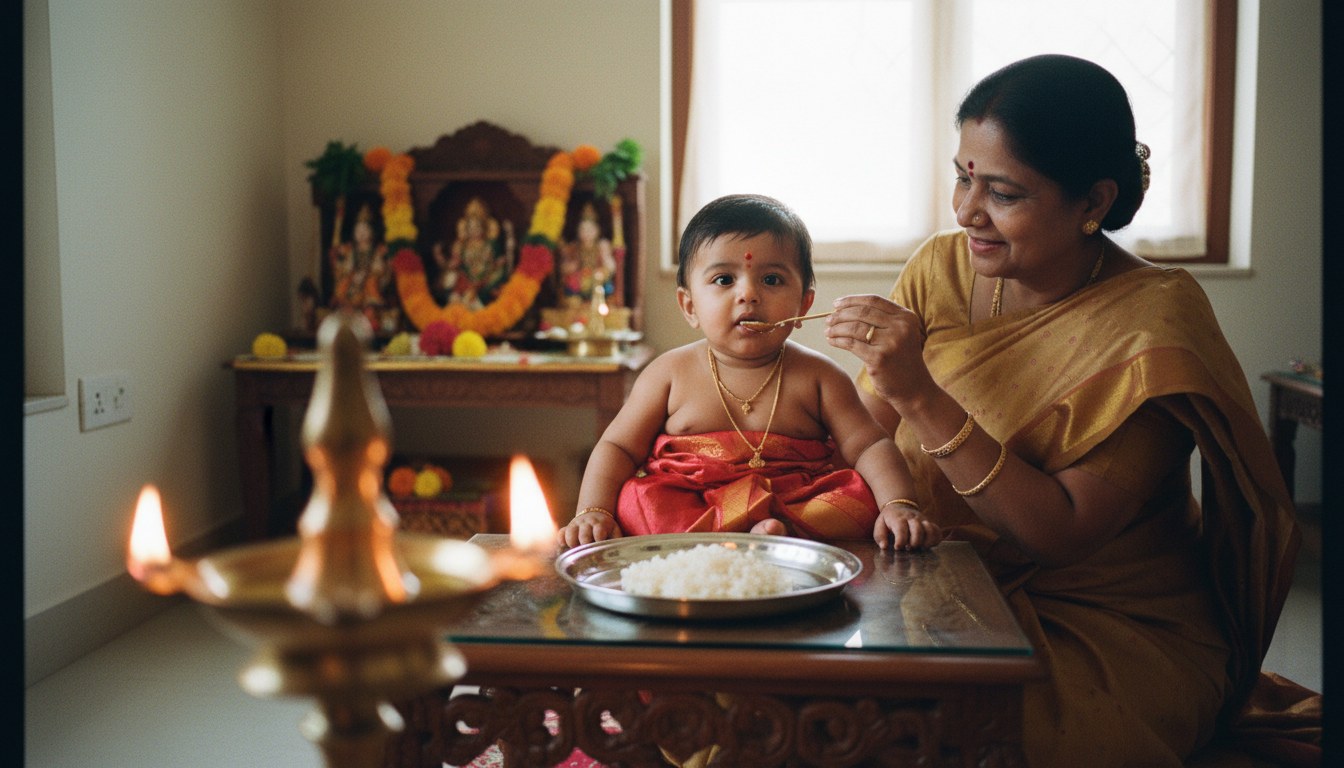
The home, or at least the room where the ceremony will take place, is cleaned and decorated. A small mandap or decorated corner is set up. The baby is bathed in the morning, dressed in new clothes — often a silk dhoti-kurta for a boy or a soft pattu langa for a girl — and adorned with light jewelry such as a gold chain or a black-beaded kaalaa teeka bracelet for protection.
2. Puja and Invocation
The family priest, or the eldest male member of the family, performs a short puja. Ganesha is invoked first to remove obstacles. Annapurna, the goddess of food and nourishment, is honored with flowers, sandalwood, incense, a lit ghee lamp, and small offerings of rice and fruit. Navagraha (the nine planets) are also saluted, especially Chandra (the moon), who is considered the presiding deity of nourishment and growth.
3. The Feeding of the First Grain
The cooked rice is prepared with ghee, a touch of honey, and a little sugar. Sometimes a few drops of cow’s ghee are added for strength, and a pinch of saffron or cardamom for fragrance. A small gold or silver spoon is preferred, as gold and silver are considered sattvic metals that bless the food without contamination.
Depending on the family tradition, the first spoonful is fed by:
- The maternal uncle (mama) — very common in North Indian and Bengali families.
- The father, in families that prefer a patrilineal blessing.
- The paternal grandfather, in some South Indian and Marathi traditions.
The chosen person whispers a simple blessing, often “May you be blessed with a long life, good health, and the strength of dharma,” before offering the first bite.
4. The “Write and Choose” Tradition
In many regions, especially in Bengal, Odisha, and parts of North India, a small and charming variation is included: a few items are placed in front of the baby — a book, a pen, a coin, a piece of jewelry, a flower, food, a small tool, or a mace. The baby is encouraged to grab one. The item the baby reaches for first is playfully taken as a sign of the child’s future inclination:
- Book or pen: a future scholar, writer, or teacher.
- Coin or jewelry: future wealth and prosperity.
- Flower: a life of beauty, devotion, or art.
- Tool or implement: a future craftsperson or engineer.
- Food: a generous, well-nourished life.
- Mace (gada): a future leader, strong and protective.
This little game has become a highlight of the ceremony and a source of much laughter and family banter.
5. Feeding of the Family and the Community
Once the baby has tasted the first rice, the rest of the prepared food is shared. In some homes, the baby is offered a small thali with rice, dal, and a sweet. In other homes, the family gathers for a larger meal together. Hospitality is a key part of the day: feeding visitors, neighbors, and the less fortunate is considered an extension of feeding the child.
6. Giving of Gifts and Dakshina
Relatives bring gifts for the baby — often a silver thali, a gold coin, new clothes, or a small bank deposit in the child’s name. The family priest is honored with dakshina (a monetary offering), fruits, and a piece of cloth. Elders are touched at the feet in respect and are given new clothes or small gifts in return for their blessings.
Regional Variations of Annaprasana Across India
India is a continent of cultures, and Annaprasana takes on different colors depending on the region. Knowing these variations can be helpful if you are planning your own ceremony and want to borrow from a tradition that feels right.
Bengal and Odisha
In Bengali and Odia families, the ceremony is called Annaprashan, Mukhe Bhaat (Bengali: মুখে ভাত, literally “rice in the mouth”), or Chaal Pranaam. The highlight is the “book, pen, and money” ritual described above, and the day often ends with a traditional Bengali feast including payesh (sweet rice pudding) as a must.
Maharashtra and the Deccan
In Marathi families, the ceremony is called Annaprashan and is most often performed in the child’s 7th or 9th month. The maternal uncle plays a key role, and a dish of batata poha or a sweet sheera is sometimes served to guests in addition to the rice offered to the baby.
Tamil Nadu, Karnataka, Andhra Pradesh, and Kerala
South Indian families often call the ceremony Choroonu (in Malayalam) or Annaprasadam. The paternal grandfather typically feeds the first rice, and a gold ring or coin is dipped in honey and ghee before being touched to the baby’s tongue as a symbol of wealth and sweet speech. The food is offered to Lord Vishnu or Ayyappan before being given to the child.
Gujarat and Rajasthan
In Gujarati and Rajasthani households, the ceremony is often held in the 7th or 9th month. A traditional sheera (sweet semolina) or a kheer of rice and jaggery is prepared. The baby is dressed in a new ghagra or dhoti and is seated on a decorated chowki (low wooden stool).
Punjab and North India
Across the wider Hindi belt, the ceremony is popularly called Muh juthi or Muh jutai (Hindi: मुँह जूठी / मुँह जुटाई, literally “tasting of the mouth”) in states like Uttar Pradesh, Bihar, Jharkhand, Madhya Pradesh, and Rajasthan. In Punjabi families specifically, it is also referred to as Mukhe da Ann — “rice for the face.” Wherever the name, the maternal uncle is usually the star of the day, often arriving with sweets, gifts, and a lot of cheer. A traditional halwa or kheer is prepared and shared with all guests.
Modern Etiquette and Practical Tips for Today’s Families
Even if you do not follow every classical step, a few practical considerations will help you plan a smooth and meaningful Annaprasana.
Pediatric Considerations
Modern pediatricians generally recommend introducing solid foods only after six months, when the baby’s gut is ready. The shastric recommendation of 6–10 months lines up well with this. If your pediatrician has any specific dietary advice for your baby, follow it: the ceremony can still be a small symbolic act, even if the actual solid food is introduced gradually afterward.
Choosing the Right Food for the First Bite
Soft, easily digestible foods are best for the first bite:
- Cooked rice moong dal kheer, lightly sweetened.
- Plain rice with a little ghee and a pinch of salt or sugar.
- Soft mashed sheera (semolina cooked with ghee and sugar).
- Ripe banana or apple puree, in modern adaptations.
Avoid spicy, salty, or processed foods at this stage. Honey should not be given to babies under one year of age in some pediatric guidelines, so check with your doctor before adding it.
Keeping the Baby Comfortable
The baby will be the center of attention, so keep a few essentials within reach: a soft burp cloth, a change of clothes, a favorite toy, and a quiet corner where the baby can nap if the ceremony runs long. Choose a time of day when the baby is usually alert and not yet due for a nap.
Photography and Memory Keeping
Annaprasana is one of the most photogenic samskaras. Many families hire a photographer or set up a small video camera. If you are the photographer, remember to capture the moment when the baby reaches for an item in the “write and choose” game — it is often the highlight of the album.
Frequently Asked Questions About Annaprasana
Is Annaprasana only for Hindus?
The ceremony is rooted in Hindu tradition, but the underlying values — welcoming a child into the community, blessing the child’s growth, and sharing a meal — are universal. Some Jain, Sikh, and Buddhist families in India also perform variations of the first-feeding ceremony, sometimes under different names but with the same spirit.
What if my baby refuses to eat on the day of the ceremony?
That is more common than you might think. Babies can be overwhelmed by the crowd, the new clothes, and the formal setting. Do not force the child. Offer a small symbolic bite; if the baby refuses, that is perfectly fine. The blessing and the family gathering are the heart of the ceremony, not the actual swallowing of the first grain.
Can Annaprasana be combined with other ceremonies?
Yes. In many families, Annaprasana is combined with Namkaran (the naming ceremony, usually done on the 11th day) if it has not been performed earlier, or with the baby’s mundan (first haircut) for logistical convenience. Combining ceremonies is a sensible modern practice; the important thing is that the rituals are performed with devotion and care, not as a hurried checklist.
What should guests bring as gifts?
Useful gifts include: a silver thali or spoon, a small gold coin, a soft new outfit in the next size up, a children’s book, a savings deposit in the baby’s name, or a thoughtful toy. Avoid toys with small parts for very young babies. Many guests also bring sweets, dry fruits, and a small envelope of cash as a token of blessing.
Is there a specific prayer or mantra for Annaprasana?
There is no single prescribed mantra, but a common invocation is a short prayer to Annapurna Devi: “Om Annapurnai Namah” or a shloka that asks for the child’s nourishment. The family priest will usually chant the appropriate mantras from the Grihya Sutras in Sanskrit during the puja, and the family can join in by simply being present, listening, and saying “Om” at the end of each chant.
Closing Thoughts on the First Rice
Annaprasana is, at its heart, a deeply human ritual. Beneath the Sanskrit names, the mantras, the gold spoons, and the elaborate puja lies a simple truth: every parent wants their child to be nourished — not just with food, but with love, with community, and with the blessings of those who came before. A spoonful of rice, given with care on a chosen morning, becomes a small but powerful prayer for that nourishment.
If you are planning an Annaprasana for your child, take a deep breath. It does not need to be perfect. It needs to be sincere. The baby will not remember the day, but you will, and so will every grandparent, uncle, and cousin who was there. Generations from now, the photograph of that first spoonful will still be doing its quiet work: reminding the family of where the child’s journey with food, with people, and with dharma truly began.
Related Articles on Sattvicgyaan
- Naamkaran: The Hindu Baby Naming Ceremony and Its Sacred Meaning
- Griha Pravesh: Hindu House Warming Ceremony — Complete Puja Guide
- Hindu Wedding Rituals Explained: A Complete Guide to the Sacred Vivaha Ceremony
- Why Do We Ring Bells in Temples? The Sacred Sound of the Ghanta
- Why Do Hindus Cremate the Dead? Hindu Funeral Rites Explained