The 4 Ashramas of Life: Brahmacharya, Grihastha, Vanaprastha, Sannyasa
In Hinduism, human life is not viewed as a single uninterrupted stretch of years. Instead, it is seen as a sacred journey divided into four distinct stages, each with its own purpose, duties, and spiritual rewards. These four stages are known as the Ashramas (आश्रम) of life. The system is one of the most elegant frameworks in Hindu philosophy for understanding how an individual can grow from a dependent child into a wise elder who prepares for liberation.
For centuries, the Ashrama system has shaped how Hindus plan education, marriage, family responsibilities, and retirement from worldly life. Although modern life rarely follows the classical pattern literally, the framework still informs Hindu thought on dharma, moksha, and the meaning of a well-lived life. This guide explains what each ashrama means, where the system comes from, and why it still matters today.
What Are the Ashramas in Hinduism?
The word ashrama (आश्रम) literally means “a place of effort” or “a place of staying near” — referring to both the stage of life and the kind of dwelling a person occupies during that stage. The four ashramas are:
- Brahmacharya (ब्रह्मचर्य) — the student stage
- Grihastha (गृहस्थ) — the householder stage
- Vanaprastha (वानप्रस्थ) — the forest-dweller / retiree stage
- Sannyasa (संन्यास) — the renunciate stage
Together, they describe a complete arc of human life: learning, contributing to society, gradual withdrawal, and final surrender to the spiritual goal. The system is sometimes called Ashrama Dharma or Chaturashrama (the four ashramas). In different regions of India, the terms take on local colour — Brahmachari and Grihasthi in the Hindi belt, Sannyasi across India, and Sannyasi/Samnyasi in classical Sanskrit texts.
The Origin of the Ashrama System
The four ashramas are first systematically described in the Dharma Shastras, particularly the Manu Smriti and the Parashara Smriti, and are explained in the Upanishads. The concept is also referenced in the Bhagavad Gita (Chapter 2, verse 31) when Krishna tells Arjuna that as a kshatriya he cannot avoid the dharma of action — every life stage has its own dharmic duty.
Classical commentators such as Medhatithi, Govindaraja, and Nilakantha elaborate the system further. The underlying idea is that each ashrama has a specific dharma — duties appropriate to that stage — and that moving through them gracefully is itself a form of yajna (inner offering).
Importantly, the ashramas were never meant to be a rigid rule for every individual. The texts themselves say that women and certain paths (such as the householder-only path followed by most people) follow slightly different progressions. In the Vaishnava tradition, for example, Grhastha is treated as the central stage around which the others revolve.
Brahmacharya: The Student Stage
Brahmacharya (ब्रह्मचर्य) is the first ashrama, traditionally spanning the years of childhood and youth up to around age 25 (though the exact span varies by text and tradition). The word combines Brahman (the supreme reality) and acharya (that which leads to it) — meaning a life that leads toward Brahman.
Duties of the Brahmachari
During Brahmacharya, the student lives with a guru (teacher), either at home or in a gurukula (traditional school), and devotes himself or herself to learning. The main duties are:
- Studying the Vedas, scriptures, and traditional subjects.
- Serving the guru and the guru’s family with humility.
- Practising celibacy (the literal meaning of brahmacharya) — conserving the vital life-force for spiritual pursuits.
- Living simply, often on alms or basic food from the guru’s household.
- Following strict discipline — early rising, bathing, prayer, and self-restraint.
The Upanayanam (sacred thread) ceremony, covered in detail in our guide to the Upanayanam / Janeu ceremony, formally marks the entry of a young person into Brahmacharya.
In modern life, the Brahmacharya spirit survives in the years of schooling and higher education, when the focus is on learning, discipline, and character-building rather than earning or family responsibilities. The values — focus, humility, and self-restraint — remain highly relevant even when the literal gurukula system is no longer the norm.
Grihastha: The Householder Stage
Grihastha (गृहस्थ) — from griha (home) and stha (one who stays) — is the stage of the householder. In traditional reckoning this begins after Brahmacharya and continues until around age 50, though again the texts allow flexibility.
The Central Ashrama
The Dharma Shastras call Grihastha the support of all the other ashramas. Without householders who produce food, raise children, and contribute to society, the student has no one to learn from, and the forest-dweller and renunciate have no one to sustain them. In our detailed guide to the four Purusharthas, we explain how the Grihastha stage is where three of the four aims of life — Dharma, Artha, and Kama — are actively pursued.
Duties of the Grihastha
- Marriage and raising a family (through the Vivaha samskara).
- Earning a livelihood through honest means (Artha) while keeping dharma as the guiding principle.
- Performing the five daily mahayajnas — offerings to the gods, ancestors, sages, guests, and all living beings.
- Supporting elders, relatives, students, and those in need.
- Fulfilling social and religious duties (samskaras for children, festivals, charity).
For most Hindus today, Grihastha is the dominant life stage. The samskaras described on sattvicgyaan.com — from Naamkaran and Annaprasana through Upanayanam and Griha Pravesh — are largely the ceremonies of the householder’s world.
Vanaprastha: The Forest-Dweller Stage
Vanaprastha (वानप्रस्थ) — from vana (forest) and prastha (setting out) — is the third ashrama, often translated as the “forest-dweller” stage. Traditionally it begins when the householder’s children are grown and self-sufficient, and the parents begin to withdraw from active worldly responsibilities.
The Transition
The classical model describes a literal move to a forest hermitage or a simpler dwelling near the home, where the couple spends more time in prayer, scripture study, and pilgrimage. In many interpretations, this is the first half of retirement — a slow handover rather than a sudden break. The husband and wife may travel to holy places, perform tapas (austerities), and guide younger members of the family.
Duties of the Vanaprastha
- Gradual detachment from material pursuits while still advising the family.
- Increased time for japa (mantra repetition), meditation, and scriptural study.
- Pilgrimages to holy tirthas and river confluences (see our piece on Kumbh Mela).
- Mentoring grandchildren and contributing wisdom without seeking to control.
- Preparing the mind for the final renunciation.
In modern terms, the Vanaprastha spirit can be seen in healthy retirement — when elders continue to guide the family, perform seva, and deepen their spiritual practice without the pressures of full-time work and primary child-rearing.
Sannyasa: The Renunciate Stage
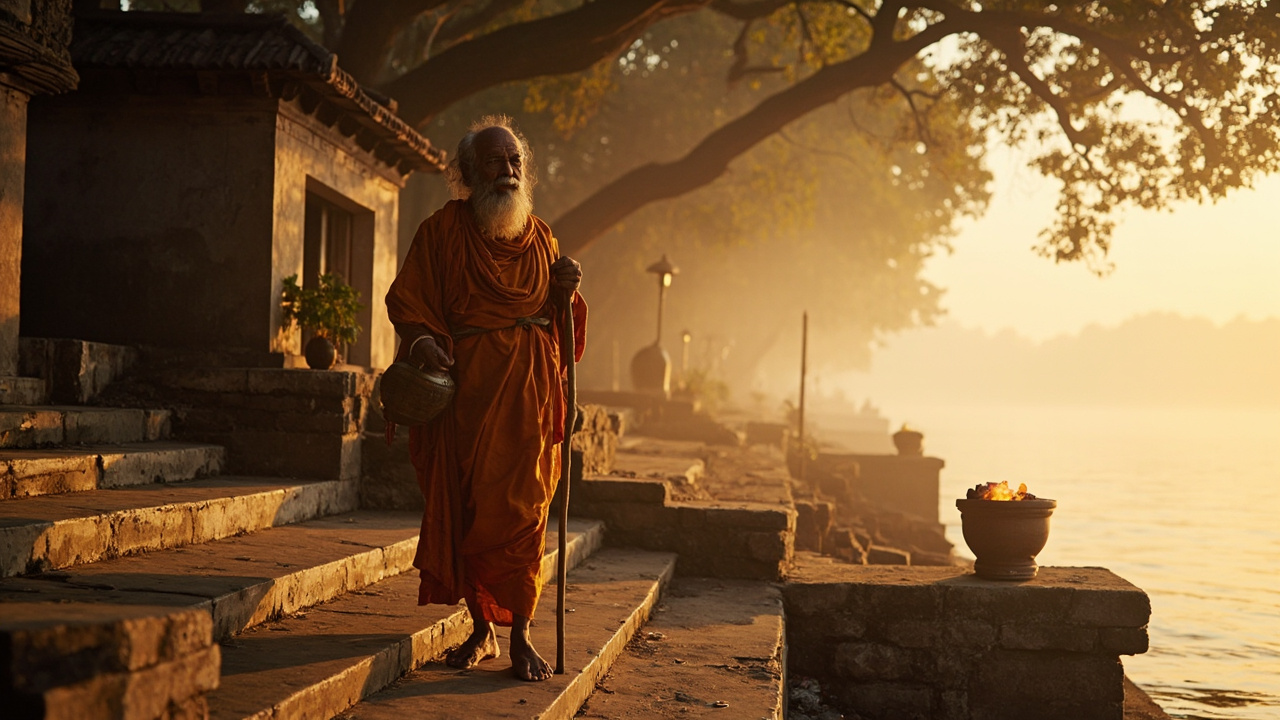
Sannyasa (संन्यास) — from sam (together) and nyasa (giving up) — is the fourth and final ashrama. The sannyasi (renunciate) gives up all attachments: home, family, possessions, identity, and even the rituals of caste and stage of life. The goal is to spend one’s remaining years — or the rest of one’s life — fully devoted to moksha, liberation from the cycle of birth and death.
What Sannyasa Involves
- Renunciation of hearth, home, and worldly duties.
- Possession only of the bare minimum — a loincloth, a water pot (kamandalu), a staff (danda), and a begging bowl.
- Dependence on alms for food, with no fixed dwelling.
- Intense meditation, japa, and study of the Upanishads and the Bhagavad Gita.
- Equality of vision — seeing the same Self (Atman) in all beings, as described in the Advaita Vedanta tradition.
In the Shaiva tradition, the sannyasi is often called a paramahamsa or jivanmukta. In the Vaishnava tradition, the equivalent is the sannyasi of the Ramanuja, Madhva, or Chaitanya lineages. The sannyasi is regarded as having no caste, no family, and no obligation except the pursuit of moksha — the same goal described in our guide to understanding Moksha.
Not for Everyone
The Dharma Shastras are careful to point out that Sannyasa is not the only legitimate path. The householder who lives a dharmic, selfless life within the world can also attain moksha — many Vaishnava acharyas teach that Grihastha itself can be a path to liberation when lived with devotion. The choice of Sannyasa is a deeply personal one, usually taken only after decades of preparation and, traditionally, with the permission of a guru.
Modern Relevance of the Ashrama System
In contemporary life, most Hindus (and indeed most people globally) cannot literally retire to a forest or renounce all possessions. But the four ashramas remain a powerful lens for thinking about life’s purpose. They encourage us to ask: Am I in the stage of learning? Am I contributing? Am I preparing to step back? Am I ready to let go?
The framework also helps in practical ways:
- Education phase (Brahmacharya) — focus on learning, discipline, character.
- Work and family phase (Grihastha) — earn, raise a family, give back.
- Mid-life transition (Vanaprastha) — gradually hand over responsibility, deepen spiritual life.
- Final phase (Sannyasa) — prepare for the end with detachment, prayer, and renunciation.
This is why many modern life-coaches, contemplative traditions, and even medical frameworks echo the ashrama pattern in their own way — recognising that humans need different rhythms at different ages.
Ashramas vs Purusharthas: Clearing the Confusion
The four ashramas are often confused with the four Purusharthas, but they answer different questions:
- The Ashramas answer “at what stage of life should I focus on what?”
- The Purusharthas answer “what are the legitimate aims of human life?”
The ashramas are stages in time; the purusharthas are goals across life. The two systems overlap beautifully: in Grihastha the first three purusharthas (Dharma, Artha, Kama) are central, while in Vanaprastha and Sannyasa, Moksha takes precedence. Knowing both helps you see how Hinduism weaves time, duty, and ultimate purpose into a single tapestry.
Conclusion
The four ashramas of Hindu life — Brahmacharya, Grihastha, Vanaprastha, and Sannyasa — form one of the oldest and most thoughtful frameworks for living a meaningful life. Whether or not one follows them literally, they offer wisdom for every age: learn deeply, give generously, withdraw gently, and let go completely when the time comes. In an age of distraction and endless striving, this ancient structure can be a quiet guide for a more intentional life.
Frequently Asked Questions
What are the 4 ashramas in Hinduism?
The four ashramas are Brahmacharya (student), Grihastha (householder), Vanaprastha (forest-dweller / retiree), and Sannyasa (renunciate). Together they describe a complete arc of human life from learning to liberation.
What is the meaning of the word “ashrama”?
The word ashrama (आश्रम) literally means “a place of effort” or “a place of staying near.” It refers to both the stage of life and the kind of dwelling a person occupies during that stage.
At what age does each ashrama begin?
Traditional texts assign approximate ages — Brahmacharya up to ~25, Grihastha from ~25 to ~50, Vanaprastha from ~50 to ~75, and Sannyasa from ~75 onwards — but the texts themselves emphasise flexibility based on the individual’s nature, family situation, and inner calling.
Is sannyasa required for moksha?
No. Most Hindu traditions teach that moksha can be attained from any ashrama. In the Vaishnava tradition especially, a householder who lives a dharmic life of devotion (bhakti) can attain liberation without taking sannyasa. The Bhagavad Gita describes multiple valid paths to the same goal.
Can a woman take sannyasa?
Yes. While the classical pattern in many texts emphasised male renunciation, women have always taken sannyasa in traditions such as the Dashanami Sampradaya founded by Adi Shankaracharya and in several Bhakti lineages. Female sannyasins are respected in their own right and follow the same outer markers of renunciation.
How are the ashramas different from the purusharthas?
The ashramas are stages of life in time; the purusharthas are the legitimate aims of human life. Ashramas describe when to focus on what; purusharthas describe what to pursue. The two frameworks complement each other and together describe the full Hindu vision of a meaningful life.
Do modern Hindus still follow the four ashramas?
Few follow the literal pattern today, but the spirit of the ashramas remains influential. Education and training in youth, work and family in middle life, gradual withdrawal in later years, and contemplative preparation at the end of life are all common patterns in modern Hindu households.
Related Articles
- The 4 Purusharthas: Dharma, Artha, Kama, Moksha — understand the four goals of life that the ashramas support.
- Upanayanam: The Hindu Sacred Thread Ceremony — the ritual that marks the entry into Brahmacharya.
- Hindu Wedding Rituals Explained — the central samskara of the Grihastha stage.
- Understanding Moksha: Liberation and Spiritual Freedom — the ultimate goal sought especially in Vanaprastha and Sannyasa.
- What is the Bhagavad Gita? — the scripture that frames action, renunciation, and the stages of life.
- Advaita vs Dvaita Vedanta — the philosophical schools that inform the teachings on Atman and Brahman central to Sannyasa.