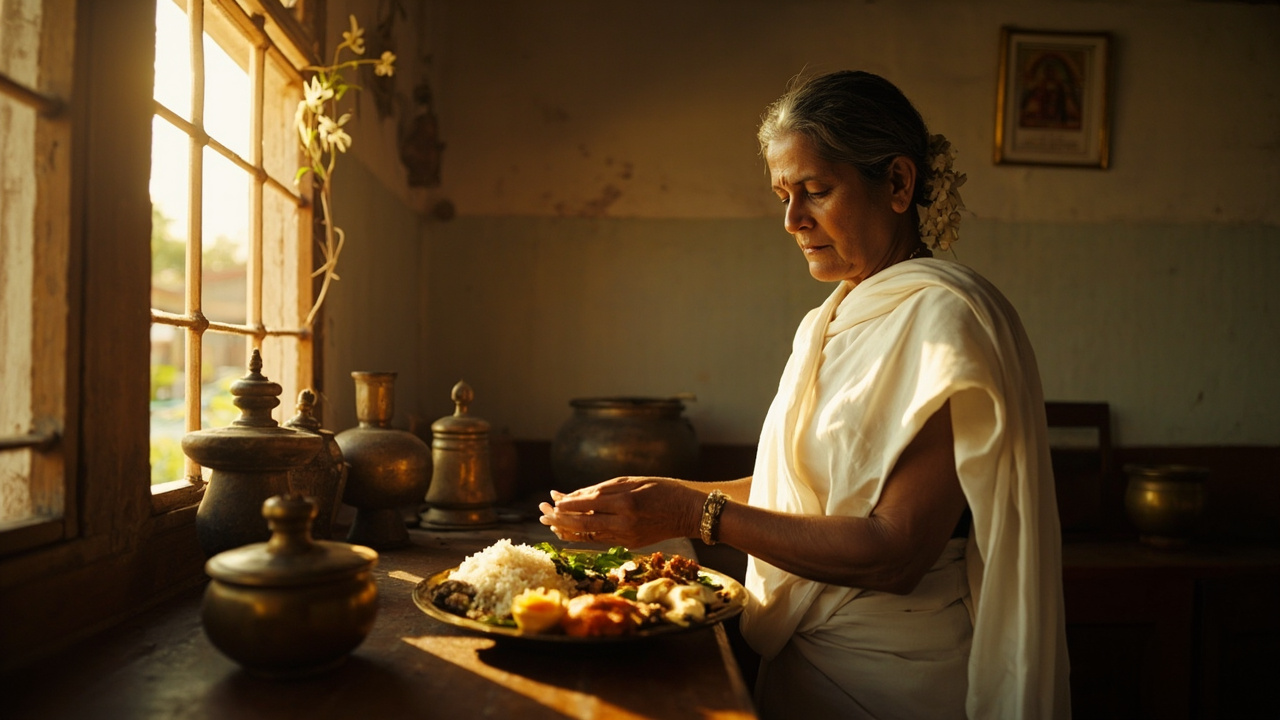
Why Do Some Hindus Avoid Onion and Garlic? Tamasic Food & the Sattvic Diet
If you have ever eaten at a South Indian Brahmin household, walked through a prasadam counter after puja at a Vishnu temple, or shared a fasting meal during Navratri, you may have noticed something missing from the plate. The idli has its sambar, the rice has its rasam, the dal has its tadka, the bhaji has its curry-leaf garnish — and yet there is no onion, no garlic, no leek, no scallion. For many Hindus, this is not a passing regional habit but a centuries-old spiritual discipline rooted in the guna philosophy of the Bhagavad Gita and the elemental theory of classical Ayurveda.
The question why do Hindus avoid onion and garlic opens a window into a much larger conversation about food, consciousness, and the body’s role in spiritual practice. This article walks through the scriptural sources, the Ayurvedic reasoning, the regional variations across India, the modern science that sometimes challenges — and sometimes confirms — the practice, and the practical differences between sattvic, rajasic, and tamasic food. By the end you will have a clear picture of what the tradition actually teaches, who follows it today, and why the avoidance is more nuanced than a simple “vegetarian plus” rule.
The Question Behind the Avoidance
It helps to begin by separating two related but distinct ideas. The first is vegetarianism, the abstention from meat, fish, and eggs. The second is sattvic eating, a stricter discipline within vegetarianism that also avoids certain plant foods — notably onion and garlic — along with alcohol, mushrooms (in some traditions), fermented foods, and stale leftovers. Many Hindus are vegetarian but eat onion and garlic without a second thought. A smaller, often more traditional subset avoids onion and garlic altogether.
So when someone asks why do Hindus avoid onion and garlic, the most accurate answer is: not all Hindus do, but a meaningful and historically important minority — especially among Brahmins, Iyengars, Iyers, Madhva Vaishnavas, Swaminarayan followers, and Jains — treat these two alliums as spiritually undesirable. The reasoning behind that treatment comes from three intertwined sources: the Bhagavad Gita’s classification of food by guna, the Ayurvedic classification of foods by their virya (heating/cooling potency) and effect on the mind, and a long tradition of monastic and ritual purity.
The Three Gunas of Food: What the Bhagavad Gita Says
Chapter 17 of the Bhagavad Gita, titled Shraddhatraya Vibhaga Yoga (The Yoga of the Threefold Faith), contains the most cited scriptural basis for Hindu food categories. Verses 8 through 10 divide foods into three types according to the gunas — the three fundamental qualities that the Samkhya philosophy says weave through all of nature.
Sattvic food — purity, clarity, lightness
The Gita (17.8) describes sattvic foods as those that promote longevity, strength, health, happiness, and joy. They are juicy, fatty, substantial, and agreeable. Classical examples include fresh milk, ghee, butter, honey, ripe fruits, sacred grains like rice and wheat, mung beans, and most freshly cooked vegetables. These foods are said to calm the mind, sharpen the intellect, and support meditation.
Rajasic food — stimulation, passion, activity
Rajasic foods (17.9) are described as bitter, sour, salty, very hot, pungent, dry, and burning. They produce pain, misery, and disease. The Gita specifically names chili heat and excessive spice. While rajasic food is not categorically forbidden — warriors, leaders, and householders may consume moderate amounts — it is considered unsuitable for those on a spiritual path.
Tamasic food — dullness, heaviness, decay
Tamasic foods (17.10) are those that are stale, tasteless, putrid, leftover, and impure. Meat, fish, fowl, alcohol, and fermented substances fall here. The key word in the verse is yuksa — unfit for sacrifice — meaning tamasic food is incompatible with yajna, puja, and any ritual offering.
Onion and garlic do not fall neatly into any single category in the Gita itself. They are mentioned indirectly through the rajasic description of pungent, heating foods (17.9). The stronger association with tamasic food — where the avoidance of onion and garlic is usually framed today — comes from later Ayurvedic and Dharmashastric texts that built on the Gita’s framework.
Why Specifically Onion and Garlic? The Scriptural Reasoning
Several classical Hindu texts directly address onion and garlic, and most scholars trace the prohibition to a combination of these sources rather than to a single verse.
The Charaka Samhita and Sushruta Samhita
The two foundational Ayurvedic texts, Charaka Samhita and Sushruta Samhita, classify onion and garlic under katu rasa (pungent taste) and assign them ushna virya (heating potency). They are described as rajasic-tamasic, exciting the passions while simultaneously dulling the intellect. Both texts recommend their use as medicine but not as daily food for the healthy or the spiritually inclined.
The Manu Smriti and Dharmashastra
The Laws of Manu (Manusmriti 5.5, 5.19) list foods that a Brahmin should avoid — garlic among them — along with onion, leeks, mushrooms, and substances that arise from impure sources. While later commentators debated the strictness, the general direction is clear: pungent, heating, and “strong-smelling” vegetables were considered unsuitable for those who wished to maintain ritual purity.
The Garuda Purana and Padma Purana
Later Puranic literature adds moral weight to the avoidance. The Garuda Purana and Padma Purana state that a person who eats garlic, onion, leeks, or mushrooms — or even food prepared in vessels that have touched them — cannot worship the deities or perform tarpanam (water-offering to ancestors) for a stipulated period. The language is strong: these foods are said to attract asuras (demons) and to repel the devas (gods). Modern Hindus who follow the avoidance often quote these verses.
The Ashtanga Hridaya and Bhava Prakasha
Ayurvedic practitioners cite the Ashtanga Hridaya of Vagbhata and the Bhava Prakasha of Bhava Mishra, which together refined the classification of onion and garlic as abhishyandi — substances that clog the channels of the body (<em>srotas</em>) and produce excessive mucous, dullness, and mental fog. The avoidance is therefore framed not as a taboo but as a clinical recommendation for clarity of body and mind.
The Ayurvedic View: Ushna Virya and the Mind
Ayurveda explains the onion-garlic avoidance in terms that go beyond simple morality. It describes food in terms of rasa (taste), virya (heating or cooling energy), vipaka (post-digestive effect), and prabhava (unique unexplained effect). Onion and garlic share four properties that classical Ayurveda considers undesirable for sattvic living.
Ushna virya — the heating potency
Both alliums are ushna, meaning they raise the body’s internal heat. In a tropical climate, excessive heat-producing foods are said to aggravate Pitta dosha and disturb the mind with irritability, anger, and restlessness. The ancient seers preferred cooling and neutral foods — coconut, cucumber, milk, ghee, mint, coriander — to maintain the equanimity needed for meditation.
Tamasic and rajasic effect on the mind
Ayurvedic texts note that onion and garlic produce a characteristic combination: the pungency stimulates (<em>rajasic</em>), while the heavy, dulling after-effect clouds the mind (<em>tamasic</em>). This dual nature makes them what one Ayurvedic commentary calls kama-uddipaka — inflamers of desire. For a renunciate or a householder pursuing brahmacharya (celibacy and self-restraint), the avoidance is practical rather than symbolic.
Raktavardhaka — blood-thickening effect
Garlic in particular is classified as raktavardhaka — something that increases blood volume and heat. While modern medicine values this for cardiovascular benefit, Ayurveda cautions against it for those whose dhatu (tissues) are already saturated or whose temperament runs hot.
Abhishyandi — channel-clogging
The abhishyandi property is the most cited Ayurvedic reason. Foods in this category are heavy, sticky, and slow to digest. They clog the body’s micro-channels (<em>srotas</em>) and produce <em>ama</em> — the toxic metabolic residue blamed for most disease. Onion and garlic are textbook examples, which is why even non-vegetarian Ayurveda followers often use them medicinally but not daily.
Who Avoids Onion and Garlic in India Today? Regional Practices
The practice is far from uniform. Geography, sectarian tradition, and family lineage all shape whether a Hindu household avoids onion and garlic.
South Indian Iyengars and Iyers
The most consistent avoidance is found among Tamil and Telugu-speaking Brahmin communities — the Smartha Iyers, the Sri Vaishnava Iyengars, the Madhva Brahmins, and the Namboothiri Brahmins of Kerala. Their kalyana samay (auspicious cooking), temple prasadam, and wedding feasts are almost entirely onion-and-garlic-free. The Telugu term pyru pindi (literally “food without onion”) describes an entire cuisine.
Gujarati Brahmins and Swaminarayan followers
Among Gujarati communities — particularly the Modh, Anavil, and Nagar Brahmins — the sattvic kitchen is the norm. The Swaminarayan sampradaya, the BAPS tradition, and the Swaminarayan temple prasadam worldwide all strictly avoid onion and garlic. The BAPS ‘Annakut’ festival, where thousands are fed daily, prepares every dish without them.
Maharashtrian, Rajasthani, and North Indian Vaishnavas
The Pushtimarg (Vallabhacharya) tradition and many Vaishnava households in Braj, Mathura, and Vrindavan keep onion-garlic-free kitchens. The Vaishnav tradition considers these foods <em>tamasic</em> and unsuitable for seva. Marathi households that follow the <em>Brahmin</em> or <em>Chitpavan</em> lineage also observe the avoidance.
Jains and some Shaiva traditions
Jains take the avoidance much further, eschewing not only onion and garlic but all root vegetables (<em>kandmul</em>) because uprooting them kills small organisms in the soil. Shaiva monasteries in parts of Tamil Nadu and Kashmir also avoid onion and garlic, treating them as <em>rajasic-tamasic</em>.
Tantric and Aghori exceptions
It is worth noting that certain Tantric and Aghori traditions actively use garlic and onion in ritual. The Mahanirvana Tantra, for example, prescribes garlic for certain protective rituals and for awakening <em>kundalini</em>. This stands as a counterpoint: not every Hindu tradition treats onion and garlic as forbidden, only those that prioritise sattvic discipline.
The Historical Roots of the Practice
The avoidance is ancient but did not appear overnight. Vedic literature — the Rigveda, Yajurveda, and Samaveda — does not explicitly forbid onion and garlic, and some Vedic rituals even prescribe garlic as a sacrificial substance. The shift toward avoidance accelerated in the post-Vedic period, particularly with the rise of:
1. The Upanishadic and Buddhist emphasis on mental clarity.
The Upanishads (c. 800-500 BCE) and the early Buddhist and Jain monastic codes (<em>Vinaya</em> and <em>Anguttara Nikaya</em>) emphasised <em>sattvic</em> living and explicitly forbade pungent root vegetables for monks. The Buddhist monastic rule against <em>kaanda</em> (bulbs and roots) directly influenced Brahminical practice.
2. The Dharmashastra codification.
From roughly 200 BCE to 400 CE, the Dharmashastras — including Manusmriti, Yajnavalkya Smriti, and Parashara Smriti — codified the avoidance into formal law for Brahmins. The prohibition also extended to those preparing food for Brahmins, creating a strong social norm.
3. The Bhakti movement’s stress on purity of heart.
The medieval Bhakti saints — Ramanuja, Madhva, Nimbarka, Vallabha, Tulsidas, Chaitanya Mahaprabhu — re-emphasised sattvic living as the foundation of devotion. Their temple kitchens and prasadam rules institutionalised the avoidance across India.
4. Colonial-period reformulation.
During the 19th and early 20th centuries, Hindu reform movements — the Arya Samaj, the Theosophical Society, and the Hindu nationalist organisations — re-articulated the avoidance as a marker of Hindu civilisational identity. The 1921 book <em>The Key of Raja Yoga</em> and the writings of Annie Besant and Swami Vivekananda popularised the sattvic onion-garlic-free kitchen across English-educated Hindus.
What Modern Science Says About Allium Foods
Modern science has a complicated relationship with the avoidance. Some studies appear to confirm parts of the classical concern; others seem to contradict it entirely.
Cardiovascular and antimicrobial benefits
Garlic (<em>Allium sativum</em>) is one of the most studied medicinal plants. Modern research confirms its cardiovascular benefits: it modestly lowers blood pressure, reduces LDL cholesterol, inhibits platelet aggregation, and contains <em>allicin</em>, a powerful antimicrobial compound. Onion (<em>Allium cepa</em>) contains <em>quercetin</em> and other flavonoids with documented anti-inflammatory effects.
Brain-fog claim revisited
The classical Ayurvedic claim that onion and garlic produce <em>ama</em> (toxic residue) and dull the mind has limited direct scientific support, though some studies note that high-allium diets can aggravate IBS and digestive sluggishness in sensitive individuals. The brain-fog effect may be partly subjective, partly dose-dependent, and partly related to individual <em>Pitta</em> constitution.
Testosterone and libido effects
The classical claim that onion and garlic stimulate desire (<em>rajasic</em>) has some indirect support: studies have found that high garlic intake can raise testosterone levels and that onion extract can improve certain parameters of male reproductive health. The Ayurvedic interpretation is not that these effects are bad in themselves but that they work against the calm needed for meditation.
The bottom line from a scientific view
Modern science does not support the sweeping spiritual claims but does suggest that very high allium intake can disrupt digestion and aggravate inflammation in susceptible people. From a scientific standpoint, daily consumption is not harmful and may even be beneficial. From a classical Hindu standpoint, the avoidance is less about bodily health and more about the quality of consciousness one wishes to cultivate.
Cooking Without Onion and Garlic: A Practical Guide
For readers who want to try the sattvic onion-garlic-free kitchen, the transition is easier than it sounds. Most Indian regional cuisines already have an onion-garlic-free tradition: the South Indian sambar, rasam, poriyal, and kootu; the Gujarati undhiyu, handvo, and dhokla; the Maharashtrian bhaji and pithla; the Rajasthani dal-baati-churma and gatte ki sabzi; the Bengali shukto (without the usual onion); and the temple prasadam across India.
Flavour builders that replace onion-garlic
The five traditional substitutes that create depth of flavour without the alliums are:
1. Asafoetida (<em>hing</em>).
A tiny pinch bloomed in hot ghee stands in for both onion and garlic in lentil dishes. It is the single most important sattvic substitute.
2. Ginger.
Fresh ginger paste, sauteed at the start of a dish, provides the pungent backbone.
3. Curry leaves.
Tempered in ghee or oil, they add aroma and digestive warmth.
4. Cumin, mustard seeds, and fenugreek.
The South Indian tempering (<em>tadka</em>) of cumin, black mustard, urad dal, dried red chilli, and curry leaves builds layered flavour without alliums.
5. Coconut.
Fresh grated coconut, coconut milk, or coconut paste adds body and sweetness that compensates for the missing onion.
A sample sattvic weekday menu
A traditional sattvic plate might include steamed white rice, a sambar made with pigeon peas and mixed vegetables (no onion, no garlic), a rasam with pepper and cumin, a poriyal of carrot and beans tempered with mustard and curry leaves, fresh thayir (yoghurt), a pickle of mango or lime, and a small portion of fresh fruit. The meal is light, varied, and deeply flavoured — proof that the absence of onion and garlic costs nothing in taste.
Frequently Asked Questions
Are all Hindus vegetarian and onion-garlic-free?
No. Most Hindus are vegetarian by tradition, but a meaningful minority — particularly in Bengal, Goa, parts of Kerala, and the Himalayan belt — eat fish, mutton, or chicken. Even among vegetarian Hindus, many eat onion and garlic without reservation. The onion-garlic-free sattvic kitchen is a stricter subset, strongest among Brahmin communities, Vaishnavas, and Jains.
Does the Bhagavad Gita explicitly forbid onion and garlic?
Not by name. Chapter 17, verses 8-10 classify food into sattvic, rajasic, and tamasic categories and describe pungent, heating foods as rajasic. The application of this to onion and garlic specifically comes from later Ayurvedic and Dharmashastric texts, not from the Gita itself.
Is onion-garlic-free cooking healthier?
For most healthy people, the health difference is small. Modern research finds cardiovascular and antimicrobial benefits in both alliums. The sattvic case rests primarily on the mind-body-spirit framework of Ayurveda and the gunas philosophy, not on direct clinical superiority.
Can I eat onion and garlic and still call myself a good Hindu?
Yes. Hinduism does not have a single dietary code enforced by any central authority. The avoidance of onion and garlic is a recommendation for those pursuing sattvic spiritual disciplines, not a test of Hindu identity. Householders in particular have wide latitude in choosing their food.
Why do Jains avoid all root vegetables?
Jains follow the principle of ahimsa (non-violence) so strictly that they avoid uprooting root vegetables, because the act of pulling them from the soil is believed to kill small organisms and microorganisms living among the roots. This extends well beyond onion and garlic to include potato, carrot, beetroot, and ginger (though dried ginger is usually accepted).
Does onion and garlic avoidance apply during fasting?
Yes, even more strictly. During Ekadashi, Navratri, Mahashivratri, Janmashtami, and other vrats, even households that normally eat onion and garlic usually drop them. The same applies to temple prasadam and to food prepared for any ritual offering.
Is the practice the same in all Vaishnava traditions?
Most Vaishnava traditions — Sri Vaishnava, Madhva, Pushtimarg, Gaudiya, Swaminarayan — follow the sattvic avoidance strictly. Some regional variations exist, but onion and garlic are generally absent from temple kitchens and prasadam.
Related Articles on Sattvicgyaan
- Why Do Hindus Fast? Meaning of Vrat, Ekadashi & Navratri
- Do Hindus Eat Meat? Understanding Hindu Dietary Practices
- Ayurveda — The Ancient Hindu Medical Science
- Why Don’t Hindus Eat Beef? The Scriptural and Cultural Roots
- The Four Purusharthas: Dharma, Artha, Kama, Moksha
- The Main Scriptures of Hinduism Explained