Why Do Hindu Brides Wear Red? Haldi & Mehendi Significance
Few images are as instantly recognisable as a Hindu bride in deep red — hands painted with mehendi, face glowing from the haldi ceremony, draped in a bridal lehenga the colour of new vermilion. Yet the choice of red, the turmeric ritual that prefaces it, and the elaborate henna that adorns the bride’s hands are not arbitrary. They form a coherent spiritual language that stretches back to the Vedas, the Puranas, and the lived wisdom of generations of married women whose symbols of wedded life — sindoor, mangalsutra, red bangles — share the same root colour.
This guide unpacks each of these threads. We will look at what red actually means in Hindu cosmology, why brides specifically wear it, the deep history behind the bridal red tradition, and the two pre-wedding ceremonies — Haldi and Mehendi — that prepare the bride for the day she steps into a new life.
The Symbolic Meaning of Red in Hinduism
In the Hindu visual vocabulary, very few colours carry the weight of red (called rakta or lohita in Sanskrit). It is the colour of Shakti — the primordial creative energy of the Goddess — and the colour of Agni, the sacred fire that carries offerings to the gods and that sits at the heart of every Hindu wedding (the vivaha homa). Red is also the colour most associated with auspiciousness, a quality the Sanskrit tradition calls mangala. Where white often signals mourning or renunciation in Hindu ritual, red signals fertility, life-force, married status, and the willingness to step into a new role.
The Devi Mahatmya, one of the great Sanskrit texts celebrating the Goddess, repeatedly describes her as clothed in red, seated on a red lotus, and adorned with red garlands. The Lalita Sahasranama, a hymn of one thousand names of the Goddess Tripura Sundari, opens by describing her as resting on a red seat and clothed in red. So when a bride wears red, she is, on one symbolic level, situating herself within that same stream of life-giving power.
Red is also the colour of sumangali — women whose husbands are alive and with whom married life is considered auspicious. The bindi, the sindoor in the parting of the hair, the red threads tied during sacred ceremonies, the vermilion used in puja — all draw from this same palette.
Why Brides Specifically Wear Red on the Wedding Day
If red is auspicious in general, the bridal red carries extra weight. Three distinct threads come together on the wedding day.
First, red signals the bride as a willing vessel for new life. Hindu marriage is a samskara — a sacrament that begins the grihastha (householder) phase of life, the second of the four ashramas. Red is associated with fertility, with the menstrual cycle, with the womb. By clothing herself in red, the bride symbolically announces that she is opening her life to the bearing and nurturing of children.
Second, red connects the bride to the Goddess and to the Goddess Lakshmi in particular. Lakshmi — the goddess of prosperity, household wellbeing, and a peaceful married home — is almost always depicted in red or in deep crimson saris. A bride who wears red on her wedding day is invoking Lakshmi’s presence in the home she is about to enter.
Third, red is the colour of the fire witness. The Hindu wedding is solemnised before the vivaha Agni, the sacred fire. The fire itself glows red and orange, and the bride walks around it seven times in the saptapadi, sometimes wearing a red saree or lehenga. The marriage is, literally, performed in her wearing the colour of the witness.
A Brief History of the Red Bridal Tradition
Red as the bridal colour has very old roots. The Rigveda, the oldest Vedic text, contains hymns for the wedding ceremony in which the bride is described as robed in red and adorned with red ornaments. The Ashtadhyayi of Panini, the fourth-century-BCE Sanskrit grammarian, uses the word arunavivahah, literally “red wedding,” to describe the standard nuptial colour. The Garuda Purana and the Brahma Vaivarta Purana both mention red bridal garments as a marker of the wife’s transition into her new household.
The continuity of this tradition is one of its most striking features. Whether you look at a fifth-century Gupta sculpture of a bride or a present-day South Indian wedding, red remains the colour of choice for the bridal centrepiece. Over the centuries, regional preferences have added variation — Bengali brides favour red-and-white, Maharashtrian brides traditionally wear a green saree with a red border (the nauvari or lugda), Kashmiri Pandit brides wear deep maroon — but red still anchors the palette.
This continuity reflects how seriously the colour symbolism is taken. Red is not picked because it flatters the complexion — though it does — but because it encodes centuries of spiritual meaning.
What is the Haldi Ceremony?
The day before (or a few days before) the wedding, the bride is led through the Haldi ceremony, called Pithi (પીઠી) in Gujarati, Ubtan in Punjabi, and Gaye Holud (গায়ে হলুদ) in Bengali — all literally meaning “the application of turmeric.” Family members, especially the bride’s maternal uncle (mama) and aunts, gather at the bride’s home. They sit the bride on a small stool or decorated patla, smear her face, arms, feet, and legs with a paste of fresh turmeric, sandalwood, chickpea flour (besan), and rose water, and sing joyful songs. Sometimes rose petals and marigold flowers are tossed over her. The bride is not expected to dress in heavy bridal wear at this stage — a simple yellow or white cotton outfit suffices, because the paste is going to stain anything she wears anyway.
The Haldi ceremony is loud, messy, full of teasing, and emotionally charged. It is also one of the most photogenic rituals of an Indian wedding.
The Spiritual and Health Significance of Haldi
The Haldi paste is not cosmetic alone. Turmeric in Sanskrit is haridra — a plant associated with prosperity, purification, and protection. It is mentioned in the Ayurveda as a varnya (complexion-improving), shothahara (anti-inflammatory), and vishaghna (detoxifying) herb. Applying it to the bride before the wedding is meant to:
1. Bless the bride with the golden glow of auspiciousness
Turmeric is the colour of the goddess. A bride who glows with haldi carries that glow into her married life.
2. Cool the body and ease pre-wedding nerves
Marriages are stressful events. The Haldi paste is traditionally applied early in the morning, with family members massaging the bride’s arms and feet to help her relax.
3. Ward off the evil eye and negative energies
Turmeric is widely used in Hindu home protection rituals. Coating the bride with it before the wedding symbolically shields her from misfortune.
4. Improve the skin before the bridal glow is captured
Many brides will tell you, honestly, that their skin has never looked better than the morning after Haldi. There is a real Ayurvedic reason for that.
What is the Mehendi Ceremony?
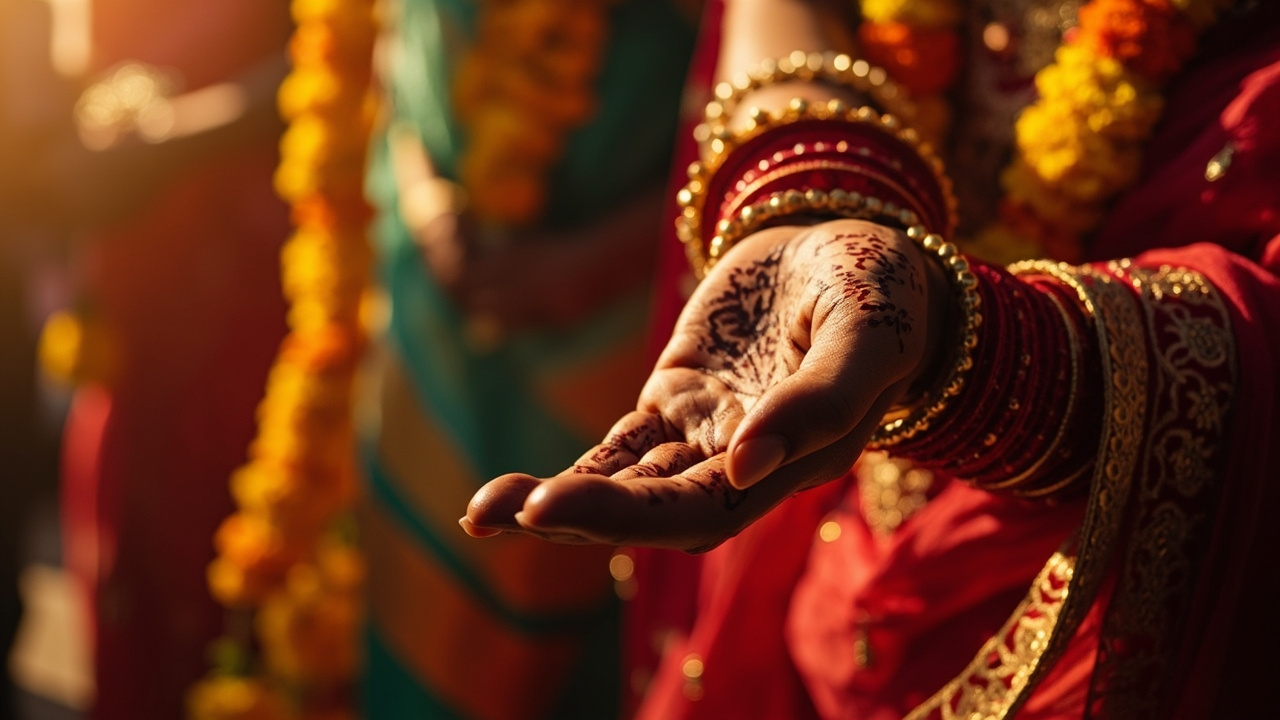
The Mehendi ceremony (also written Mehndi, called Alata in Odia, Myrtle in some South Indian traditions) is the evening of intricate henna art, song, and dance that usually follows the Haldi ceremony. The bride sits on a decorated chair or chowki, surrounded by her female family and friends, while a mehendi artist applies fresh henna paste in elaborate patterns on her palms, the tops of her hands, her fingers, the back of her wrists, her feet, and sometimes her forearms.
The henna paste is made from the crushed leaves of the Lawsonia inermis plant, mixed with water, lemon juice, and essential oils. It is applied from a small cone, left to dry for several hours, and then scraped off to reveal a deep reddish-brown stain that darkens over the next 24 to 48 hours. Good mehendi is judged by how dark and even the final stain is, and by the intricacy of the pattern.
The bride’s hands and feet cannot do anything practical for several hours — they are essentially immobilised by the drying henna. This is the source of much light-hearted teasing: the bride cannot use the bathroom on her own, she cannot eat with her hands, and her sister or cousin will usually help her with everything.
The Symbolism Behind Mehendi Designs
The patterns applied in mehendi are not purely decorative. They carry meanings that go back centuries.
Hidden initials of the groom’s name. A traditional game during the mehendi ceremony is for the artist to hide the groom’s name or initials somewhere in the bride’s pattern, and the groom has to find them on the wedding night. Some grooms never do.
The deeper the colour, the stronger the love. There is a beloved folk saying — “Haldi ki guni, Mehendi ki ghani, dulhan ki puri, pati ki puri” — that links deeper henna stains, the bride’s patience during application, and the love her husband will have for her.
Symbols of fertility, prosperity, and protection. Most bridal mehendi patterns include peacocks (for beauty and love), lotuses (for purity and spiritual blossoming), mango motifs (for fertility), paisleys (for abundance), elephants (for wisdom and longevity), and the groom’s name hidden in the pattern.
The cooling of the body. Ayurvedic tradition holds that henna cools the body’s internal temperature. In the days before the wedding, when the bride is undergoing enormous emotional and physical exertion, the cool touch of the henna is meant to keep her balanced.
Regional Variations in Bridal Red and Haldi–Mehendi
India is not one tradition — it is many. Across the country, the Haldi–Mehendi–Red bridal sequence is performed with regional variation.
North India (Punjab, Haryana, Delhi)
The Punjabi Gaye Holud is famous for its music, dance, and the bride’s yellow outfit smeared with haldi. The mehendi often features the heaviest patterns, with the groom’s name hidden in the design. The wedding day itself is dominated by red, often in a heavily embroidered lehenga.
West Bengal and Assam
Bengali brides traditionally wear a red-and-white Banarasi saree with a heavy red border — the iconic combination that you see in any Bengali wedding. The haldi ceremony is called Gaye Holud, and the bride is fed sweets and smeared with turmeric by family members. The Alata ceremony is the application of red liquid alum to the feet.
Maharashtra and Gujarat
Maharashtrian brides wear the nauvari or lugda, often green with a red border, but the kunku (sindoor) and the bridal ornaments are predominantly red. The Haldi is the Pithi ceremony in Gujarati.
South India (Tamil Nadu, Karnataka, Kerala, Andhra Pradesh)
South Indian brides more often wear a Kanjeevaram silk saree in bright red, deep maroon, or sometimes mustard-yellow for the wedding. The Haldi and Mehendi ceremonies are simpler than in the North, but the bride’s hands and feet are still painted with henna. In Tamil, the henna ceremony is Kalavaanam; in Malayalam, it is simply Mehendi.
Rajasthan
Rajasthani bridal wear is famously red — heavy ghagras with gold gota work, multiple necklaces, nath (nose ring), and dense sindoor. The Haldi is intimate, often just the women of the family.
These are only a few regional variants. Within each region, caste, community, and family custom add further nuance. The deep underlying theme — red, haldi, henna, sindoor, marriage — remains constant.
Frequently Asked Questions
Why do Hindu brides specifically wear red and not white?
In Hindu symbolism, white is the colour of renunciation, widowhood, or — in some South Indian and monastic contexts — purity and detachment from worldly life. Red is the colour of life-force, marriage, fertility, and the Goddess. The two colours carry opposite meanings, so a bride in white would send the wrong signal on her wedding day.
Are there Hindu brides who wear colours other than red?
Yes. Modern brides increasingly choose other colours — gold, pink, maroon, sometimes even pastels — but red remains by far the most common. In many communities, the bride is expected to wear red for at least one ritual of the wedding even if she changes into another colour for the main ceremony.
What is the paste applied during the Haldi ceremony?
It is a paste of fresh turmeric rhizome (often ground at home the morning of the ceremony), chickpea flour (besan), sandalwood, milk or curd, and rose water. It is meant to soften the skin, give the bride a glow, and ward off the evil eye.
How long does bridal mehendi take to apply?
A full bridal mehendi, covering the palms, the tops of the hands, the fingers, the wrists, the feet, and sometimes the forearms, takes between three and seven hours when done by a skilled artist. The paste is then left to dry for another two to four hours before being scraped off.
Is the mehendi ceremony religious or social?
Both. It is not mentioned in the Vedas as a mandatory ritual, but it is deeply traditional across North India, Pakistan, Bangladesh, and the diaspora. Its roots include beauty rituals, the symbolism of henna as a cooling and protective substance, and the social joy of gathering the women of the family before the wedding.
Why is the groom’s name hidden in the mehendi pattern?
This is a folk tradition rather than a scriptural one. The bride’s family hides the groom’s name in the pattern, and the groom is supposed to find it on the wedding night. It is a playful way to begin married life with some fun and a small test of patience.
Do all Hindu communities do both Haldi and Mehendi?
Most do, but the names and emphases differ. South Indian weddings place more weight on the temple visit and the tying of the mangalsutra than on a Haldi ceremony. Bengalis have a separate Alata ceremony alongside their henna ceremony. Even where a community does not formally call it “Haldi,” the turmeric ritual before the wedding is nearly universal.
Related Articles
- Hindu Wedding Rituals Explained: A Complete Guide to the Sacred Vivaha Ceremony
- Why Do Married Women Wear Mangalsutra? Sacred Meaning, History & Regional Names
- Sindoor and Chooda: Meaning, Significance & Regional Traditions in Hinduism
- What is the Significance of Bindi and Tilak on the Forehead?
- Why Do Hindus Fast? Meaning of Vrat, Ekadashi, Navratri & Other Hindu Fasts
- What is Ayurveda? The Ancient Hindu Medical Science