Why Does Krishna Wear a Peacock Feather? Hindu Symbolism Explained
Few images in Hindu iconography are as instantly recognisable as Lord Krishna’s peacock feather (मोर पंख, Mor Pankh) — the slender quill with its iridescent blue-green eye rising gently from His crown. Devotees in Vrindavan, Varanasi, Mumbai and Madurai all paint, sculpt and worship Krishna with this single feather as a defining ornament. Yet most people who see it never ask the deeper question: why a peacock feather, and not gold, jewels or another bird’s plume? In this guide we trace the mythology, scripture, philosophy and regional names behind Krishna’s peacock feather, and explain why it remains the most beloved symbol in Vaishnava worship today.
1. What Is the Peacock Feather in Krishna’s Iconography?
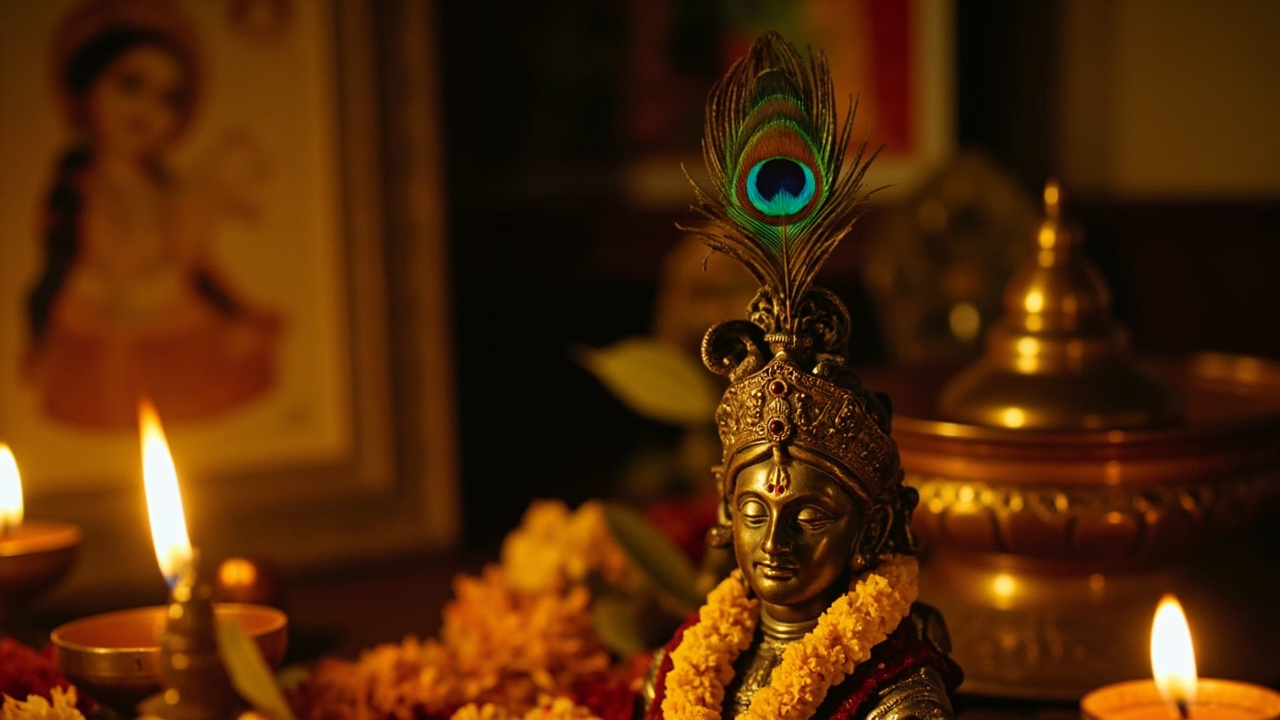
The peacock feather (Mayura Pankha or Mor Pankh) is one of the standard ornaments of Lord Krishna’s divine form, alongside the pitambara (yellow silk garment), the vaijayanti mala (forest-flower garland), the murli (bamboo flute) and the makara kundala (crocodile-shaped earrings). In almost every traditional murti — whether carved in dark granite from South India, cast in bell-metal in Bengal, or painted in Nathdwara style in Rajasthan — Krishna wears a single tall peacock feather rising from the centre of His crown, tilted slightly to His right.
The feather is recognisable for three features: its slender shaft (the rachis), its soft barbs in coppery-gold, and the unmistakable “eye” at its tip — a vivid blue-green ocellus ringed with bronze and indigo that seems to catch light from many directions. This eye is the symbolic centre of the feather and the centre of its meaning, as we will see in section 3.
2. The Mythological Origin: Why Krishna Picked Up the Feather
Several Puranic stories explain how Krishna came to wear the peacock feather. The most widely recited comes from the Bhagavata Purana (Skanda 10, Adhyaya 21 — the Rasa Lila chapter) and from local Braj traditions preserved in the Prem Sagar and Braj Vilasa.
One day in Vrindavan, Krishna was dancing the Rasa Lila with the Gopis when the peacock of the forest — a proud bird with a magnificent tail — began to strut and display its feathers. Impressed by this dance, Krishna took a single fallen feather from the ground and placed it in His own crown. He then continued the Rasa Lila, declaring that no ornament in the three worlds compared to this feather, because it had been offered by a creature wholly absorbed in love of God.
Another tradition, told in the Garga Samhita, adds that the gopis teased Krishna for having only a plain crown. While they laughed, a peacock passed overhead and a single feather drifted down. Krishna caught it, placed it in His hair, and the gopis immediately fell silent — they realised that no gem they could offer could equal this natural, unstaged gift of the forest.
Yet another telling — popular in Tamil and Telugu Vaishnava temples — recounts that the peacock had earlier been cursed by a sage to be reborn with proud plumage, and Krishna’s acceptance of its feather was the act that freed the bird from that curse. In every version, the meaning is the same: the peacock feather is a gift of nature, accepted humbly, and not an ornament of royal vanity.
3. Symbolism of the Peacock Feather (Mayura Pankha)
Traditional commentators list six principal layers of meaning in the peacock feather worn by Krishna. Each layer speaks to a different devotee, so the symbol works for beginners and scholars alike.
3.1 The “Eye” of Discrimination. The feather’s blue-green eye represents the eye of wisdom — the discerning vision (viveka) that sees through illusion (maya) to the truth of the Self. Just as the eye-spot is neither the feather itself nor its colour, so the wise devotee sees the world without being deceived by its surface. This is the most frequently quoted meaning in Advaita commentaries on the Bhagavata Purana.
3.2 Sweetness over Pride. The peacock is famously proud (ahankara) — it dances to display its own beauty. Krishna, by wearing the feather of such a proud bird, demonstrates that He accepts and sanctifies even prideful devotion. The lesson for devotees: God accepts the prayer of an ordinary person even if it is mixed with ego, vanity or worldly motive, and transforms it into pure love.
3.3 Union of Opposites. Krishna’s complexion is dark blue (shyama varna); the peacock feather is iridescent green-blue with bronze; together they show that Krishna contains within Himself the union of sky and forest, infinity and intimacy. This is a recurring theme in the Gita Govinda of Jayadeva, where Radha’s eyes are described as carrying the same colour as Krishna’s peacock feather.
3.4 Subjugation of the Ego. Just as Lord Shiva sits on a tiger skin and Lord Ganesha rides a mouse, Krishna wears a peacock feather that once belonged to a vain bird. The wearer tames the wearer-of-the-feather: pride, when offered to God, becomes humility.
3.5 Beauty without Cruelty. The peacock feather is obtained without harming the bird — the peacock sheds its feathers naturally every year after the mating season. Krishna’s ornament is therefore cruelty-free (ahimsa-friendly), in keeping with his teaching in the Bhagavad Gita that a wise person is “friendly and compassionate to all beings” (BG 12.13).
3.6 The Lotus of the Heart. In yoga and tantra iconography, the peacock feather is sometimes linked to the Anahata (heart) chakra. Devotees who meditate on Krishna’s image visualise the peacock feather at the crown of their inner form, opening the heart to divine love.
4. Scriptural References to Krishna’s Peacock Feather
While the peacock feather is most prominent in the Bhagavata Purana and later devotional literature, the earliest reference is found in the Harivamsha (an appendix to the Mahabharata), which describes Krishna’s ornaments as a forest-flower garland and a single peacock feather in His hair.
Later, the Brahma Vaivarta Purana (Krishna Janma Khanda, Chapter 18) elaborates: when Krishna appeared to His mother Yashoda, He was already adorned with the pitambara, the vaijayanti mala, the makara kundala and a peacock feather. The text emphasises that these were not added by anyone — they were intrinsic to His divine form (svabhavika alankara).
The Padma Purana (Uttara Khanda) contains a passage in which the gopis of Vrindavan describe Krishna as “piccha-mandita-murdaja” — “He whose crown is adorned with the peacock feather (piccha).” This compound appears repeatedly in Sanskrit devotional poetry (stotra) on Krishna.
Modern commentators such as Swami Sivananda and A.C. Bhaktivedanta Swami Prabhupada (in the Bhagavata Purana commentaries of ISKCON) have all written at length on the symbolism of the peacock feather as a defining Vaishnava mark (lakshana).
5. The Peacock and Krishna: Spiritual Lessons
The relationship between Krishna and the peacock also carries a moral teaching. The peacock is sometimes compared to a person who performs great austerities (tapas) yet remains proud of those very austerities — its beautiful tail is both its tapas and its vanity. Krishna, by wearing that feather, shows that He accepts even the prideful penitent and uses their pride as an ornament of devotion.
In Tamil Vaishnavism, this teaching is summarised in the line: “Picchai irukka pizhai illai” — meaning roughly, “If Krishna has accepted it, the blemish is gone.” This idea appears in the hymns of the Alvar saints, particularly Nammalvar and Andal.
For the devotee, the practical lesson is this: even a prayer mixed with ego, even a japa that wanders, even an aarti performed with impure motive — when offered to Krishna, is accepted. The peacock feather is the visible proof that God accepts imperfect love.
6. Mor Pankh in Hindu Rituals and Worship
The peacock feather is not only on Krishna’s crown — it is also used in domestic worship. Devotees keep a single Mor Pankh on the puja shelf near the Krishna murti; some place it in the thali during Janmashtami abhishekam; others fan the murti gently with a chamara (yaks-tail fan) and a peacock-feather fan (piccha-vyajana) during morning aarti.
In Vrindavan and Nathdwara, the traditional piccha-vyajana is used by the temple pujari when offering bhoga shringar — Krishna is dressed, garlanded and then gently fanned with the peacock-feather fan before the curtain is drawn. The peacock feather is also an essential item in the Janmashtami cradle ceremony (jhulan utsav): a single feather is placed at the head of the cradle.
In many Indian homes — particularly in Gujarat, Rajasthan, Maharashtra and Tamil Nadu — a framed peacock feather is hung on the eastern wall of the puja room, often alongside a picture of Krishna. Some households place the Mor Pankh in a small silver casket (Mor Pankh ki Katori) and offer it daily bhanga (til) and dhoop.
7. Regional Names and Cultural Variations
The peacock feather is called by different names across India’s languages and traditions. Knowing these variants helps devotees recognise Krishna iconography in temples from Kashi to Madurai.
- Sanskrit: Mayura Pankha (मयूरपक्ष), Piccha (पिच्छ), Piccha-vyajana (the fan), Sikhi-piccha
- Hindi: Mor Pankh (मोर पंख) or Mor Pankhi
- Bengali: Mor Pankha (মোর পাখা) — used in the Mangalchandi Mangalkavya and Vaishnava padavali kirtan
- Tamil: Mayil Parai (மயில் பரை) — common in the Divya Prabandham of the Alvars
- Telugu: Nemali Penu (నెమలి పెను), Piccha
- Kannada: Navilu Parige (ನವಿಲು ಪರಿಗೆ)
- Malayalam: Mayil Parayum Kuruthu
- Marathi: Mor Pankh (मोर पंख), Piccha-vyajana in temples
- Gujarati: Mor Pankh (મોર પાંખ)
- Punjabi: Mor Pankh (ਮੋਰ ਪੰਖ)
- Odia: Mayura Pankha (ମଯୂର ପଙ୍ଖ)
In temple lexicon, the peacock-feather fan is called piccha-vyajana in Sanskrit and picchi or piccha pankhawala in Hindi. The single feather worn in the crown is simply piccha or sikhi-piccha.
8. Peacock Feather in Hindu Art and Iconography
In Shilpa Shastra (the canonical texts on Hindu sculpture and painting), the peacock feather is part of the standard alankara of Lord Krishna’s murti-shilpa. The texts prescribe the feather as being slightly taller than the crown, tilted at a five-degree angle to the right, with the eye-spot visible from the front. Fresco painters in Nathdwara, Mysore, Puri and Thanjavur follow the same rule.
In Tanjore (Thanjavur) painting, the peacock feather is rendered with gold leaf and semi-precious stones; the eye-spot is often picked out in lapis or turquoise. In Pichwai painting of Nathdwara, the feather appears as a stylised teardrop filled with dotted work in green and indigo. In pattachitra of Odisha and Bengal, the feather is drawn with delicate cross-hatching to suggest its barbs.
The peacock feather has also entered modern Vaishnava iconography — ISKCON murtis in Mayapur, Vrindavan and around the world almost universally feature one prominent feather; the sankalpa of the murti always includes “piccha-dhari” (“He who holds/wears the feather”) among Krishna’s names.
9. Misconceptions About Krishna’s Peacock Feather
A few misconceptions are worth correcting for seekers.
“It’s just decoration.” While the feather is undeniably beautiful, it is not arbitrary decoration. Shilpa texts and Purana commentaries uniformly ascribe symbolic meaning to it. To reduce it to mere ornament is to miss the iconographic language that the acharyas (teachers) encoded in every detail of Krishna’s form.
“It means Krishna was vain.” The opposite is true. Krishna wears the feather of a bird known for pride to teach that God accepts imperfect devotion. The feather represents humility-through-acceptance, not vanity.
“Only Vaishnavas should keep the feather.” Many Shaiva and Shakta households also keep the Mor Pankh in their puja room as a sacred object of beauty and as a general symbol of auspiciousness. The peacock is also the vahana (vehicle) of Lord Kartikeya (Murugan/Skanda), so the feather is honoured across Hindu traditions.
“You should pluck the feather from a peacock.” Never. The feather should only be collected after the peacock has shed it naturally — usually after the rains. Buying Mor Pankh from shops that source from ethical suppliers is the standard practice. Tying a peacock or trapping one for its feather is a serious offence against ahimsa.
10. Conclusion: A Feather That Teaches Devotion
Krishna’s peacock feather is a small ornament that carries a vast teaching. It speaks of the eye of wisdom, of pride offered and sanctified, of cruelty-free beauty, of the union of sky and forest, of imperfect love that God still accepts. From the Sanskrit commentaries of the acharyas to the Bhajan mandalis of Vrindavan and the puja shelves of modern Indian homes, the Mor Pankh (मोर पंख) remains one of the most loved symbols in Sanatana Dharma.
Next time you stand before a Krishna murti — in a temple, on a calendar, in a song or in your own heart — pause for a moment at the single feather in His crown. It is not an accessory. It is a quiet sermon, written by the Lord Himself, in the language of birds and forests and light.
Frequently Asked Questions
1. Is the peacock feather sacred in Hinduism?
Yes. The peacock feather (Mor Pankh / Mayura Pankha) is considered sacred across Hindu traditions. It is most strongly associated with Lord Krishna, who wears it in His crown, and is also venerated as the symbol of Lord Kartikeya (Murugan), whose vahana is a peacock.
2. What does the peacock feather (Mor Pankh) symbolise in Krishna worship?
The peacock feather symbolises the eye of wisdom (viveka) that sees through illusion, the acceptance of prideful devotion, the union of opposites (dark and iridescent), the subjugation of ego, beauty without cruelty (the feather is naturally shed), and the awakening of the heart centre.
3. Can we keep a peacock feather at home?
Yes. Many Hindu households keep a single Mor Pankh on the puja shelf, often in a small silver casket (Mor Pankh ki Katori). It is also commonly hung on the eastern wall of the puja room next to a picture of Krishna. The feather should be naturally shed (not plucked) and handled respectfully.
4. Why does Krishna have only one peacock feather?
Scripture and Shilpa Shastra both prescribe a single peacock feather — never a fan of multiple feathers — in Krishna’s crown. The singularity symbolises that wisdom (the eye) is one, not many; the many distractions of the mind are resolved in the single eye of discernment that Krishna embodies.
5. Is the peacock feather mentioned in the Bhagavad Gita?
The Bhagavad Gita does not name the peacock feather directly. The peacock feather appears in the Bhagavata Purana, the Brahma Vaivarta Purana, the Padma Purana and the Harivamsha, and in the stotras composed by the Alvar saints and Jayadeva. The Gita’s principle of equal vision (sama-darshana) is, however, often connected by commentators to the symbolism of the feather’s eye.
6. What is the difference between the peacock feather and the Indian flag emblem?
The Indian national emblem and flag feature the Ashoka Chakra (a 24-spoked dharma wheel), not the peacock feather. The peacock feather remains a religious-cultural symbol of Krishna and Kartikeya. The two are sometimes confused in popular culture but are entirely distinct in origin and meaning.
7. Where exactly is the peacock feather placed in Krishna’s hair?
According to Shilpa Shastra texts such as the Manasara and the Shilpa Ratna, the peacock feather is placed at the centre of the crown (makuta), rising slightly higher than the crown itself, and tilted gently to the right. The eye-spot is oriented so it is visible from the front when the devotee stands before the murti.
Related Articles
- Why Do Some Deities Have Blue Skin or Animal Features? — Hindu Symbolism Explained
- Dashavatara: The Ten Avatars of Vishnu Explained
- What is the Bhagavad Gita? Summary, Teachings & Significance
- What is Karma? The Hindu Law of Cause and Effect
- Why Do Hindus Fast? (Ekadashi, Navratri, Sawan)
- Why Do Hindu Brides Wear Red? Haldi & Mehendi Significance