What is the Bhagavad Gita? Hindu Scripture Explained
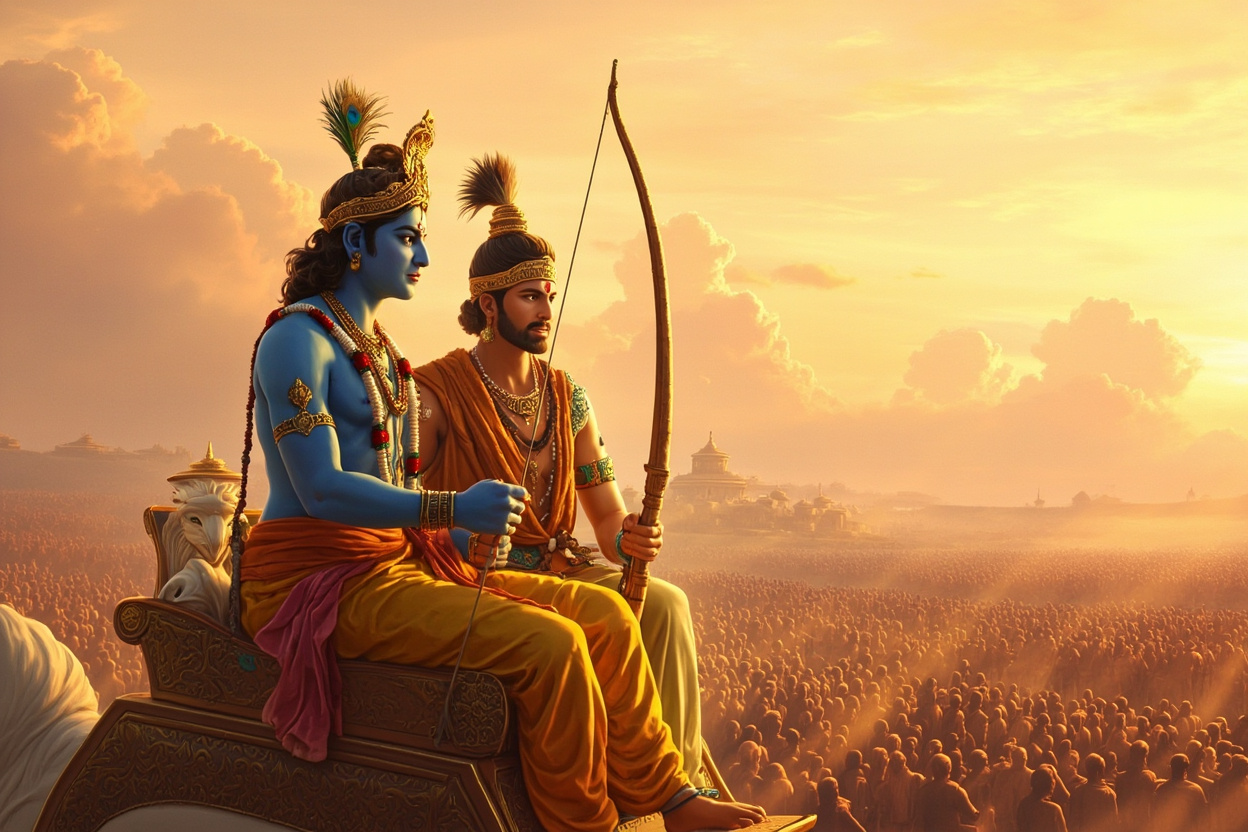
The Bhagavad Gita is a 700-verse Hindu scripture presented as a conversation between Prince Arjuna and Lord Krishna on the morning of a great war. Composed in Sanskrit and traditionally dated between the 5th and 2nd centuries BCE, it sits inside the epic Mahabharata yet reads as a self-contained guide to ethics, the nature of the self, and the path to spiritual freedom. In seven hundred verses, it answers one of the most human questions a person can face: what should I do when every choice seems to cost something precious?
The Setting: A Battlefield Conversation
The Bhagavad Gita opens not in a forest hermitage or a palace court, but on the open field of Kurukshetra, where two massive armies are drawn up against each other. The blind king Dhritarashtra, sitting far from the field, asks his charioteer and counselor Sanjaya to describe what is happening. Sanjaya, gifted with divine sight by the sage Vyasa, narrates the scene.
On one side stand the Pandavas — five brothers led by the warrior Arjuna, who have been cheated out of their kingdom and are fighting to reclaim it. On the other side stand the Kauravas, their cousins, who refuse to return what they took. Both armies include grandfathers, teachers, friends, and cousins. The war is not a foreign invasion; it is a civil war inside the same family.
Arjuna’s Crisis
As the conch shells sound, Arjuna asks Krishna to drive his chariot between the two armies so he can see whom he must fight. When he does, the weight of what is about to happen lands on him all at once. He sees his uncles, his gurus, his childhood companions. His bow slips from his hands. He tells Krishna he will not fight.
This is the moment the entire Bhagavad Gita is built around. Arjuna is not a coward — he is one of the most accomplished warriors alive. What breaks him is the realization that winning the war means killing people he loves. He turns to Krishna not for strategy, but for clarity: tell me what the right thing to do is, when the right thing seems to require something terrible.
Krishna’s Teaching
Krishna responds with a teaching that unfolds over eighteen chapters. He begins with the practical — a warrior’s duty, called kshatra dharma, does not disappear simply because the cost is high — and then widens the lens to cover the nature of the self, the structure of reality, and the paths that lead to liberation.
What is striking, even on a first reading, is how direct Krishna is. He does not flatter Arjuna, does not promise him an easy path, and does not claim the dilemma is small. He treats Arjuna’s question as worthy of the deepest answer he can give, and the answer runs through several different philosophical threads without contradiction.
The Four Yogas
One of the Bhagavad Gita’s most lasting contributions is its synthesis of four spiritual paths under one roof.
Karma Yoga is the yoga of action. The most quoted verse of the entire text, 2.47, captures it in one line: karmaṇy-evādhikāras te mā phaleṣu kadācana — you have the right to action alone, never to its fruits. The point is not to abandon action, but to act with full commitment while releasing attachment to the result. Modern readers often describe this as the hardest and most practical of the four paths.
Jnana Yoga is the path of knowledge. It is the disciplined inquiry into what is real and what is temporary — distinguishing the eternal self (atman) from the body, the mind, and the roles we play. This path is closest to a philosophical meditation.
Bhakti Yoga is the path of devotion. It holds that the heart opens through love — directed at the divine in any form the devotee can genuinely love. Krishna describes it as the most direct route for a heart that is already moved by love.
Raja Yoga is the path of inner discipline — meditation, breath, and the stilling of the mind. The Gita treats it as preparation for the deeper insights of the other three paths.
What is unusual is that the Gita does not rank these paths as competitors. It treats them as different doors into the same room, suited to different temperaments.
The Self, the Gunas, and the Goal
Beneath the practical advice sits a metaphysics. The Gita teaches that the real self — the atman — is not born and does not die. The body changes; the self witnesses. Krishna describes the cosmic structure in terms of three gunas — sattva (clarity), rajas (activity), and tamas (inertia) — qualities of nature that shape every experience. Liberation, called moksha, is freedom from identification with these qualities and a clear seeing of the self that stands behind them.
This is also where Krishna reveals his cosmic form in Chapter 11, an experience that overwhelms Arjuna. The teaching is not that Krishna is showing off; it is that the divine, when fully seen, contains everything — every timeline, every creature, every act.
Why the Bhagavad Gita Still Matters
The Gita’s modern appeal comes from the fact that its central question is not ancient. Every era produces its own Kurukshetra — situations where the right action seems impossible, where duty conflicts with love, where the cost of doing what is right feels unbearable. The Gita does not promise that such situations will disappear. It offers a way to act inside them without being consumed by them.
It has shaped the lives of figures as different as Mahatma Gandhi, who carried a copy with him and turned to it in moments of decision, and the physicist Robert Oppenheimer, who famously quoted its verses after the first nuclear test. It is read by monks and stockbrokers, by traditional households and by students far from any religious upbringing, because it speaks to the part of the human situation that does not change.
How to Approach It
The Bhagavad Gita is short enough to read in a single sitting and deep enough to read for a lifetime. A few practical notes for a first-time reader:
- Pick a translation that matches your purpose. If you want philosophical precision, look at the translations by Swami Gambhirananda or Winthrop Sargeant. If you want literary beauty, the translation by Laurie L. Patterson or the verse-only rendering by Shri Purohit Swami are good entry points.
- Don’t try to absorb it all at once. Reading two or three chapters at a time, then sitting with them, is more fruitful than racing to the end.
- Read it twice. The first reading gives you the shape; the second reading lets you actually hear the questions Arjuna is asking.
- Avoid reading it as a how-to manual. The Gita is not a list of rules. It is a sustained argument about the kind of person you should try to become.
Whether you approach it as scripture, as philosophy, or as one of the great works of world literature, the Bhagavad Gita rewards patient attention. It is, in the end, less about a war that took place long ago and more about the kind of life a person can choose to lead in any age.
Conclusion
The Bhagavad Gita is a 700-verse conversation that begins with a warrior’s collapse and ends with a vision of reality itself. It is short, demanding, and remarkably direct. For more than two thousand years it has been the entry point through which most people approach the wider world of Hindu thought, and it remains the scripture that Hindus themselves turn to most often in moments of real decision.
FAQ
What does “Bhagavad Gita” mean?
The name means “Song of God” in Sanskrit. Bhagavad means “of the divine” or “the blessed one,” and gita means “song.” It is also simply called the Gita.
How long is the Bhagavad Gita?
It contains 700 verses, divided across 18 chapters. Most translations run between 100 and 140 pages depending on the commentary included.
Is the Bhagavad Gita part of the Vedas?
No. The Gita is part of the Mahabharata, one of the two great Sanskrit epics, and is classified as smriti (the remembered tradition) rather than shruti (the revealed Vedas). It is, however, treated as scripture in Hindu practice and is often studied alongside the Upanishads.
Do you have to be Hindu to read the Bhagavad Gita?
No. The Gita is read by people of many backgrounds, including Buddhists, Jains, and seekers without a religious affiliation. It is taught in university philosophy and comparative religion programs worldwide.
Which is the most important verse of the Bhagavad Gita?
Verse 2.47 — karmaṇy-evādhikāras te mā phaleṣu kadācana — is the most quoted. It teaches that you have the right to your actions but never to the fruits of those actions. It is the verse most often cited as the practical heart of the Gita.
How is the Bhagavad Gita different from the Upanishads?
The Upanishads are philosophical texts in dialogue form, often abstract and meditative. The Gita takes those same ideas and applies them to a concrete, emotionally charged situation — a person who must act now and cannot escape the consequences. The Gita is, in a sense, the Upanishads put to work.
Related Articles
Continue exploring our Hinduism FAQ series: