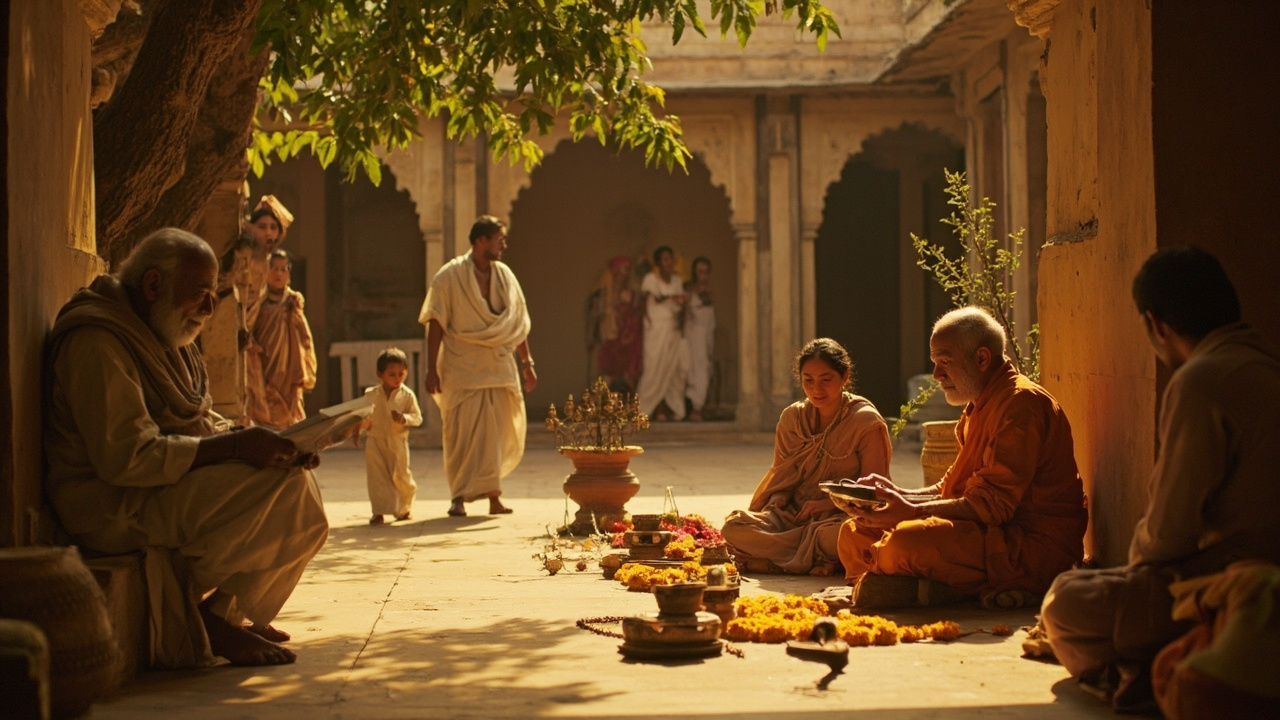
The 4 Purusharthas: Dharma, Artha, Kama, Moksha — A Complete Guide
Hindu philosophy offers a remarkably practical framework for understanding the purpose of human life. Rather than presenting a single path or a single goal, it identifies four aims of life known as the Purusharthas (पुरुषार्थ) — the legitimate pursuits that every human being is encouraged to balance over a lifetime. These four aims are Dharma (righteous duty), Artha (material prosperity), Kama (desire and pleasure), and Moksha (spiritual liberation). Together, they describe a life that is simultaneously ethical, prosperous, joyful, and ultimately free.
Unlike philosophies that reject worldly life in favor of pure renunciation, or those that embrace material success without moral grounding, the Purusharthas teach a balance. Each aim is valid in its own place. The challenge — and the wisdom — lies in knowing when, how much, and in what order each one should be pursued. This article explains each Purushartha, the scriptural basis behind it, the order in which they are traditionally pursued, and how the four can be applied in a modern life.
What Are the Purusharthas?
The word Purushartha comes from two Sanskrit roots: purusha (पुरुष, the soul or person) and artha (अर्थ, purpose or goal). Literally, it means “the goal of the soul” or “the aim of human life.” The concept is most fully articulated in classical Hindu dharma literature, including the Manusmriti, the Mahabharata, and the Shanti Parva.
While the exact list varies slightly across texts, the four most widely accepted Purusharthas are:
- Dharma (धर्म) — Righteous duty, ethics, law, and cosmic order
- Artha (अर्थ) — Material prosperity, livelihood, and economic well-being
- Kama (काम) — Desire, love, pleasure, and emotional fulfillment
- Moksha (मोक्ष) — Liberation from the cycle of birth and death
The first three — Dharma, Artha, and Kama — are sometimes called the Trivarga (त्रिवर्ग) or “threefold aim,” and they describe the legitimate goals of householder life. The fourth, Moksha, is the ultimate goal that becomes central in the later stages of life. Importantly, Hindu philosophy does not see these aims as competing — they are complementary, and a complete life touches all four.
Dharma — Righteous Duty
Dharma is the foundation of the four aims. The word has no single English equivalent — it translates loosely as duty, righteousness, law, cosmic order, and truth depending on context. At its deepest level, Dharma is the principle that holds the universe together; at the human level, it is the ethical and moral code that governs how a person lives.
The Bhavishya Purana defines Dharma beautifully: “Dharma is that which upholds both the individual and the society.” In daily life, Dharma guides everything from honesty in business to kindness in family, from performing daily puja to upholding one’s marriage vows.
What Does Dharma Include?
- Personal ethics — honesty, compassion, self-discipline, and non-violence (ahimsa)
- Social duties — responsibilities toward family, community, and society
- Sacred duties — daily prayer, festival observance, pilgrimages, and samskaras (life-cycle rituals)
- Professional duty — fulfilling one’s role in society with integrity
The Bhagavad Gita (2.31) emphasizes that Dharma is not abstract — it is something to be lived. Lord Krishna tells Arjuna: “Considering your dharma as a warrior, you should not waver; for there is nothing better for a Kshatriya than a righteous war.” In other words, performing one’s own duty — even when difficult — is the highest Dharma.
Artha — Material Prosperity
Artha refers to material wealth, economic security, and the means of livelihood. Far from being a distraction from spiritual life, Artha is recognized as a legitimate and necessary pursuit. A person who cannot feed their family, pay their debts, or maintain a household is not free to pursue higher goals — and Hindu philosophy acknowledges this reality.
The ancient text Kautilya’s Arthashastra — a treatise on statecraft and economics — dedicates itself entirely to the subject of Artha. The Mahabharata also affirms: “From Dharma comes Artha, and from Artha comes Kama.” In other words, Artha is the practical foundation that supports both ethical living and the enjoyment of life.
Forms of Artha
- Personal wealth — income, savings, property, and assets
- Professional success — career, business, skills, and reputation
- Economic security — providing for family, dependents, and old age
- Social standing — respect earned through honest work
Hinduism does not view wealth as inherently unspiritual. The Lakshmi (goddess of wealth) and Kubera (god of riches) are revered deities, and prayers for prosperity are a regular part of Hindu worship. What matters is how wealth is earned and how it is used. Wealth gained through dishonesty, exploitation, or at the cost of others’ well-being is not true Artha — it is a distortion of it.
Kama — Desire and Pleasure
Kama is the pursuit of desire, love, beauty, sensory pleasure, and emotional fulfillment. It includes the legitimate enjoyment of food, art, music, romance, family life, and the senses. The Kama Sutra — written by the sage Vatsyayana — is the classical Sanskrit text on this subject, and it treats desire as a serious subject worthy of thoughtful, ethical exploration.
Hinduism is unusual among the world’s spiritual traditions in that it does not demonize desire. The Kama Sutra opens with the verse: “Kama, the enjoyment of appropriate objects by the five senses — sight, smell, taste, touch, and hearing — assisted by the mind, is the proper domain of Kama.”
Kama in Daily Life
- Family and marriage — emotional intimacy, love, and the raising of children
- Art and beauty — music, dance, poetry, painting, and architecture
- Food and sensory pleasures — celebration of festivals, traditional cuisine, and hospitality
- Romantic love — including the naming of a child after loved ones, and the deep bonds of family life
The key teaching around Kama is moderation and context. Desire pursued within the boundaries of Dharma and Artha is natural and life-affirming. Desire pursued at the cost of ethics, family, or health becomes a source of suffering. The Bhagavad Gita (2.62-63) warns: “While contemplating the objects of the senses, a person develops attachment; from attachment comes desire; from desire arises anger…” — and this chain leads to one’s downfall.
Moksha — Liberation
Moksha is the ultimate aim of human life in Hindu philosophy. It refers to liberation from the cycle of birth, death, and rebirth (samsara) and the realization of one’s true nature as the eternal self (Atman). The article on Atman: The Eternal Soul Within explains this in detail.
While the first three Purusharthas are about living well within the world, Moksha is about transcending the world. It is the realization that the true Self is not the body, the mind, or the ego — but the infinite, eternal consciousness that witnesses all experience. This realization frees the soul from the cycle of karma and rebirth.
Paths to Moksha
Hinduism describes four classical paths, each suited to a different temperament:
- Jnana Yoga (ज्ञान योग) — The path of knowledge and self-inquiry
- Bhakti Yoga (भक्ति योग) — The path of devotion to God
- Karma Yoga (कर्म योग) — The path of selfless action
- Raja Yoga (राज योग) — The path of meditation and mental discipline
The Upanishads declare this truth repeatedly. The Chandogya Upanishad (7.25.2) says: “Tat Tvam Asi” (Thou Art That) — the individual soul is, in essence, the same as the universal reality. Realizing this truth — even just once, deeply — is the beginning of Moksha. The full guide to Moksha explores this in greater depth.
The Order and Balance of the Purusharthas
One of the most important teachings about the Purusharthas is that they are meant to be pursued in sequence and in balance. The classical teaching is that the first three — Dharma, Artha, and Kama — are pursued in the householder stage of life (Grihastha Ashrama), while Moksha becomes the focus in the later stages (Vanaprastha and Sannyasa).
Why Order Matters
- Dharma first — Without ethics, wealth and pleasure become destructive
- Artha second — Material security is the foundation for ethical living and family life
- Kama third — Pleasure and love are enjoyed responsibly, within the boundaries of dharma and supported by artha
- Moksha ultimately — Once worldly duties are fulfilled and attachments loosen, the soul turns toward liberation
The Mahabharata captures this wisdom in a striking verse: “Dharma is the foundation, Artha is the means, Kama is the desire, and Moksha is the ultimate goal. A person who pursues all four in their proper order attains the highest fulfillment.”
The opposite of balance is also instructive. The Bhagavad Gita warns against the extremes: one who pursues only Dharma becomes a rigid ascetic; one who pursues only Artha becomes greedy; one who pursues only Kama becomes a slave to desire; and one who pursues Moksha too early — before fulfilling worldly duties — can become ungrounded. The teaching is integration, not exclusion.
Purusharthas in Modern Life
The four Purusharthas are not just abstract philosophy — they offer a remarkably practical framework for modern life. For a 21st-century reader, the four aims can be understood as:
- Dharma — Your values, ethics, and sense of purpose. The principles that guide your decisions, your work, and your relationships.
- Artha — Your career, finances, and the ability to provide — for yourself and those who depend on you.
- Kama — Your relationships, hobbies, joys, and the things that make life worth living — family, art, nature, and love.
- Moksha — Your inner life, spiritual practice, and the search for meaning beyond material success.
This framework is increasingly relevant in a world that often pressures people to choose between success and meaning. The Purusharthas teach that a complete life touches all four dimensions — and that a person can be simultaneously ethical, prosperous, joyful, and spiritually awake.
Frequently Asked Questions
What is the difference between Dharma and Karma?
Dharma refers to one’s duty, ethics, and righteous path in life. Karma refers to action and its consequences — the cosmic law that every action creates a corresponding result. Dharma guides the nature of one’s actions; Karma governs the consequences. Living in accordance with Dharma tends to produce positive Karma. The deeper principle of Karma is explained in our dedicated article.
Are the four Purusharthas mentioned in the Vedas?
The explicit list of four Purusharthas is most clearly articulated in the Smriti literature (such as the Manusmriti) and the Itihasa (the Mahabharata and Ramayana). The concept is consistent with Vedic teachings but the fourfold classification became formalized in later dharma literature. The article on Hindu scriptures explains how Shruti and Smriti texts relate.
Can a person pursue Moksha in this lifetime?
Yes. Hindu philosophy teaches that Moksha is attainable in this very life, though it requires deep spiritual practice, self-inquiry, and the grace of God. The Bhagavad Gita (8.16) states: “From the highest world (Brahmaloka), there is no return.” Those who attain Moksha are called Jivanmukta (liberated while living) — they are free inwardly, even as they continue to live in the world.
Is Kama a sin in Hinduism?
No. Kama is one of the four legitimate aims of life. Hinduism does not teach that desire is inherently sinful — only that misguided or excessive desire, pursued at the cost of Dharma and others’ well-being, leads to suffering. The Kama Sutra explicitly places Kama within the framework of Dharma, Artha, and Moksha.
How are the Purusharthas related to the Ashramas (stages of life)?
The four Ashramas (life stages) — Brahmacharya (student), Grihastha (householder), Vanaprastha (forest-dweller), and Sannyasa (renunciate) — are traditionally the framework in which the Purusharthas are pursued. The first three Purusharthas (Dharma, Artha, Kama) are central to the Grihastha stage, while Moksha becomes the focus in the Vanaprastha and Sannyasa stages. This structure is described in the dharma-shastra tradition.
Do all Hindus believe in all four Purusharthas?
Yes, the four Purusharthas are widely accepted across Hindu traditions, including Vaishnavism, Shaivism, Shaktism, and Smarta traditions. The relative emphasis may differ — some traditions stress Bhakti and Moksha, while others give more weight to Dharma — but all four aims are recognized as legitimate aspects of a complete life.
Related Articles
- Atman: The Eternal Soul Within — Explore the Hindu concept of the eternal self, foundational to understanding Moksha.
- Understanding Moksha: Liberation and Spiritual Freedom — A deeper look at the fourth and ultimate Purushartha.
- What is Karma? Understanding the Law of Cause and Effect in Hinduism — How the law of Karma shapes every pursuit of the Purusharthas.
- Hindu Wedding Rituals Explained: A Complete Guide to the Sacred Tradition — How Dharma and Kama come together in the sacred householder life.
- What is the Meaning of Sanatana Dharma? — The eternal way of life that gives context to all four Purusharthas.
- How to Do Puja at Home: A Complete Step-by-Step Guide for Beginners — Living the Purushartha of Dharma through daily spiritual practice.