What is Ahimsa? The Hindu Principle of Non-Violence Explained
Walk into any Hindu temple, ashram, or even a yoga studio in Mumbai, Rishikesh, or Brooklyn, and you will hear the word ahimsa (अहिंसा) before you see the deity. It is the first word in the Mahavira Jain prayer, the opening vow of the yoga sutras, and the cornerstone of Mahatma Gandhi’s entire political philosophy. Yet for all its familiarity, ahimsa is one of the most misunderstood concepts in Hinduism — often reduced to “don’t eat meat” or “be nice” in casual conversation. The real meaning is far deeper, older, and more demanding.
This guide unpacks what ahimsa truly means in the Hindu tradition: its Sanskrit roots, its appearance in the Vedas, Upanishads, Bhagavad Gita, and Yoga Sutras, the practical difference between ahimsa and passivity, and how a principle articulated around 1500 BCE still shapes Indian vegetarianism, Jain monks walking barefoot, the global animal-rights movement, and even modern vegan debates. Whether you are a Hindu seeker, a student of comparative religion, a yoga practitioner, or simply a curious reader, this article will give you the complete picture.
The Sanskrit Meaning of Ahimsa
The word ahimsa is a compound of the Sanskrit prefix a- (meaning “not” or “non-“) and himsa (हिंसा, meaning “violence,” “injury,” or “the act of causing harm”). In its simplest translation, ahimsa means “non-violence” or “the absence of harm.” But this translation is deceptively narrow.
Classical Sanskrit commentators like Panini (c. 4th century BCE) and Yaska (author of the Nirukta, the oldest Sanskrit etymology text) defined himsa much more broadly than physical violence. Himsa includes:
1. Physical harm (shareerika himsa)
Any act that causes bodily injury to another living being — striking, killing, restraining against consent, or even exposing a creature to danger.
2. Verbal harm (vaachika himsa)
Speech that wounds — lying, slander, gossip, harsh words, abusive language, and even truth spoken cruelly. The Manusmriti (5.39) calls harsh speech toward a teacher or elder a graver himsa than a physical blow.
3. Mental harm (maanasika himsa)
Thought, intention, and emotion directed toward another’s suffering — contempt, jealousy, the silent wish for someone’s downfall, schadenfreude, and contemptuous judgment.
So ahimsa is not just “do not kill.” It is the deliberate, continuous choice to abstain from harm in all three dimensions of human action: body, speech, and mind. This is why the Yoga Sutras of Patanjali (2.35) define ahimsa as the foundational yama (social discipline) — when non-violence is established in a person, it is said to abandon all hostility in their presence.
Ahimsa in Hindu Scripture: A Timeline
Ahimsa did not arrive in Hinduism fully formed. It evolved across centuries, moving from a ritual restraint to a universal moral principle.
The Rigveda: Reverence for All Life
The Rigveda (c. 1500–1200 BCE), the oldest Hindu scripture, contains several hymns that show reverence for all life without yet using the word ahimsa. Rigveda 10.87 famously declares that cows are “the mothers of the gods” and should never be slaughtered. Rigveda 10.125 praises the goddess Vāc (Speech) and warns that false or harmful speech creates asuric (demonic) energy.
The Upanishads: From Ritual to Inner Restraint
By the Upanishadic period (c. 800–500 BCE), the focus shifted from external ritual purity to inner moral discipline. The Chandogya Upanishad (3.17.4) frames non-violence as a path to divine union. The Taittiriya Upanishad (1.11) instructs the student to practice ahimsa, satyam (truth), and asteyam (non-stealing) as the foundation of tapas (spiritual austerity).
The Bhagavad Gita: Ahimsa in Difficult Times
Arjuna’s crisis on the battlefield of Kurukshetra is the most famous discussion of violence in Hindu thought. Krishna does not command blind violence, nor does he command cowardly retreat. In Bhagavad Gita 2.19, Krishna teaches that the embodied Self is eternal — it neither kills nor is killed. In chapter 11, he reveals his cosmic form, then urges Arjuna to act according to his svadharma (personal duty) as a Kshatriya warrior.
This is one of the most subtle teachings on ahimsa in Hinduism. The Gita does not interpret ahimsa as passive refusal to fight. Instead, it reframes violence through three lenses: (1) the Self cannot truly be killed, (2) attachment to outcomes is the real himsa, and (3) sometimes action in accordance with dharma is itself a form of ahimsa when it prevents greater harm. As Krishna says in 3.8: “Action is superior to inaction. Even the maintenance of your body cannot be accomplished without action.”
The Yoga Sutras: Ahimsa as the First Yama
Patanjali’s Yoga Sutras (c. 200 BCE – 200 CE) place ahimsa as the very first of the five yamāni (social restraints) — before truthfulness, non-stealing, celibacy, and non-possessiveness. Sutra 2.35 states: “In the presence of one who has firmly established non-violence, all hostility ceases.” Sutra 2.30 adds: ahimsa-pratisthayam tat-sannidhau vairatyagah — non-violence purifies the practitioner to the point where wild animals and enemies lose their aggression in their presence. This is a radical claim, and it is the source of the Jain and Buddhist extension of ahimsa into a total life-discipline covering diet, profession, and movement.
The Dharma Shastras: Caste, Vocation, and Necessary Harm
The Dharma Shastras (Manu, Yajnavalkya, Parashara, and others) acknowledged a hard reality: not every human being can avoid all physical himsa. A farmer, a soldier, a fisherman, a woodcutter — all interact with life. To resolve this, the shastras distinguished between sankalpa (intention) and kriya (act). A Kshatriya who fights in a righteous war with detachment accrues no sin; a Brahmin who harms a creature with intent to torture accumulates heavy papa (demerit). This is the source of the modern Indian distinction between “necessary harm” (such as eating plant-based food) and “gratuitous harm” (such as factory farming).
Ahimsa in Daily Hindu Practice
For most practicing Hindus, ahimsa is not a metaphysical abstraction. It is woven into daily rituals, food choices, and social behavior.
Vegetarianism and Ahimsa
Many — but not all — Hindu communities practice lacto-vegetarianism as a direct expression of ahimsa. Cow protection (go-raksha) is especially emphasized because of the cow’s economic and spiritual role in agrarian India. The Manusmriti (5.56) names the cow as equal to the earth itself, and harming a cow is described as equal to harming a Brahmin in severity. Coastal, northeastern, and some South Indian communities historically ate fish or meat, and modern Hindu vegetarians span a wide spectrum — from those who exclude only beef to committed vegans who also avoid root vegetables (as Jain ascetics do, to avoid uprooting and killing the plant).
Ahimsa and the Kitchen
Hindu household rituals often include small daily reminders of ahimsa. The boondi or prasad (sacred food offering) is prepared with the awareness that each grain is a life sustained. Many Hindus offer water (tarpana) to ancestors and departed souls before meals — a small act of acknowledging that all eating involves some harm to other creatures.
Ahimsa in Speech
The Manusmriti lists ten forms of sinful speech — lying, slander, harsh words, useless chatter, falsehood, and so on. The Yoga Sutras (2.36) follow this with: “For one established in truthfulness, every action and its consequences become subject to their will.” Daily practice of ahimsa for many Hindus begins not with the dinner plate but with the tongue — avoiding gossip, refraining from angry words, and speaking only what is true, kind, and necessary.
Festivals That Embody Ahimsa
Several Hindu festivals foreground non-violence. Paryushana (shared with Jains) is an eight-day period of fasting, forgiveness, and reflection. Jain Mahavir Jayanti honors the Tirthankara Mahavira, who extended ahimsa to its most rigorous form. Diwali in northern India celebrates the return of Lord Rama to Ayodhya, but the lamps of Diwali also symbolize the inner victory of non-violence over the violence of ego, ignorance, and fear. Many Indian families observe Ahimsa Diwas (non-violence day) on October 2, the birthday of Mahatma Gandhi and Lal Bahadur Shastri.
Ahimsa is Not Passivity: The Gita and the Warrior’s Dilemma
One of the most persistent Western misunderstandings of ahimsa is that it means pacifism, refusal to act, or submission to injustice. The Hindu tradition explicitly rejects this reading. The Bhagavad Gita is the clearest counter-example.
When Arjuna hesitates on the battlefield, his reasoning is essentially pacifist — he does not want to kill his relatives, his teachers, his elders. Krishna does not endorse this view. Instead, he teaches three points that recast ahimsa:
1. The Self cannot be killed
Only the body is destroyed. The Self (Atman) is eternal, unborn, and undying. To refuse to act out of misplaced compassion for the body is, in Krishna’s view, a form of avidya (ignorance).
2. Action without attachment is itself a form of ahimsa
When Arjuna fights as a Kshatriya without hatred, without joy in killing, without attachment to victory — he acts according to his dharma. This is non-violent action.
3. Inaction in the face of injustice is also himsa
Krishna’s famous verse 3.20 (Janaka and other kings attained perfection through action alone) is sometimes read as a permission for violence, but its deeper meaning is that failing to act against unrighteousness is itself a form of harm — to the victim, to society, and to one’s own dharma.
This is why the Bhagavad Gita has been read as both a justification for righteous war and a foundation of Gandhian non-violent resistance. The reading depends on what one considers the greater ahimsa in a given moment.
Ahimsa Beyond the Human: Plants, Insects, and the Microbial World
Critics often point to a paradox: if ahimsa means non-violence toward all life, why do Hindus eat plants? The Vedic tradition engages this question directly.
The Shvetashvatara Upanishad (3.18) notes that jivas (individual souls) exist even in plants. Eating plant life therefore does involve some himsa. The solution is not to refuse to eat (which is impossible for a body) but to minimize harm, perform Japa or a brief prayer over food, and offer the meal to the Divine (Bhagavad Gita 4.24) so the act of eating becomes a yajna (sacrifice), not a destruction.
Jainism pushes this further with the doctrine of aikantavada — avoiding root vegetables (which uproot many microbes), wearing a mouth-cover (muhpatti) to avoid inhaling insects, sweeping paths before walking to avoid stepping on ants. This is the most radical interpretation of ahimsa, and it is not the Hindu mainstream — but it profoundly influenced Hindu thought, especially in Vaishnava traditions where Lord Vishnu and his avatars are sometimes said to have taken forms that protect the smallest creatures.
Ahimsa in Modern Hindu Voices: Gandhi, Vivekananda, and the Global Yoga Movement
The modern relevance of ahimsa in Hindu thought is impossible to overstate.
Mahatma Gandhi (1869–1948)
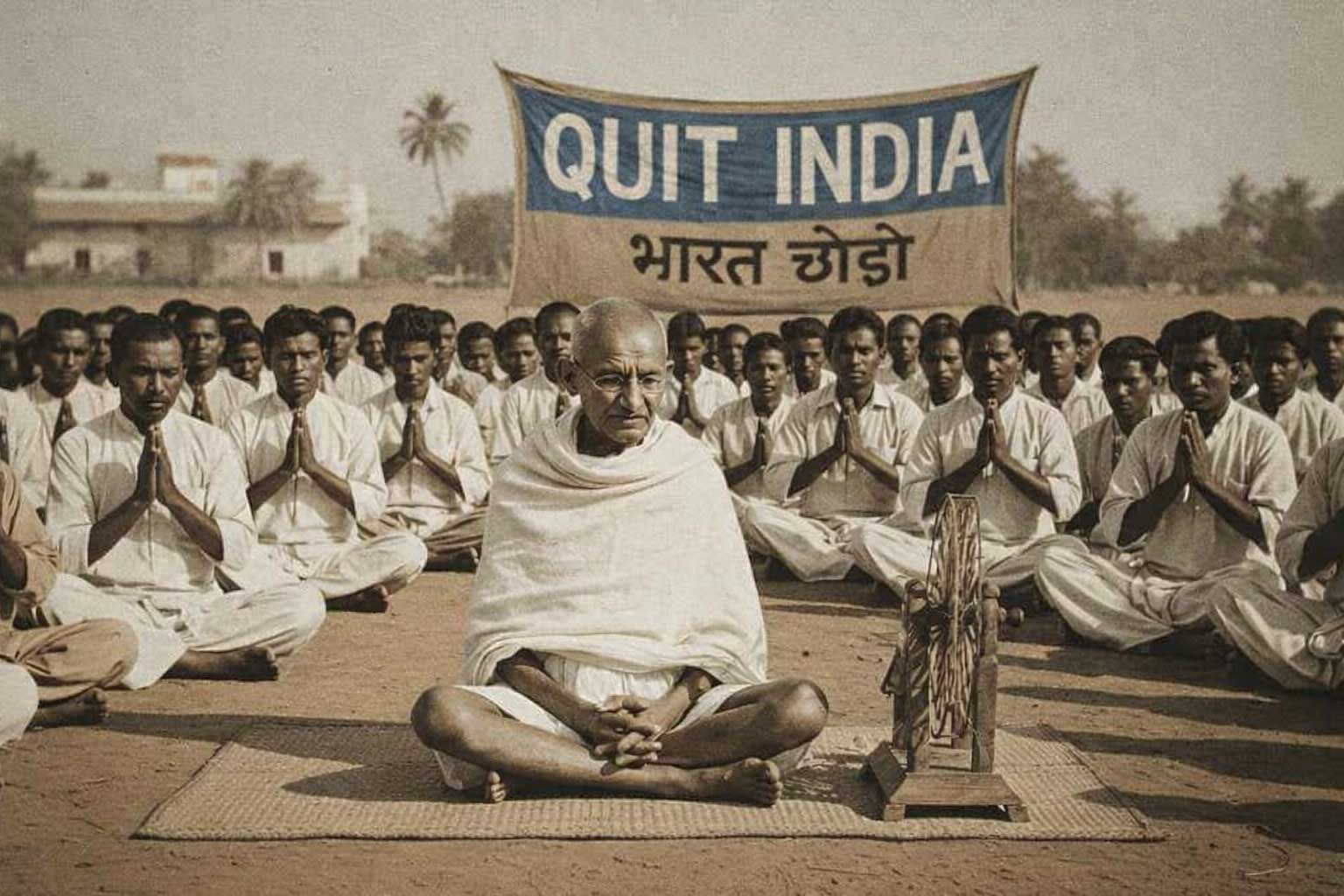
Gandhi did not invent ahimsa, but he did transform it from a personal religious discipline into a political philosophy. In his 1927 book An Autobiography: The Story of My Experiments with Truth, Gandhi wrote: “Ahimsa is the first article of my faith. It is also the last article of my creed.” He fused the Bhagavad Gita’s teaching on detached action with the Sermon on the Mount, the Jain principle of total non-violence, and Tolstoy’s Christian pacifism to produce Satyagraha — “truth-force” or “soul-force” — the philosophical foundation of the Indian independence movement.
Swami Vivekananda (1863–1902)
Vivekananda taught that ahimsa was the central contribution of Hinduism to world civilization. In his 1893 Chicago address and subsequent writings, he argued that India had survived centuries of invasion because its principle of non-violence made conquest spiritually costly for the conqueror. He framed ahimsa not as weakness but as the highest form of strength: “Ahimsa is the highest dharma. Ahimsa is the best tapas. Ahimsa is the greatest gift. Ahimsa is the highest self-control. Ahimsa is the highest sacrifice. Ahimsa is the highest power. Ahimsa is the highest friend. Ahimsa is the highest truth. Ahimsa is the highest teaching.” (Mahabharata, Shanti Parva, 115.23–24 — a verse Vivekananda frequently cited.)
Modern Yoga and the West
When yoga moved from India to the West in the 20th century, the practice of ahimsa often came with it — translated as “non-violence toward all living things.” Many modern Western yoga studios include a vegetarian or vegan cafe, avoid leather mats, and frame the first yama as a guideline for personal ethics. This is a simplified version of the Hindu teaching, but it is a popularization that has, according to a 2018 study in the journal Religion, Brain & Behavior, made vegetarianism more socially acceptable in many Western urban centers.
Common Misconceptions About Ahimsa
Let us address four common misunderstandings.
Misconception 1: Ahimsa is just vegetarianism
No. Ahimsa is far broader than diet. A vegetarian who speaks with contempt, gossips, or harbors jealousy is committing the verbal and mental forms of himsa regardless of what they eat.
Misconception 2: Ahimsa means pacifism in all situations
The Bhagavad Gita, the Ramayana (where Rama fights Ravana), and the Mahabharata (where Krishna counsels war against adharma) all show that ahimsa does not mean refusing to act. It means acting without inner violence — without hatred, without cruelty, without attachment to outcome.
Misconception 3: Ahimsa is a Hindu-only idea
Not quite. Ahimsa is a pan-Indian principle shared with Buddhism, Jainism, and Sikhism. Each tradition has interpreted it differently — Buddhism and Jainism have historically been more rigorous, while Hinduism has accepted degrees of harm necessary to life (e.g., agriculture, defense).
Misconception 4: Ahimsa forbids self-defense
Traditional Hindu dharma permits self-defense when one’s own life, the lives of loved ones, or dharma itself is at stake. The Mahabharata allows the Pandavas to fight. The Ramayana shows Rama defending sages from demons. Modern Hindu thought, including Gandhi’s, distinguishes between non-violence as personal discipline and non-violence as a political strategy.
How to Practice Ahimsa Today: A Practical Guide
For readers inspired to bring ahimsa into daily life, the Hindu tradition offers a graduated path.
1. Begin with Speech
For one week, observe silence before speaking. Ask: Is this true? Is this kind? Is this necessary? If all three are yes, speak. If any is no, pause. The Mahabharata (Shanti Parva, 161.7) advises: “Speak what is true, speak what is pleasant, do not speak what is true but unpleasant, do not speak what is pleasant but false.” This is one of the most quoted lines on vaachika ahimsa.
2. Examine Your Plate
If you are not vegetarian, consider a single meatless day per week. Many Hindus observe Ekadashi (twice a month) as a day of fasting or simple plant-based eating. Begin there.
3. Mind the Mind
When a hostile thought arises toward another person, observe it without acting on it. The Yoga Sutras (1.33) recommend maitri (friendliness toward the happy), karuna (compassion toward the suffering), mudita (joy toward the virtuous), and upeksha (indifference toward the wicked) as a daily cultivation of non-violent thoughts.
4. Act Without Attachment
Whatever your work — teaching, healing, building, programming, parenting — try to do it for the work itself, not for the reward. This is the essence of the Karma Yoga path described in the Bhagavad Gita.
5. Serve the Suffering
When in doubt about whether to act, ask: does this action reduce suffering in the world? Ahimsa is not just abstaining from harm — it is the active promotion of compassion. As the Mahabharata (Anu Parva 115.23) says: “He who does not cause harm to any creature is the highest in the world.”
Conclusion: Ahimsa as a Way of Being
To call ahimsa the most important word in Hinduism is not an overstatement. It is the seed from which the entire ethical life of the Hindu tradition grows. It shapes the kitchen, the speech, the mind, the politics, the yoga mat, and the battlefield. It is older than the Buddhist and Jain versions of the same principle, broader than vegetarianism, more demanding than pacifism, and more practical than most Western summaries suggest.
If you take one thing from this article, let it be this: ahimsa is not the absence of action. It is the presence of awareness. To live ahimsa is to be fully awake to the harm that thought, word, and deed can cause — and to choose, again and again, the path of greater care.
Frequently Asked Questions
What does ahimsa mean in simple words?
Ahimsa (अहिंसा) is a Sanskrit word meaning “non-violence” or “the absence of harm.” It is one of the most important ethical principles in Hinduism, Buddhism, and Jainism. The word breaks down into a- (not) and himsa (violence or injury), and covers harm done through thought, word, and deed — not just physical action.
Is ahimsa only about not eating meat?
No. While vegetarianism is one common expression of ahimsa, the principle is much broader. The Hindu tradition teaches that ahimsa includes non-violence in speech (avoiding gossip, harsh words, and lies), non-violence in thought (avoiding hatred, jealousy, and contempt), and non-violence in action toward all living beings — human and animal.
Does the Bhagavad Gita support ahimsa?
Yes and no. The Bhagavad Gita teaches that the Self (Atman) is eternal and cannot be killed, so in a metaphysical sense, violence toward the Self is impossible. Krishna also teaches that detached action performed as a duty (Karma Yoga) does not create the sin of himsa. However, the Gita does not endorse violence driven by ego, attachment, or cruelty — and it teaches that inaction in the face of adharma is also a form of harm.
Is ahimsa a Hindu concept or a Buddhist concept?
Both, and Jainism too. Ahimsa appears in the Vedas, Upanishads, and the Bhagavad Gita — making it part of the Hindu tradition from at least 1500 BCE. Buddhism and Jainism developed the principle further, sometimes more rigorously (especially in Jainism’s avoidance of any harm to insects and microbes). It is best understood as a pan-Indian ethical principle, not the property of any one religion.
How is ahimsa different from pacifism?
Pacifism is the refusal to fight in any circumstance. Ahimsa is the refusal to act with inner violence — hatred, cruelty, attachment to outcomes. A Hindu practitioner of ahimsa can fight in a just war, defend a victim, or even correct a child firmly, provided the action is performed without inner violence. The Mahabharata‘s Kshatriya heroes and the Ramayana‘s Lord Rama both act in this way.
Can ahimsa be practiced part-time?
Yes, and most Hindus practice it as a graduated path. Many observe vegetarianism on specific days (Ekadashi, Navratri, Mondays or Thursdays), practice fasting rituals, or commit to a single act of non-violence at a time — such as avoiding gossip, refraining from a particular food, or doing one act of service per week. The Hindu tradition generally sees ahimsa as a lifelong cultivation, not an all-or-nothing attainment.
Did Mahatma Gandhi invent ahimsa?
No. Ahimsa has been a central concept in Hinduism, Buddhism, and Jainism for over 3,000 years. Gandhi’s contribution was to translate ahimsa into a political philosophy — Satyagraha (truth-force) — and to use it as the strategic foundation of the Indian independence movement. Gandhi himself credited the Bhagavad Gita, the Buddha, and Mahavira as his teachers.
Related Articles on SattvicGyaan
- What is Karma? Law of Cause and Effect in Hinduism — Understand how karma and ahimsa are two sides of the same coin — every action has consequences, and non-violent action creates positive karma.
- Why is the Cow Sacred in Hinduism? — A direct application of ahimsa in Hindu daily life: why the cow is protected, revered, and treated as a symbol of the principle of non-violence.
- The 4 Purusharthas: Dharma, Artha, Kama, Moksha — Ahimsa is rooted in dharma (righteous living). Learn how the four aims of life integrate non-violence into a complete ethical framework.
- Do Hindus Eat Meat? Understanding Hindu Dietary Practices — A practical look at how ahimsa has shaped Hindu dietary habits across regions, castes, and centuries.
- Main Scriptures of Hinduism: A Beginner’s Guide — Where to read the Vedas, Upanishads, Bhagavad Gita, and Yoga Sutras in English to deepen your understanding of ahimsa at its source.
- Understanding Moksha: Liberation and Spiritual Freedom — Ahimsa is one of the practical stepping stones toward moksha. See how non-violence connects to the highest goal of Hindu life.
- What is Maya? The Illusion in Hinduism — A companion concept to ahimsa: how the world of perceived violence is rooted in maya, and how the practitioner learns to see beyond it.