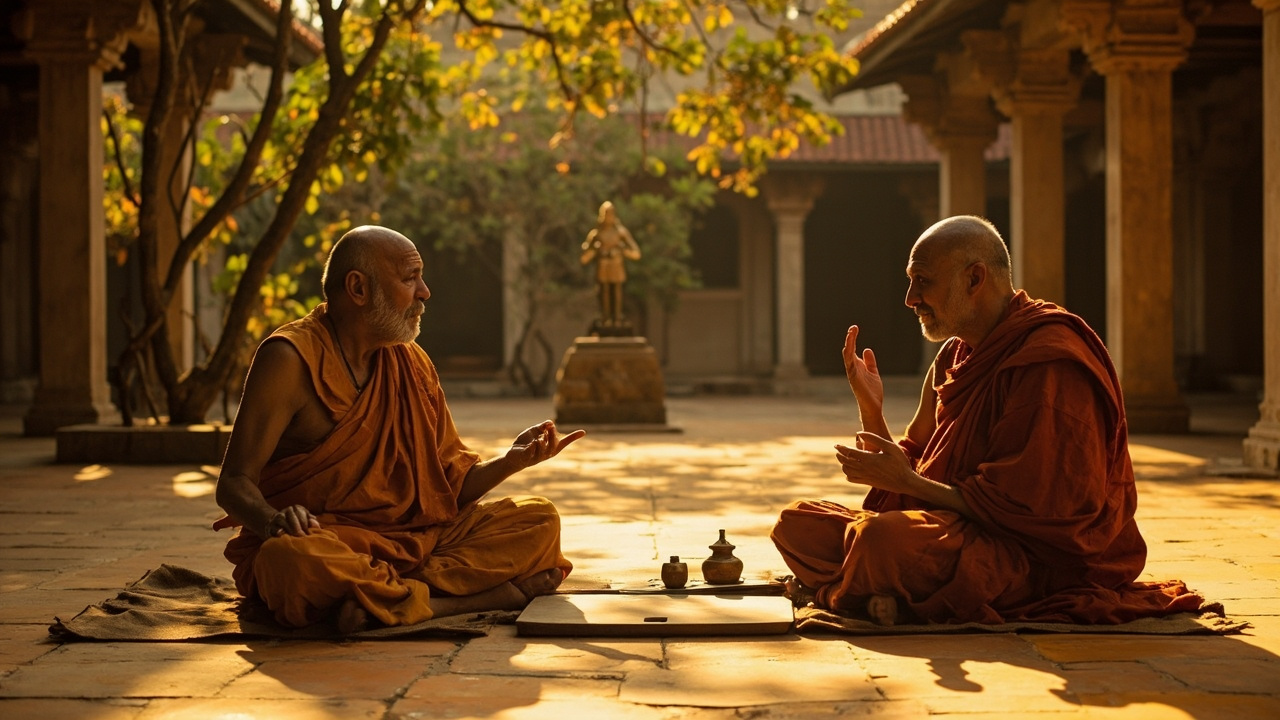
Advaita vs Dvaita Vedanta: What’s the Difference?
If you have ever read a Hindu philosophy book or joined a temple discussion, you have probably heard the words Advaita and Dvaita used almost like rival team names. They are not rival religions, but two of the most influential interpretations of Vedanta, the philosophical backbone of Hinduism. The advaita vs dvaita debate has shaped how Hindus think about God, the soul, the world, and the goal of life for more than a thousand years, and it is still very much alive in temples, monasteries, and YouTube lectures today.
This guide walks you through both schools in plain English. You will learn what each one teaches, where they agree, where they sharply disagree, who their founding sages were, and why the difference matters for everyday Hindu practice. No prior knowledge of Sanskrit required.
What Are Advaita and Dvaita? The Big Picture
Vedanta literally means “the end of the Vedas.” It refers to the teaching of the Upanishads, the Brahma Sutras, and the Bhagavad Gita, three texts Hindus call Prasthanatrayi, the “triple starting point” of Indian philosophy. Within Vedanta there are several sub-schools, and the two most famous are:
- Advaita Vedanta — founded by Adi Shankaracharya in the 8th century CE. The word advaita means “not two.” It teaches that there is only one ultimate reality, and that the many things we see in the world are appearances on top of that one reality.
- Dvaita Vedanta — founded by Madhvacharya in the 13th century CE. The word dvaita means “two.” It teaches that the individual soul and the Supreme Being are fundamentally and eternally distinct.
Both schools accept the same sacred texts as authoritative. The disagreement is about what those texts mean. Think of it as two careful readers of the same book, each insisting the other has missed the main point.
The Core Question: Is the World Real?
Almost every other disagreement between the two schools comes down to a single question: Is the world we see around us ultimately real, or is it an appearance that hides something deeper?
Advaita answers: the world is mithya, a Sanskrit word usually translated as “illusory” or “relatively real.” It is not unreal the way a dream is unreal in the moment of waking, but it is not the final truth either. Behind the world, and behind you, there is one consciousness called Brahman, and that is the only thing that is fully, completely, ultimately real.
Dvaita answers: the world, the soul, and God are all real, and they remain forever different from each other. To call the world an illusion is, in Madhva’s view, a serious misunderstanding of the scriptures. The world is the loving creation of a personal God, and the soul’s job is to live within it wisely and reach God through grace.
Everything else, the question of whether God has a form, whether temple worship can liberate you, and how to read the Upanishads, flows from that one fork in the road.
Advaita Vedanta — The Path of Non-Duality
Adi Shankaracharya (788–820 CE) systematized the advaita view in his commentaries on the Brahma Sutras, the Upanishads, and the Bhagavad Gita. His core teachings can be summed up in a few points.
1. Brahman alone is real
There is one infinite, formless, unchanging reality called Brahman. The famous Mahavakya “Tat Tvam Asi” (You are That) from the Chandogya Upanishad declares that your innermost self and Brahman are not two things. The world of names and forms is a temporary play (lila) of that one reality.
2. The world is mithya
Mithya is the most misunderstood word in Hindu philosophy. It does not mean “fake” in the cheap sense. It means “that which has dependent, ever-changing reality, like the silver you mistake for a mother-of-pearl in dim light.” A wave is real as a wave, but its reality is not separate from the ocean.
3. The individual self is not separate, only appears to be
What you call “I” is Atman, the inner self, and Atman is Brahman. The feeling of being a separate person, with a separate body, life story, and ego, is caused by avidya, ignorance of your true nature. When that ignorance is removed through knowledge (jnana), the separate self dissolves.
4. Liberation is knowledge, not ritual
In Advaita, moksha (liberation) comes from jnana, direct knowledge of the identity of Atman and Brahman. Rituals and devotion can purify the mind and prepare it for that knowledge, but they cannot on their own deliver liberation.
5. God with form is a helpful stepping stone
Shankara did not reject temple worship. He wrote devotional hymns to Krishna, Shiva, and the Divine Mother. For most people, he said, worshipping a personal God is the right path for their stage of life. It is a ladder to be climbed and then set aside.
Dvaita Vedanta — The Path of Eternal Distinction
Madhvacharya (1238–1317 CE), also known as Madhva or Ananda Tirtha, founded the dvaita school in Udupi, Karnataka. He too wrote major commentaries on the same three texts, but reached very different conclusions.
1. Five eternal differences (Pancha Bheda)
Dvaita teaches that there are five permanent distinctions that can never be merged:
- God (Vishnu / Narayana) is distinct from the individual soul (jiva).
- The individual soul is distinct from other individual souls.
- The soul is distinct from matter (jada).
- God is distinct from matter.
- Different forms of matter are distinct from one another.
2. The world is genuinely real
Madhva argued that to call God’s creation an illusion insults both God and the scriptures. The world is a real, meaningful, purposeful creation. Trees, rivers, your body, and your mind are not illusions; they are the playground where the soul learns to love God.
3. The soul is an eternal servant of God
In Dvaita, you are a tiny, eternal soul that is forever dependent on God. You will never become God, and you will never be absorbed into a formless Brahman. The highest possible relationship is that of a devoted servant to a loving Lord, like a child to a parent.
4. Liberation comes through grace, devotion, and surrender
Moksha in Dvaita is not the dissolving of the self but its eternal, blissful service to Vishnu in Vaikuntha, the spiritual realm. It is reached by bhakti (devotion), by surrender (prapatti), and above all by the grace of God.
5. God is always personal
For Madhva, the personal form of Vishnu or Krishna is the Supreme Being, not a stepping stone. To say the personal God is a lower truth is, in his view, a misreading of the scriptures and a slight to the Lord who lovingly takes form to save his devotees.
Side-by-Side: How Advaita and Dvaita Compare
| Question | Advaita Vedanta | Dvaita Vedanta |
|---|---|---|
| Founding teacher | Adi Shankaracharya (8th c.) | Madhvacharya (13th c.) |
| Key meaning of the name | Not two | Two |
| Ultimate reality | One formless Brahman | A personal Supreme Being (Vishnu) |
| Status of the world | Mithya (relatively real) | Genuinely real, God’s creation |
| Nature of the soul | Identical to Brahman | Eternally distinct from God |
| Path to liberation | Knowledge (jnana) | Devotion (bhakti) and grace |
| What happens at moksha | Absorption into formless Brahman | Eternal service to God in Vaikuntha |
| Main monastic center | Sringeri, Kanchi, Dwaraka, Puri | Udupi (Ashta Mathas) |
| View of temple worship | Useful for most, transcended at the highest stage | The highest expression of love for God |
Notice that the disagreement is not about whether God exists, whether the Vedas are true, or whether liberation is real. Both schools fully affirm all of those. The split is metaphysical: are we ultimately one with God, or eternally distinct?
The Other Major Vedanta Schools
Advaita and Dvaita are the most famous Vedanta schools, but they are not the only ones. Two others are worth knowing.
Vishishtadvaita — Qualified Non-Duality
Founded by Ramanujacharya (11th century), this school teaches that souls and matter are real and distinct, but together they form the body of God. Brahman has a real personal form (Vishnu / Narayana), and we are all parts of his body, distinct but never separate in a deeper sense. This is the philosophical basis of the Sri Vaishnava tradition and major temples like Srirangam and Tirupati.
Dvaitadvaita — Dualist Non-Dualism
Founded by Nimbarkacharya, this school says Brahman is both the material and efficient cause of the world, and that the world is both real and a play of his energy. It is sometimes called the middle path between Advaita and Dvaita.
Shuddhadvaita — Pure Non-Dualism
Founded by Vallabhacharya (16th century), this is the school behind the Pushti Marg tradition and the famous Krishna temples of Nathdwara and the Braj region. It teaches that the world is a real and sacred manifestation of Krishna’s bliss, and that the soul’s path is pushti bhakti, devotion nourished by divine grace.
So when you read about Vedanta, think of it as a family, not a single line. Advaita and Dvaita are the most influential brothers, with Vishishtadvaita, Dvaitadvaita, and Shuddhadvaita as close cousins who also have millions of followers.
Why This Debate Still Matters for Hindus Today
You may be wondering: does any of this matter for the average devotee who just wants to visit a temple, light a lamp, and chant a mantra? In practice, yes, in three quiet ways.
1. It shapes how temples are run
Many famous temple mathas (monastic headquarters) follow one school or another. The Shankaracharya of Sringeri, the heads of the Kanchi Kamakoti Peetham, and the four Shankaracharya peeths of Puri, Dwaraka, Joshimath, and Sringeri are Advaita institutions. The Ashta Mathas of Udupi follow Dvaita. The Srirangam and Tirupati traditions follow Vishishtadvaita. Each matha trains its own scholars, runs its own monasteries, and preserves a lineage.
2. It shapes how the scriptures are taught
If you read a commentary on the Brahma Sutras by Shankara, by Madhva, or by Ramanuja, you will get three very different explanations of the same sutra. Knowing the school behind the commentary helps you understand which interpretation you are reading.
3. It shapes the goal of spiritual life
For the Advaitin, the highest goal is to realize, “I am Brahman.” For the Dvaitin, it is to live eternally in God’s presence as a humble servant. For the Vishishtadvaitin, it is to be a loving part of God’s body. All three paths are considered valid by most Hindus, and many devotees happily draw from more than one of them at different stages of their lives.
Frequently Asked Questions
Is Advaita the oldest Vedanta school?
No. The Upanishads and the Brahma Sutras came first. Advaita as a systematic school was articulated by Gaudapada and then by Adi Shankaracharya in the 8th century CE. Earlier sages like Yajnavalkya and Uddalaka Aruni taught the oneness of Atman and Brahman, but they did not build a formal school with commentaries on the Prasthanatrayi.
Did Adi Shankara and Madhvacharya know each other?
No, they lived about 500 years apart. Shankara was 8th century, Madhva was 13th century. Madhva explicitly wrote his works as a critique of Advaita, and Advaitins in turn wrote rebuttals of Dvaita. The debate between them is one of the great intellectual rivalries in Indian history.
Is one school more popular than the other?
It depends on region and community. Advaita has historically had a very wide influence through the four Shankaracharya peeths, the Smarta tradition, and the modern Vedanta movement. Dvaita is dominant in coastal Karnataka, in many Madhva Brahmin communities, and in the ISKCON lineage through Madhva’s influence on Gaudiya Vaishnavism. Vishishtadvaita is the heart of Sri Vaishnavism in Tamil Nadu and Andhra.
Do Hindus have to choose one school?
Not formally. Most Hindus happily take darshan at temples of different traditions, recite texts from multiple lineages, and read teachers of more than one school. Picking one as your main study is helpful for clarity, but rejecting the others is uncommon outside monastic settings.
Which school believes in a personal God?
Dvaita, Vishishtadvaita, Dvaitadvaita, and Shuddhadvaita all take a personal form of God as the Supreme, often Vishnu, Narayana, or Krishna. Advaita teaches that the personal God is real and worshipful for most people, but is ultimately a name-and-form version of the formless Brahman. All schools agree that devotion to a personal God is a legitimate and powerful path.
Is Advaita the same as Buddhism?
No, although they share a few words. Buddhists teach that there is no permanent self at all, not even an eternal Atman. Advaitins strongly affirm the eternal Atman and just say it is identical with Brahman. Buddhists reject the Vedas, Advaitins base their entire teaching on them. The two traditions are close neighbors but very different in their conclusions.
Where can I read these teachings in English?
Good starting points include Swami Vivekananda’s lectures on Vedanta, Swami Dayananda Saraswati’s commentaries, the works of Swami Paramarthananda, the writings of B.N.K. Sharma for Dvaita, and the Bhashya commentaries of Shankara, Ramanuja, and Madhva in translation.
Related Articles on Sattvic Gyaan
- Atman: The Eternal Soul Within — a deep dive into the Hindu idea of the inner self that both schools discuss.
- What Are the Main Scriptures of Hinduism? — the Vedas, Upanishads, Bhagavad Gita, and more, with a guide to which texts Vedanta draws from.
- What is the Bhagavad Gita? A Simple Guide — Krishna’s teaching that both Advaita and Dvaita claim as their own.
- Understanding Moksha: Liberation and Spiritual Freedom — what liberation actually means, and how each school defines it.
- The Four Purusharthas: Dharma, Artha, Kama, Moksha — the four goals of human life, of which moksha is the last.
- What is Karma? The Law of Cause and Effect — the cosmic law that frames the soul’s journey in both schools.