Diwali: The Deeper Spiritual Significance Explained
Every year, as the monsoon ends and the autumn sky turns crisp, more than a billion Hindus, Jains, Sikhs, and Buddhists light lamps across homes, temples, and streets. They call it Diwali (दीपावली), Deepavali (தீபாவளி), or Deepabali — names that simply mean “a row of lights.” But beneath the fireworks, the sweets, and the new clothes lies a much older story. Diwali is not primarily a social celebration; it is a sacred reminder that light always triumphs over darkness, both in the world outside and in the human heart.
This article walks you through the deeper spiritual significance of Diwali — the cosmic symbolism, the scriptural roots, the five sacred days, and how the festival has been observed across India and the world for more than two thousand years.
What Does “Diwali” Actually Mean?
The word Diwali comes from the Sanskrit dīpāvalī (दीपावली), which means “a row of lamps” or “a sequence of lights.” The deeper etymology reveals its purpose: dīpa means a single lamp, and āvalī means a row or a line. So Diwali is, at its literal core, an unbroken line of small flames that push back the night.
In South India the festival is more commonly called Deepavali (Tamil: தீபாவளி, Telugu: దీపావళి, Kannada: ದೀಪಾವಳಿ, Malayalam: ദീപാവലി). In Bengal it overlaps with Kali Puja, when the Divine Mother in her fierce form is worshipped on the same night. In Maharashtra and Gujarat the festival is called Diwali or Divāḷī. Across all regions the core idea is the same: light is sacred, and to kindle a lamp is to participate in the cosmic victory of good over evil.
This is also why the festival is sometimes referred to as Deepotsava, meaning “the festival of lamps,” and in some temples you will see the same word used for the ceremonial lighting of a thousand brass lamps during the celebration.
The Five Days of Diwali — Not Just One Night
Most people think of Diwali as a single night of fireworks. In practice it is a five-day festival, and each day carries a distinct spiritual meaning:
Day 1 — Dhanteras (Dhanvantari Trayodashi)
The festival begins with Dhanteras, the thirteenth day of the dark fortnight of Kartik. On this day Hindus worship Lord Dhanvantari, the celestial physician and the mythical originator of Ayurveda, and Goddess Lakshmi, the deity of wealth and prosperity. Buying gold, silver, or new utensils on Dhanteras is symbolic: it represents an invitation to Lakshmi into a freshly cleansed home.
Day 2 — Choti Diwali (Naraka Chaturdashi)
The second day, also called Choti Diwali or Roop Chaturdashi, commemorates Lord Krishna’s victory over the demon Narakasura. In South India the morning begins with an oil bath before sunrise, a ritual believed to free the devotee from the sins of the previous year. The word choti simply means “small,” signaling that this Diwali night is the prelude to the main event.
Day 3 — Diwali / Lakshmi Puja (Amavasya)
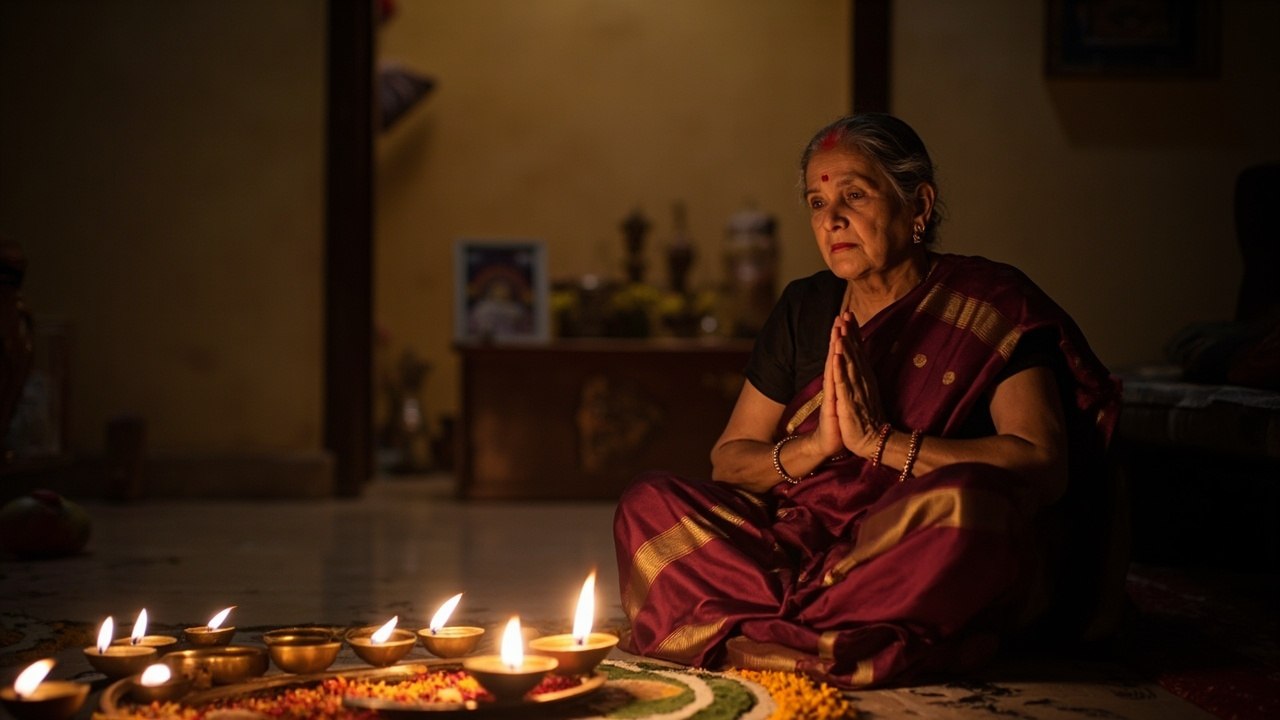
The main night. The new-moon night (Amavasya) of Kartik is the darkest night of the year, and Hindus fill it deliberately with lamps. Houses are cleaned, doorsteps are decorated with rangoli, and families gather for Lakshmi Puja — the central ritual of the festival. This is the night when the wealth deity is believed to roam the earth, choosing which homes are worthy of her blessing.
Day 4 — Govardhan Puja (Padwa)
The day after Diwali is dedicated to Lord Krishna’s lifting of the Govardhan mountain, when he protected the villagers of Braj from the wrath of Indra. In many regions, especially in North India, this day is also called Padwa or Pratipada and marks the beginning of the new financial year for traditional businesses. Married women pray for the long life and well-being of their husbands, much like the sacred symbols of marriage they wear.
Day 5 — Bhai Dooj (Yama Dwitiya)
The festival closes with Bhai Dooj, a day when sisters apply a tilak on their brothers’ foreheads and pray for their protection and long life. The ritual echoes the bond between Yama, the god of death, and his sister Yamuna, and is the festival’s closing affirmation of family bonds.
Lakshmi Puja — The Heart of Diwali Night
Of all the rituals across the five days, Lakshmi Puja on Amavasya is the spiritual center of gravity. Performed after sunset, the puja involves:
- Setting up a clean altar with the idol or image of Goddess Lakshmi, often alongside Lord Ganesha — the remover of obstacles — and sometimes Saraswati, the deity of learning.
- Lighting five lamps, one for each of the five elements (earth, water, fire, air, ether) and placing fresh marigold flowers and a small bowl of rice around the deity.
- Chanting the Lakshmi Sahasranama (the thousand names of Lakshmi) or the Sri Sukta from the Rig Veda.
- Offering sweets, particularly homemade ladoos and kheel-pattal, and distributing prasad to family members and neighbors.
The deeper symbolism of the puja is striking: Lakshmi does not sit on a throne of gold; she stands on a lotus rising from the waters of cosmic existence. Her four hands represent the four Purusharthas — dharma, artha, kama, and moksha. By worshipping her with lamps on the darkest night, devotees are declaring that prosperity is meaningful only when it is rooted in righteousness.
The Story of Rama’s Return to Ayodhya
The most popular narrative behind Diwali is from the Ramayana. After fourteen years of exile and a fierce battle against the demon king Ravana, Lord Rama, his wife Sita, and his loyal brother Lakshmana return to the kingdom of Ayodhya. The people of Ayodhya, overjoyed, lit thousands of earthen lamps to guide their king home through the dark forest.
The return of Rama is far more than a political homecoming. In the symbolism of the Hindu tradition, Rama represents the ideal human being — a being who combines warrior strength (he destroyed Ravana) with absolute devotion to dharma (he never strayed from righteousness, even at great personal cost). Sita represents the soul that has been tested by fire; Lakshmana represents selfless service. Diwali, in this telling, is the celebration of dharma’s restoration.
This is also why, in many North Indian households, a small Ram Darbar (a tableau of Rama, Sita, Lakshmana, and Hanuman) is placed at the puja altar during Diwali — the festival is a re-enactment of Ayodhya’s joy.
The Story of Krishna and Narakasura
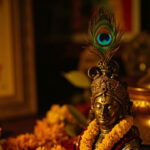
In South India and in many Maharashtrian and Gujarati traditions, the central Diwali story is different: it is the victory of Lord Krishna over the demon Narakasura. According to the Padma Purana, Narakasura had terrorized the heavens and the earth, abducting 16,000 princesses and stealing the earrings of Aditi, the mother of the gods. Krishna, riding his mount Garuda, defeated the demon in battle and freed the captives.
The morning after this victory — the day known as Naraka Chaturdashi — devotees take an oil bath at sunrise. The bath is symbolic of being cleansed from the residue of the past year. Sweets are distributed, and in Tamil Nadu this day is also called Deepavali Nombu, a day of fasting and prayer.
Together, the two stories — Rama’s homecoming and Krishna’s victory — show that Diwali is not bound to a single narrative. The festival absorbs whichever local tradition has been kept alive in a region, while preserving the same underlying truth: light is restored, darkness is dispelled, and dharma is reaffirmed.
Inner Diwali — The Victory Within
Perhaps the most powerful layer of Diwali’s spiritual significance is the inner one. Hindu philosophy has long taught that the battle between light and darkness is not only fought in the outside world; it is fought, every single day, in the human mind.
The Bhagavad Gita describes the daivi sampatti — divine qualities such as truthfulness, compassion, and self-control — and the asuri sampatti — demonic qualities such as anger, greed, and pride. The lighting of a lamp on Diwali night is a prayer that the divine qualities within us will shine brighter than the negative ones. As the Isha Upanishad puts it, the Self within shines like a lamp; the outer lamp is simply a reminder of that inner light.
For this reason, the lamps lit during Diwali are not meant to chase away literal darkness — they could simply use a switch. They are meant to chase away avidya, ignorance. When the home is filled with rows of small flames, the message is clear: let there be light — in the streets, in the temples, and above all in the heart.
Diwali in Jainism and Sikhism
Diwali is not a Hindu-only festival. Jains observe it as the day Lord Mahavira, the 24th Tirthankara, attained moksha (liberation) at Pavapuri in Bihar. The lamps lit by Jains on this night symbolize the light of the soul freed from the cycles of birth and death — the same light that all Hindu traditions ultimately seek.
Sikhs celebrate Diwali as Bandi Chhor Divas, marking the day Guru Hargobind, the sixth Sikh Guru, was released from imprisonment in the Gwalior Fort and returned to Amritsar. The famous Akhand Path (continuous recitation of the Guru Granth Sahib) is completed on this day, and the Golden Temple in Amritsar is illuminated with thousands of lamps in a scene that closely mirrors the Hindu Diwali celebration.
Across these traditions, the festival keeps its core message: truth is vindicated, the captive is freed, and light returns.
Diwali Around the World
Diwali is now celebrated in nearly every country with a significant Indian diaspora. In Nepal, the festival is called Tihar and lasts five days, with crows, dogs, cows, and oxen worshipped on the first four days before humans on the fifth. In Sri Lanka, the Tamil community lights lamps and exchanges sweets in much the same way as in Tamil Nadu. In Malaysia, Singapore, and Mauritius, public spaces are lit up and open-air markets stay open late into the night. In Trinidad and Tobago, the festival has been celebrated since the arrival of Indian indentured laborers in the 19th century and is a national holiday.
In each of these places, the festival has retained its spiritual core. The lamps, the sweets, the new clothes, and the gatherings of family are not merely customs; they are a continuous thread that ties diaspora communities back to a shared civilizational memory.
How to Celebrate Diwali with Spiritual Intent
If you want this year’s Diwali to feel more than just a public holiday, a few small practices can bring its spiritual meaning to life:
- Clean the home before Diwali — not just physically, but emotionally. Old resentments, broken relationships, and grudges can be quietly released. The outer cleanliness is meant to mirror an inner one.
- Light a row of five lamps, not one — each for one of the five elements, or one for each member of the family. A single lamp is symbolic; a row is the festival.
- Read the Ramayana — even one chapter from the Yuddha Kanda, where Rama defeats Ravana, can connect the family to the story that gave rise to Diwali.
- Share sweets — the giving of mithai is not a courtesy; it is the literal practice of sharing the sweetness of life with those around you. Include neighbors, servants, and those who might otherwise be forgotten.
- Sit in silence for a few minutes after the puja — the lamps will still be burning, the house still fragrant. A few minutes of mauna (silence) after the rituals lets the inner work the festival was designed for actually happen.
None of these practices are difficult. Together they take less than a day. But they transform Diwali from a public celebration into a private renewal — and that is the festival’s deeper spiritual significance.
Frequently Asked Questions
Why is Diwali called the festival of lights?
Diwali gets its name from the Sanskrit word dīpāvalī, meaning “a row of lamps.” The festival is called the festival of lights because Hindus light rows of small earthen lamps in their homes, temples, and streets to symbolize the victory of light over darkness, knowledge over ignorance, and good over evil.
What is the spiritual meaning of lighting diyas on Diwali?
Lighting a diya on Diwali represents the removal of inner darkness — ignorance, ego, greed, and attachment — and the awakening of the divine light that, according to the Upanishads, already shines within every human being. The lamp outside is a reminder of the lamp inside.
Which is the most important day of Diwali?
The third day — Amavasya of the Kartik month — is the main day of Diwali. Lakshmi Puja is performed on this night, and it is the night on which most households light the largest number of lamps, exchange gifts, and burst crackers. However, all five days of the festival carry their own importance.
Is Diwali only a Hindu festival?
No. Diwali is also celebrated by Jains as the day Lord Mahavira attained moksha, by Sikhs as Bandi Chhor Divas (the release of Guru Hargobind), and by some Buddhists. It is also observed by the Hindu and Jain diaspora in dozens of countries around the world.
What is the difference between Diwali and Deepavali?
Diwali and Deepavali are the same festival. Deepavali is the original Sanskrit form of the word and is the term used in South India. Diwali is the contracted, more common North Indian pronunciation. Both mean a row of lamps.
How long should Diwali celebrations last?
Traditionally, Diwali celebrations span five days — from Dhanteras to Bhai Dooj. Many families also keep a wider “festive season” of about ten days that begins with Vagh Baras and ends with Labh Pancham, especially in Gujarat and Maharashtra.
Can Diwali be celebrated without firecrackers?
Yes. Many families now observe a noiseless Diwali, especially in cities where air pollution from firecrackers has become severe. The core of Diwali is the lamp, the puja, the family, and the inner resolve to dispel darkness — none of which require firecrackers.
Related Articles on Sattvicgyaan
- Hinduism & Environmental Conservation: Ancient Roots of Modern Ecology
- Why Do Hindus Fast? The Meaning of Vrat, Ekadashi, Navratri
- Why Do Hindus Touch Elders’ Feet? The Sacred Tradition of Charan Sparsh
- The 4 Purusharthas: Dharma, Artha, Kama, Moksha — A Complete Guide
- What is Karma? The Law of Cause and Effect Explained
- Understanding Moksha: Liberation and Spiritual Freedom in Hinduism