Kumbh Mela: What It Is, Why It Happens, and What Happens There
Every few years, an entire city of tents, ashrams, and bamboo bridges rises on a riverbank in India. Over the course of a few weeks, tens of millions of Hindu pilgrims walk barefoot into cold winter waters to take a single bath. The event is called the Kumbh Mela — the largest peaceful gathering of people on Earth, and one of the oldest continuously observed religious festivals in the world. In 2019, the Prayagraj Kumbh drew an estimated 150 million visitors, a number that briefly made it visible from space.
To a first-time visitor or a curious reader outside India, the Kumbh Mela can look like a wall of colour and chaos — naked ash-smeared sadhus, brass bands, head-shaving barbers, children clutching their parents, police barricades, and saffron flags waving over a sea of tents. Behind the spectacle is a deeply layered set of stories, dates, scriptures, and astrological alignments that Hindus have been telling for centuries. This guide walks through the what, where, when, who, and why of Kumbh Mela so you can understand not just what happens there, but what it means.
The Origin Story: Samudra Manthan and the Pot of Nectar
The word Kumbh means “pot” in Sanskrit, and Mela means “gathering” or “fair.” Put together, Kumbh Mela literally means “the gathering of the pot.” The “pot” in question is the kumbha of amrita, the nectar of immortality, which Hindu mythology says the gods and demons churned out of the cosmic ocean.
The story comes from the Samudra Manthan (“churning of the ocean”), a long episode in the Puranas. According to the Vishnu Purana and the Bhagavata Purana, the devas (gods) had grown weak because of a curse by the sage Durvasa. To recover their strength, they needed to drink amrita. They agreed with the asuras (demons) to churn the cosmic milk-ocean together, using Mount Mandara as the churning rod and the serpent Vasuki as the rope.
When the pot of amrita finally emerged, the demons seized it. Fearing the demons would misuse the nectar, Lord Vishnu took the form of the enchantress Mohini, distracted the asuras, and whisked the pot away. As she flew across the sky, four drops of the nectar fell to Earth — at Prayagraj (the Triveni Sangam of the Ganga, Yamuna, and mythical Saraswati), Haridwar (where the Ganga enters the plains), Nashik (on the Godavari, in Maharashtra), and Ujjain (on the Shipra, in Madhya Pradesh). These four cities became the sacred sites of the Kumbh Mela.
The Four Sacred Sites of Kumbh Mela
Kumbh Mela is held at four places, each linked to one of the dropped nectar-drops and to a specific zodiac alignment of Jupiter, the Sun, and the Moon:
Prayagraj — Triveni Sangam (the Confluence)
The most famous of the four is the Triveni Sangam at Prayagraj (formerly Allahabad) in Uttar Pradesh. This is the mythical confluence of three rivers: the Ganga, the Yamuna, and the Saraswati, which Hindu tradition says flows underground to meet them. Bathing at the sangam is believed to wash away lifetimes of accumulated sin and to shorten the soul’s journey toward moksha (liberation from the cycle of rebirth). The Prayag Kumbh is held every twelve years, with a smaller Magh Mela each year.
Haridwar — Where the Ganga Enters the Plains
Haridwar, literally “the gate of God,” sits in Uttarakhand where the Ganga leaves the Himalayas and begins its long journey across the plains. The Haridwar Kumbh falls when Jupiter enters Aquarius (Kumbh in Sanskrit — hence the festival’s name) and the Sun is in Aries. Pilgrims stand on the Har Ki Pauri ghat and bathe in the fast-flowing Ganga.
Nashik — On the Banks of the Godavari
In Maharashtra, the Kumbh Mela is held at Nashik (and at Trimbakeshwar, about 28 km away) on the Godavari river. Here too, legend says the nectar-drop fell during Mohini’s flight. The Nashik Kumbh is also called Simhastha, because it falls when Jupiter enters the Leo (Simha) zodiac sign. The cycle here is also twelve years.
Ujjain — On the Banks of the Shipra
Ujjain in Madhya Pradesh is the fourth Kumbh site. It sits on the Shipra river and is also one of the seven sacred cities of Hinduism, with the famous Mahakaleshwar Jyotirlinga temple. The Ujjain Kumbh, like Nashik’s, is timed to Jupiter’s transit into Leo.
When Is Kumbh Mela Held? The Astrological Timing
Unlike a fixed-date festival such as Diwali or Holi, the timing of Kumbh Mela is determined by the alignment of specific planets in the zodiac. The general rule is this: Kumbh Mela is held when Jupiter enters the relevant zodiac sign and the Sun enters a specific position, and these alignments recur roughly every 12 years. Because Jupiter’s actual orbital period is about 11.86 years, the Kumbh rotates among the four sites in a 12-year cycle.
There is also a more important variant called the Maha Kumbh Mela, which is held only at Prayagraj and only when Jupiter is in Aries and the Sun and Moon are in specific positions. The last Maha Kumbh at Prayagraj was in 2025. There is also an even rarer Purna Kumbh, which only happens every 144 years.
Each Kumbh lasts about six to eight weeks, but the most important bathing days are concentrated in the first few weeks. These specific dates are called Shahi Snan — the royal bath days — and they are the heart of the festival.
The Shahi Snan — The Royal Bath
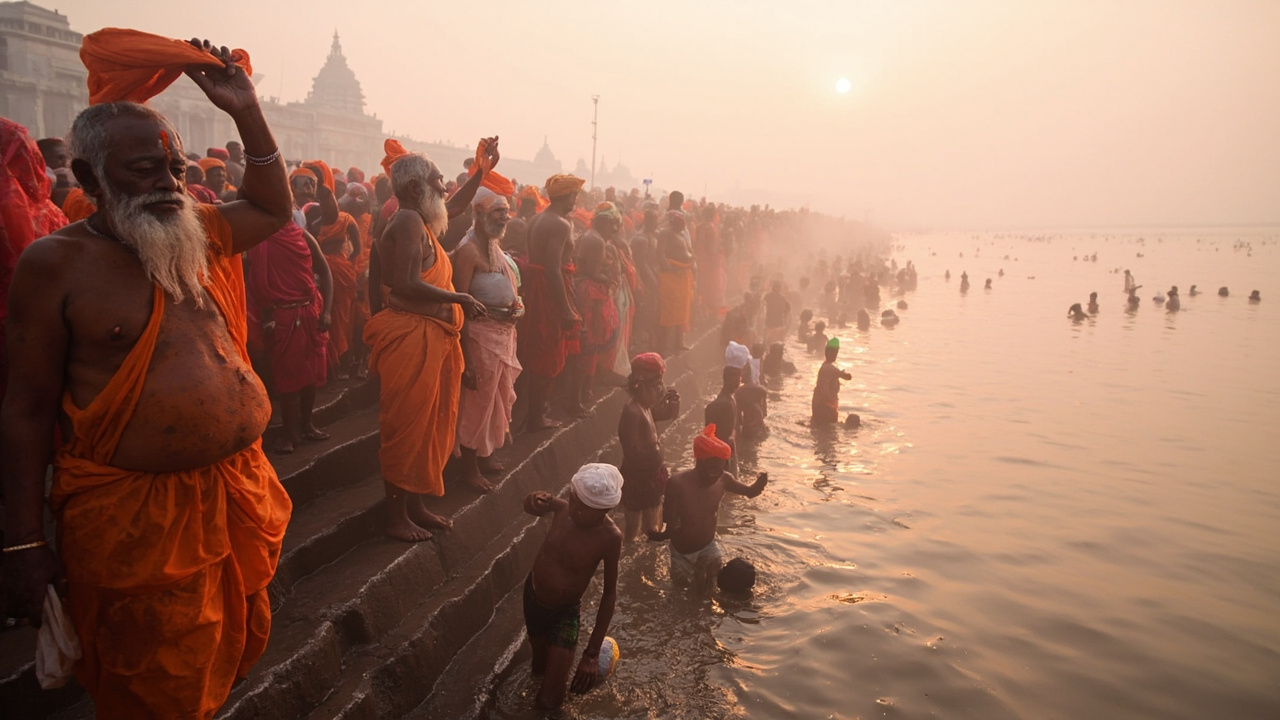
If you have ever seen a photograph of Kumbh Mela, it almost certainly shows a Shahi Snan day. These are the most sacred dates of the festival, and the bathing order on those mornings is fixed and ancient.
The Shahi Snan procession is led by the akharas — Hindu monastic orders of sadhus and ascetics, each with centuries of tradition behind them. The most photogenic are the Naga Sadhus, naked or nearly naked ascetics who smear their bodies with sacred ash (vibhuti), wear their hair in long matted dreadlocks (jata), and carry weapons like tridents, swords, and kamandalu (water pots). On Shahi Snan days, they march in procession through the city to the river, accompanied by the beating of drums, blowing of conch shells, and chanting of victory slogans.
By custom, the akharas bathe in a specific order — for example, the Mahanirvani Akhara often goes first, followed by the Juna, the Atal, the Nirvani, and the Digambar sects. After the sadhus have bathed, ordinary pilgrims enter the water in waves. The dates of Shahi Snan are calculated by Vedic astrologers and announced well in advance.
Naga Sadhus and the Akharas
The naked ash-smeared sadhus you see on television are Naga Sadhus — warrior-ascetics who trace their lineage to the Shaiva tradition of Lord Shiva. Many of them have lived for decades in Himalayan caves or in forested ashrams, appearing in public only at Kumbh Mela.
They are organised into akharas, which function as monastic orders and, historically, as armed militias. The seven main akharas today are Mahanirvani, Juna, Atal, Nirvani Anand, Digambar, Nirmal, and Bada Udaseen. Each akhara has its own leader (a mahamandaleshwar or shankaracharya), its own flag, its own sect of Shaiva or Vaishnava practice, and its own rules for disciples. For a student of Hindu monasticism, the Kumbh Mela is one of the few chances to see all of them gathered in one place.
Most Naga Sadhus are followers of Shiva, but Vaishnava sadhus and Shakta (goddess-centred) orders also attend. Their presence is part of why the Kumbh is described as a gathering of all of Hinduism rather than a single sect’s festival.
What Actually Happens at Kumbh Mela
Beyond the bathing days, Kumbh Mela is also one of the largest temporary cities ever built. Modern Kumbhs include:
- Temporary tent cities housing anywhere from 50 to 100 million pilgrims
- Massive pontoon bridges across the river
- Hundreds of discourses, kirtans (devotional singing), and Vedic recitation sessions by scholars and saints
- Free bhandaras (community kitchens) feeding millions of pilgrims daily
- Health camps and lost-and-found centres run by the state government
- Special trains, highways, and pilgrim corridors to manage the inflow
Many ordinary pilgrims spend their time at the Kumbh not just bathing but also taking darshan (sacred sight) of revered saints, getting head-shaved at the barbers’ ghats, performing tarpan (water-offerings to ancestors), and listening to discourses on the Bhagavad Gita, the Upanishads, and the Yoga Sutras.
The Spiritual Significance — Why Do Hindus Attend?
For the pilgrims who come, the Kumbh Mela is not a tourist event — it is one of the most spiritually consequential acts of their lives. Three core ideas motivate the trip:
- Purification of past sins. Bathing at the right place, at the right time, with the right intention is believed to wash away paap (sins accumulated across lifetimes). This is the practical, karmic promise of the festival.
- A step toward moksha. Within the broader Hindu framework of the four purusharthas (the aims of a human life), Kumbh Mela is associated with the fourth and highest aim — moksha, or liberation from the cycle of rebirth. Bathing at the sangam, especially during the Shahi Snan, is said to accelerate this journey.
- A rare chance to be in the company of saints. Sadhus, swamis, and renunciates from across the country gather at the Kumbh. For many pilgrims, simply being in the proximity of these holy men, hearing them speak, and receiving their blessing (darshan) is itself a deeply transformative experience.
It is also a deeply communal experience. Families travel together across generations. Friends meet at the same ghats they met at a decade ago. Returning home after Kumbh Mela is, for many Hindus, a kind of spiritual graduation.
Kumbh Mela in Modern Times
The Kumbh Mela has been documented by outside observers for centuries — the Chinese traveller Xuanzang visited a Kumbh at Prayag in the 7th century CE. In the colonial era, the British built railway lines partly to manage the pilgrim flow. In recent years, the scale has grown dramatically. The 2019 Prayagraj Kumbh drew more than 150 million visitors — more people than the entire population of Russia.
Modern Kumbhs involve major logistical challenges: crowd-management systems, sanitation for tens of millions of temporary residents, river-water quality monitoring, and security. The Indian Army, navy, and air force have all been deployed at various Kumbhs. There is also ongoing ecological debate around the impact of pontoon bridges, mass bathing, and plastic waste on the rivers themselves — a conversation that resonates with the Hindu framing of rivers as living deities.
Yet for all the changes in scale, the spiritual core of the festival has stayed remarkably steady. A grandmother from a small village in Tamil Nadu who walks down to the sangam at dawn to take her bath in 2025 is doing essentially the same thing that her great-great-grandmother did in 1945, or that Xuanzang watched in the 7th century. The pot of nectar has long since evaporated, but the gathering it began goes on.
Frequently Asked Questions
What is Kumbh Mela in simple words?
Kumbh Mela is the largest peaceful gathering of Hindu pilgrims on Earth. It is held every few years at four sacred river sites in India — Prayagraj, Haridwar, Nashik, and Ujjain — and centres on the ritual bathing in rivers during specific astrological alignments. The name literally means “the gathering of the pot of nectar” and comes from the Hindu story of the churning of the cosmic ocean.
Where is the Kumbh Mela held?
The Kumbh Mela rotates between four sites: the Triveni Sangam at Prayagraj (Uttar Pradesh), Har Ki Pauri at Haridwar (Uttarakhand), the Godavari river at Nashik (Maharashtra), and the Shipra river at Ujjain (Madhya Pradesh). Each site is associated with a different astrological alignment.
When is Kumbh Mela held?
The Kumbh Mela is held approximately every 12 years at each of the four sites. The exact dates are determined by the position of Jupiter, the Sun, and the Moon in the zodiac. There is also a more important Maha Kumbh Mela held at Prayagraj every 144 years; the most recent was in 2025.
What happens on Shahi Snan days?
Shahi Snan (“royal bath”) days are the most sacred dates of the Kumbh. On these mornings, the akharas (Hindu monastic orders of sadhus and ascetics) lead the procession into the river. The Naga Sadhus, naked ash-smeared ascetics of the Shaiva tradition, are the most visible participants. After the sadhus bathe, ordinary pilgrims enter the water in waves.
Why are sadhus naked at Kumbh Mela?
The naked ascetics you see are Naga Sadhus, members of Shaiva monastic orders who have renounced all possessions, including clothing. They smear their bodies with sacred ash, wear their hair in long dreadlocks, and carry items like the trident and kamandalu. Their renunciation of clothing is a public symbol of having let go of material identity.
Is Kumbh Mela the largest gathering in the world?
Yes, Kumbh Mela is widely regarded as the largest peaceful gathering of people on Earth. The 2019 Prayagraj Kumbh attracted an estimated 150 million visitors over its six-week run, a number briefly visible from satellite imagery. The Maha Kumbh at Prayagraj in 2025 drew even larger crowds.
Do non-Hindus attend Kumbh Mela?
Yes. Kumbh Mela is open to people of all backgrounds, and visitors from many countries and faiths attend to observe the rituals, listen to the discourses, and see the city of tents. The event has been studied by sociologists, anthropologists, and public-health researchers from around the world.
What is the difference between Kumbh Mela and Magh Mela?
The Magh Mela is the annual smaller version of the Kumbh held every year at Prayagraj in the Hindu month of Magh (January–February). The full Kumbh Mela at Prayagraj happens every twelve years; the Magh Mela is a yearly event that draws smaller crowds but follows many of the same bathing traditions.
Related Articles
- Why Do Hindus Fast? Meaning of Vrat, Ekadashi, Navratri
- The 4 Purusharthas: Dharma, Artha, Kama, Moksha
- Understanding Moksha: Liberation and Spiritual Freedom
- What is Karma? The Law of Cause and Effect
- What is the Bhagavad Gita? Summary, Teachings, and Significance
- Hinduism and Environmental Conservation