What is Sandhyavandanam? Hindu Twilight Prayer — Meaning, Procedure & Significance
Sandhyavandanam (संध्यावन्दनम्) is the ancient Hindu daily ritual of reciting the Gayatri Mantra at the three junctures of the day — dawn, noon, and dusk. Performed for centuries by Brahmin men after their Upanayanam (sacred thread ceremony), it is one of the five Pancha Mahayajnas (daily sacrifices) prescribed in the Dharma Sutras, and is considered the spiritual backbone of a Brahmin’s daily life. In this guide, we explore what Sandhyavandanam means, the scriptural basis behind it, the exact procedure, the role of the Gayatri Mantra, and why this simple daily prayer has shaped Hindu consciousness for over three millennia.
What Does “Sandhyavandanam” Mean?
The word Sandhyavandanam is a Sanskrit compound of two terms: Sandhya (संध्या), meaning “twilight” or “the junction between two periods”, and Vandanam (वन्दनम्), meaning “salutation”, “worship”, or “obeisance”. Together, the word literally translates to “worship at the twilight hour”.
In the broader Vedic context, sandhya refers to any transitional period — the dawn between night and day, the noon between morning and afternoon, and the dusk between day and night. Each transition was considered a spiritually charged moment when the veil between the human and the divine thins, and the recitation of sacred mantras was believed to carry disproportionate merit. The act of “vandanam” — bowing, saluting, reciting with reverence — was the proper human response to these charged hours.
In Tamil and South Indian usage, the prayer is also called Sandhyavandhanam (with a terminal anusvara), and among Iyengars (Sri Vaishnavas) it is sometimes specifically referred to as Sandhyavandanam Prayogam — the “rite” or “procedure” of twilight prayer, since the manual of ritual steps is itself a key part of the tradition.
The Three Daily Sandhyas
The Shatapatha Brahmana and the Dharma Sutras (particularly the Asvalayana, Apastamba, and Paraskara Grihya Sutras) prescribe that Sandhyavandanam must be performed three times every day. Each juncture has its own name, its own astronomical trigger, and a slightly modified ritual sequence.
1. Prataḥ-Sandhya (प्रातःसन्ध्या) — Dawn Prayer
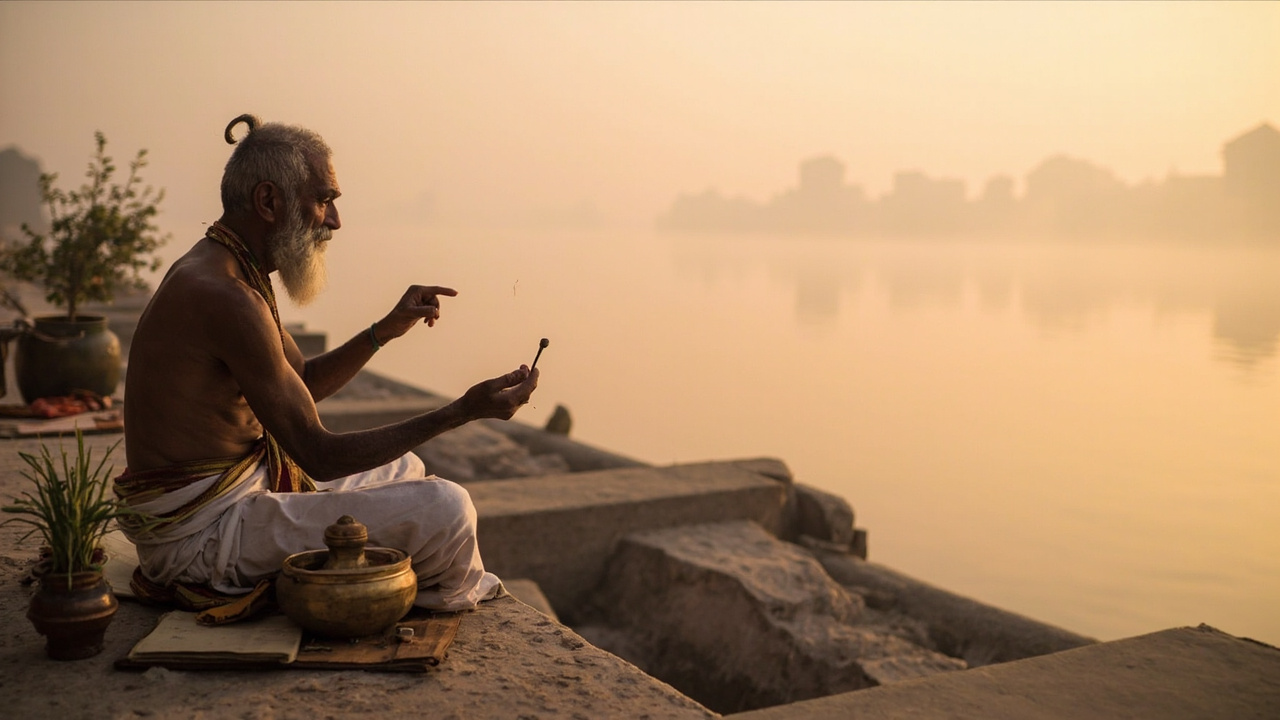
Performed when the stars are still visible but a thin reddish glow appears on the eastern horizon — roughly 96 minutes (two muhurtas) before sunrise according to traditional calculations. This is considered the most important of the three and the one where the Gayatri Mantra is recited in full. Brahmins traditionally bathe in cold water before this prayer, often in a nearby river or tank.
2. Madhyahnika-Sandhya (माध्याह्निकसन्ध्या) — Noon Prayer
Performed at the midpoint of the day when shadows fall directly beneath an object — the astronomical “midday” rather than 12:00 PM on the clock. The mantra recitation is shorter (sometimes only the Gayatri is repeated without the full expansion), and a bath is not strictly required.
3. Sayam-Sandhya (सायंसन्ध्या) — Dusk Prayer
Performed from afternoon until about 12 minutes after sunset, when the reddish glow fades from the western horizon. This is also called Pradosha in some traditions, although Pradosha more technically refers to a slightly later evening juncture linked to Shiva worship.
A dedicated practitioner never skips any of the three. The Manusmriti (6.8) states that missing even a single Sandhya through negligence causes loss of the Brahmin’s daily merit (dina-phalam).
Who Performs Sandhyavandanam?
Sandhyavandanam is fundamentally a dvija (twice-born) ritual — it is open only to those who have undergone the Upanayanam (sacred thread ceremony) and are invested with the yajnopavita (sacred thread, also called janeu in Hindi or poonool in Tamil). Within the dvija fold, it is most strictly observed among Smartha Brahmins, Iyer Brahmins, and Konkani Saraswat Brahmins. Other Brahmin sub-communities (such as Chitpavans or Havyaka Brahmins) follow their own regional Grihya Sutras with minor procedural variations.
The ritual may be performed by boys as soon as their Upanayanam is complete — historically, around ages 7 to 12 depending on the region. In traditional gurukula education, the morning Sandhya was the first task of the day before Vedic recitation began.
Women in most Brahminical traditions traditionally do not perform Sandhyavandanam in the same public form, although in some South Indian Smarta and Srivaishnava traditions women may recite a shortened Gayatri prayer at the threshholds or as part of their daily Sandhya Vandanam. The reformist Arya Samaj tradition (founded by Swami Dayananda Saraswati in the 19th century) actively encouraged women to perform the full Sandhyavandanam, viewing scriptural gender restrictions as later additions.
The Step-by-Step Procedure
The exact steps vary slightly by tradition and sect, but a typical Smartha Brahmin’s pratah-sandhya follows this sequence, drawn largely from the Asvalayana Grihya Sutra and codified in digests such as the Nityakarma Paddhati.
1. Achamanam (आचमनम्) — Purification
The practitioner, after bathing and wearing a fresh yajnopavita, sits cross-legged (often sukhasana or padmasana) on a clean mat facing east (north in some traditions). They take water three times in the palm of the right hand — each time sipping a few drops while reciting the Achamanam mantras: “Keshavaya namah, Govindaya namah, Madhave namah…” (twelve names of Vishnu or Surya, depending on tradition). This purifies the speech organs and the digestive tract symbolically.
2. Pranayama (प्राणायामः) — Breath Control
The practitioner performs Pranayama — a controlled breath exercise, typically inhale-retain-exhale in a 1:4:2 ratio. A brief japa of the Bija Mantra “Om” accompanies each cycle, repeated 3 to 12 times. This is believed to steady the mind and bring the pranas (life-forces) under conscious direction.
3. Gayatri Japa (गायत्रीजपः) — Recitation of the Mantra
The core of Sandhyavandanam is the vocal recitation of the Gayatri Mantra, ideally on a mani (prayer bead) string of 108 beads. The full Gayatri is recited 108 times in the morning Sandhya, 28 times at noon, and 108 times at dusk (totalling roughly 244 recitations per day). Some traditions also include the extended Anganyaasa and Karanyasa mudras — symbolic gestures invoking the mantra into the limbs and fingers.
4. Tarpanam (तर्पणम्) — Offering to Gods, Sages, and Ancestors
With water and darbha grass held in the cupped palm, the practitioner offers water to the gods (Deva Tarpanam), to the sages (Rishi Tarpanam), to the ancestors (Pitru Tarpanam), and finally to one’s self. The water drips through the fingers and the bent darbha blade. In some traditions, this is done standing, facing the sun, with the right arm exposed.
5. Upasthana (उपस्थानम्) — Final Salutation
Concluding prayer: “Kartaa mayi sreshthatamam karmakartum vidhehi me” or similar, requesting the divine to bless the day’s work. A short pradakshina (circumambulation) of the worship area and a final namaskara close the ritual.
The Gayatri Mantra — The Heart of Sandhyavandanam
The Gayatri Mantra, recited in the central step, is among the most sacred mantras in Hinduism. It appears in the Rigveda (3.62.10) attributed to the rishi Vishvamitra:
“Om bhargo devasya dhimahi, dhiyo yo nah prachodayat.”
Translation: “We meditate on the splendour of the radiant Sun God (Savitur); may He illuminate our intellects.”
The full Gayatri incorporates three Vedic meters (Gayatri, Ushnik, Anushtubh) with the sacred syllable Om. The traditional commentary identifies the deity of the mantra as Savitur (the solar deity), and the rishi as Vishvamitra. The mantra is sometimes described as the Veda in a single breath — encapsulating the entire Vedic insight that the divine light and the human intellect are not separate.
Swami Vivekananda, in his interpretation of Sandhyavandanam in the late 19th century, called the Gayatri Mantra “the essence of all the Vedas”, and his disciple Sister Nivedita famously wrote that “the Gayatri is the mother of the Vedas”. The mantra is also recited by non-Brahmins as part of devotional prayers, weddings, and funerals, even if the full Sandhyavandanam procedure is reserved for dvija Brahmins.
Scriptural Basis
The authority for Sandhyavandanam flows from several layers of Vedic and post-Vedic literature:
Vedic
The Yajur Veda in its prose commentary sections (the Brahmanas) explicitly prescribes a daily Sandhya prayer. The Shatapatha Brahmana discusses the cosmic symbolism of the three junctions. The Gayatri Mantra itself comes from the Rigveda (3.62.10).
Grihya Sutras
The domestic ritual manuals — Asvalayana, Paraskara, Apastamba, Gobhila — detail the practical steps of Sandhya for their respective branches of Brahmins. These are the most relevant texts for the daily procedure.
Dharma Shastras
The Manusmriti (Chapter 4 and 6) lists Sandhyavandanam as a daily obligation (nityakarma) of the Brahmin. The Yajnavalkya Smriti discusses it in similar terms. The Dharma Sindhu, a digest by Kashinath Upadhyaya (1790 CE), remains a standard reference for daily conduct including Sandhyavandanam.
Puranas
The Garuda Purana, Vishnu Purana, and Brahma Vaivarta Purana all glorify Sandhyavandanam as a path to moksha. The Padma Purana declares that a Brahmin who performs the three daily Sandhyas accumulates the merit equivalent to a thousand Asvamedha sacrifices.
Benefits and Significance
Hindu texts describe three primary categories of benefit from daily Sandhyavandanam:
Spiritual Merit (Dharma-Phalam)
Recitation of the Gayatri burns away past sins, earns divine grace, and grants spiritual progress toward moksha. The Brahma Sutras (in various commentaries) suggest the Gayatri, by constantly reminding the practitioner of the divine, loosens the knots of avidya.
Mental Discipline and Clarity
Twice-daily or thrice-daily mantra recitation acts as a meditation anchor. Modern studies on mantra repetition and breath control show measurable effects on heart-rate variability, stress reduction, and focus — consistent with what traditional texts claim about dhi (intellect) being “illuminated” through the practice.
Cultural Continuity
Sandhyavandanam has functioned as the social marker and self-definition of Brahmin communities for over two thousand years. Performing it together (in some monastic settings called Goshti Sandhya) reaffirms identity and shared tradition.
Modern Practice and Revival
By the early 20th century, daily Sandhyavandanam had declined sharply outside Brahmin enclaves and religious institutions, replaced by morning and evening temple visits or secular work schedules. Swami Dayananda Saraswati’s Arya Samaj attempted a major revival in the 1870s, republishing the procedure in Hindi and campaigning to bring it back into schools and households.
In contemporary India, regular practice survives mainly in:
- Traditional Brahmin families (particularly in Tamil Nadu, Karnataka, coastal Andhra, coastal Karnataka, Konkan, and Kashi/Varanasi)
- Religious mathas and hermitages
- Vedic schools (pathshalas and gurukulas) where students perform it daily under guidance
Online Sandhyavandanam tutorials on YouTube have introduced the procedure to diaspora Hindus in the United States, UK, Singapore, and Australia. Many temples now offer morning Sandhya group recitations where anyone interested — Brahmin or not — can attend and listen, even if full dvija ritual remains restricted to those with Upanayanam.
The growing global interest in meditation, breathwork, and Hindu philosophy has renewed curiosity about Sandhyavandanam as a form of structured daily spiritual practice, distinct from gym routines or yoga sessions — and arguably more enduring.
Frequently Asked Questions (FAQ)
1. Can non-Brahmins perform Sandhyavandanam?
Strictly, the dvija ritual is open only to those with Upanayanam. However, anyone can recite the Gayatri Mantra itself as a devotional prayer (at temple visits, weddings, or as part of their meditation). The Arya Samaj tradition actively encourages all (including women and non-Brahmins) to perform the full procedure.
2. What if I miss a Sandhya?
Traditional texts recommend performing the missed Sandhya as soon as remembered, with shortened procedure. Persistent neglect is considered a lapse in daily nityakarma. The Dharma Sindhu details prayaschitta (atonement) rites.
3. Do women perform Sandhyavandanam?
In most Smartha and Srivaishnava traditions of South India, women are not required to perform the dvija form. But many women in those communities recite the Gayatri Mantra daily as part of their personal prayer. The Arya Samaj encourages all women to perform the full Sandhya. Reformist Hindu movements including the Theosophical Society have campaigned for wider inclusion.
4. How long does it take?
A full morning Sandhyavandanam with 108 Gayatri recitations takes 25-40 minutes for an experienced practitioner. The noon and dusk versions are shorter (15-20 minutes).
5. Do I need to learn Sanskrit first?
Yes — the mantras are in Vedic Sanskrit and must be pronounced correctly. A guru or qualified teacher can guide the pronunciation, ideally through in-person transmission. Many online resources exist, but traditional texts caution against self-learning from written sources alone.
6. Is Sandhyavandanam the same as meditation?
It contains meditative elements (Pranayama, mantra repetition), but it is also a ritual with fixed steps (Achamanam, Tarpanam, Upasthana). Compare with puja (which is more elaborate and deity-specific) and japa (which is mantra-only).
7. Can I do it at home or do I need a temple?
At home is fine — most practice it in a private clean space. The key requirement is facing the correct direction (east at dawn, north or east at noon depending on tradition, west at dusk) and a quiet atmosphere.
Related Articles on Sattvicgyaan
- Upanayanam: The Hindu Sacred Thread Ceremony — Meaning, Vidhi & Significance
- Pancha Mahayajna: Meaning and Significance in Hinduism
- Why is Sanskrit Considered Sacred? The Divine Language of Hinduism Explained
- Why Do We Ring Bells in Temples?
- Why Do Hindus Fast? (Ekadashi, Navratri)
- The 4 Ashramas of Life (Brahmacharya, Grihastha, Vanaprastha, Sannyasa)