Why Does Shiva Have a Third Eye? Hindu Symbolism Explained
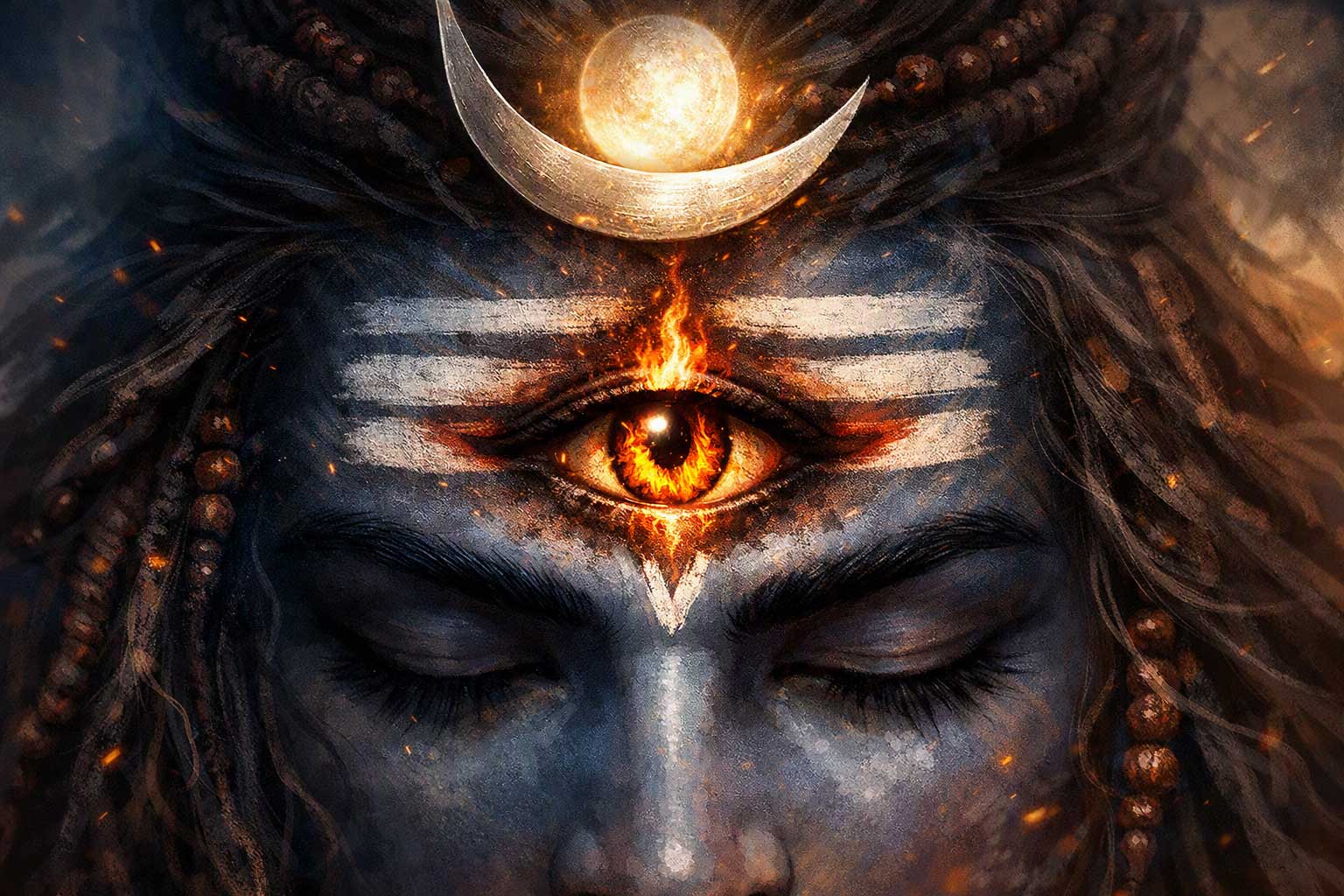
If you have ever stood before a Shiva murti in a temple and noticed the vertical eye marked on its forehead, you may have wondered why does Shiva have a third eye. That extra eye — called Trinetra (त्रिनेत्र) in Sanskrit, meaning “three-eyed,” and known regionally as Trinetram (त्रिनेत्रम्) in Tamil, Trinetramu (త్రినేత్రము) in Telugu, and Munnetra (മൂനെട്ര) in Malayalam — is one of the most recognizable features in the entire Hindu pantheon. It is not a decoration. It is a theological statement about the nature of consciousness, the destruction of illusion, and the god’s power to withdraw the world into itself.
This guide explains the mythological origin of Shiva’s third eye, what it represents in Hindu philosophy, where it appears in scripture, how it is connected to Kundalini and the subtle body, and how it shapes modern Hindu iconography and practice. By the end, you will see that small painted mark for what it really is: a doorway into the most counterintuitive idea in Shaiva theology.
What Is the Third Eye (Trinetra)?
In Hindu thought, every human being has more than two eyes — we just do not normally perceive through the others. The two physical eyes see the outer world of forms, names, and actions. The third eye, called Trinetra in Sanskrit or the jnanachakshu (eye of wisdom), is said to perceive reality as it truly is: undifferentiated, unbounded, and luminous. For most of us, it is closed. For Shiva, it is permanently open.
When a deity is described as Trinetri or Trilochan (“three-eyed”), this third eye is what the term points to. It is the eye of inner illumination — the same faculty that yogis cultivate through meditation, mantra, and prānāyāma. Shiva is not simply a god who happens to have an extra eye. He is the deity whose own consciousness is fully awakened, and the third eye is the visible marker of that awakening.
This is why the mark appears on his forehead and not, say, on his chest or his hand. The forehead is the seat of the Ajna chakra, the subtle energy center located between the eyebrows that yogic physiology associates with intuition, command, and direct perception beyond duality.
The Mythological Origin: How Shiva’s Third Eye Opened
Most devotees first encounter the third eye through the dramatic myth of Kamadeva, told at length in the Shiva Purana and the Matsya Purana. The story explains why Shiva has a third eye in narrative form — and why it is, above all, an eye of fire.
After the death of his first consort Sati, Shiva withdrew from the world. He sat in deep tapas on Mount Kailash, eyes closed, lost in the absolute. The gods, desperate for him to re-engage with creation (and especially to fall in love again so that his son Kartikeya could be born to destroy the demon Taraka), sent Kamadeva, the god of desire, along with his wife Rati and his friend Vasanta (the spring), to disturb his meditation.
Kamadeva shot his flowery arrow at the seated Shiva. The moment the arrow touched him, Shiva’s third eye opened — and from it blazed a fire so intense that Kamadeva was reduced to ash in an instant. The world held its breath. Rati wept. The gods intervened. Eventually Shiva relented and restored Kamadeva, but only after the lesson had been made permanent: the third eye is not gentle. It is the organ of supreme withdrawal, and it can annihilate what the mind attaches to.
This myth is the single most quoted reason for the third eye’s existence. It encodes three theological claims at once: that Shiva’s tapas is inviolable, that desire (kama) is the opposite of wisdom, and that the fire of pure consciousness can consume any object of attachment without residue.
The Three Eyes and the Three Gunas
Hindu philosophy teaches that all of manifest reality is woven from three fundamental qualities, the triguna: Sattva (clarity, harmony), Rajas (activity, passion), and Tamas (inertia, darkness). Shiva’s three eyes are traditionally mapped onto these three qualities, which gives the iconography a precise philosophical meaning.
- The right eye — the Sun (Surya): associated with Sattva, the principle of light, clarity, and pure being. This is the eye of dharma, vision, and action in alignment with cosmic order.
- The left eye — the Moon (Chandra): associated with Tamas in its gentler aspect, the principle of receptivity, mind, emotion, and the cooling rhythm of time. This is the eye of rest, compassion, and inward turning.
- The central third eye — Fire (Agni): associated with Rajas in its highest, transformative form — not restless activity but the burning intensity of awakened consciousness that consumes ignorance. This is the eye of jnana, of total perception, and of pralaya (cosmic dissolution).
Read together, the three eyes show that Shiva contains the entire spectrum of manifestation. He is not outside the gunas — he is their witness and, when he opens the third eye, their master.
Scriptural References to the Third Eye
The third eye is not a late Puranic invention. It appears across the scriptural canon, in texts of widely different periods and styles.
The Shvetashvatara Upanishad (c. 400–200 BCE) describes the cosmic purusha as having “three eyes” and being the source of the sun, moon, and fire — an early theological identification of the three luminaries with the three eyes. The Mahabharata repeatedly refers to Shiva as Tryambaka (“three-eyed one”) and Trilochan, particularly in the Anushasana Parva and the Sauptika Parva. The Shiva Purana and the Linga Purana contain the longest narrative expansions, including the Kamadeva episode and the symbolism of the three gunas. The Matsya Purana retells the same myth with additional detail on the cosmic fire that emerged from the opened eye.
The Atharvaveda also refers to Rudra (Shiva’s Vedic form) as having a “far-shining” eye in the forehead, often identified with the sun in his destructive aspect. So when we ask why does Shiva have a third eye, we are answering a question that Vedic seers were already asking thousands of years ago.
Philosophical Meaning: Wisdom and the Destruction of Illusion
Beneath the mythology, the third eye is a philosophical symbol. In Advaita Vedanta and Tantric Shaivism alike, the third eye represents the transition from avidya (ignorance) to jnana (knowledge) — from seeing the world as a collection of separate things to seeing it as a single, luminous whole.
The two physical eyes see duality: subject and object, self and other, light and dark. The third eye sees the underlying unity. When it opens, the ordinary world does not disappear — it is recognized for what it has always been, a play of consciousness (Shiva’s own play, in theological terms). This is why the third eye is associated with the fire of pralaya, the cosmic dissolution at the end of each age. It is the faculty that can unmake the universe because it sees the universe as already made of consciousness, not made of separate stuff.
In Shaiva Siddhanta, this is sometimes called the eye of Pratyaksha — direct, unmediated perception of Shiva as the only reality. In Kashmir Shaivism (Trika), it corresponds to the moment of pratyabhijna, the “re-cognition” of one’s identity with the universal Self.
The Third Eye and the Kundalini
Yogic physiology locates the third eye in the Ajna chakra, the sixth of the seven primary energy centers, situated between the eyebrows. The Ajna chakra is the command center: it is where the practitioner is said to see with closed eyes, where intuitive knowing becomes clearer than sensory perception, and where the guru’s grace is said to enter.
According to Tantric physiology, the dormant energy of Kundalini Shakti rises from the base of the spine through the central channel (sushumna) and ascends through each chakra. When it reaches the Ajna, the third eye is said to open. In advanced states, this opening produces inner light (prabha or jyoti), spontaneous insight, deep silence, and a stable sense of witnessing presence.
This is why many Shiva devotees practice Trataka (steady gazing), Shambhavi Mudra (gazing at the mid-brow), or pranayama techniques that direct prana toward the Ajna. They are not trying to grow a physical eye on their foreheads. They are attempting to awaken the same faculty that Shiva’s third eye represents — the capacity to perceive what lies beyond the veil of ordinary consciousness.
Symbolism in Hindu Art and Iconography
In temple sculpture and bronze casting, Shiva’s third eye is rendered in several consistent ways. On Chola bronzes and on most South Indian temple murtis, it appears as a small vertical eye in the center of the forehead, often slightly elongated, sometimes surrounded by a subtle flame or lotus motif. In North Indian painting and modern poster art, it is usually depicted as a fully formed eye with eyelashes, sometimes shown emitting a stylized flame.
The third eye is almost always present on icons of Shiva Nataraja (the cosmic dancer), Shiva Lingam representations (where the eye is sometimes marked on the lingam itself or on the surrounding yoni base), Bhairava (the fierce form), and Shiva as Dakshinamurti (the silent teacher). On other deities, the third eye is reserved for specific moments: it opens on Shiva when he is angered, when he teaches, when he destroys, or when he withdraws the universe into himself.
The crescent moon, the Ganga in his locks, the serpent Vasuki, and the third eye together form the standard iconographic package — a complete vocabulary of his cosmic role. To remove the third eye from a Shiva murti is to misread the iconography entirely.
The Third Eye in Modern Hindu Practice
In contemporary Hindu practice, the third eye shows up in several places. It is painted on the forehead of Shiva murtis in home shrines, often in red, white (vibhuti), or a subtle gold. Devotees sometimes draw a small vertical mark on their own foreheads during meditation to symbolize the awakening of this inner eye. The bindi worn by women is sometimes also understood as echoing this symbolism — a third-eye reminder on the forehead, though its meaning and origin are distinct.
In popular culture, the third eye has become a near-universal shorthand for “intuition,” “seeing through illusion,” or “psychic vision.” Hindu teachers have sometimes welcomed this, sometimes pushed back against it. The mainstream Shaiva view is that the third eye is not a magic power; it is a metaphor — and a practice — for seeing reality as it truly is. It does not predict the future or read minds. It recognizes what is already the case.
This is also why Shiva is sometimes called the Adiyogi, the first yogi. He is the archetype of the meditator whose eye of wisdom never closes, and from whose stillness all creation and dissolution proceed. Every human being who sits in meditation and watches the mind without following it is, in a small but real way, opening their own Trinetra.
Conclusion
So why does Shiva have a third eye? Because he is the deity whose consciousness is fully open, who sees what the two ordinary eyes cannot, and who can withdraw the world into its source with a single glance. The Trinetra encodes the highest claim of Shaiva theology: that the universe is a play of consciousness, that consciousness can recognize itself, and that recognition is at once illuminating and destructive of everything that is not real.
The third eye is also a practical symbol. It points to a faculty that every human being can cultivate — through meditation, mantra, prānāyāma, and the grace of a teacher. Whether we ever see light at the Ajna or simply notice the silence that follows a few minutes of steady gazing, we are moving in the direction the third eye points to.
When you next stand before a Shiva murti and notice that small vertical mark on the forehead, look for a moment longer. It is not decoration. It is an invitation.
Frequently Asked Questions
What is the third eye of Shiva called?
Shiva’s third eye is called Trinetra (त्रिनेत्र) in Sanskrit, meaning “three-eyed.” He is also known as Tryambaka (त्र्यम्बक) and Trilochan (त्रिलोचन), both meaning “three-eyed one.” In South Indian languages it is Trinetram (Tamil), Trinetramu (Telugu), and Munnetra (Malayalam).
Why did Shiva open his third eye?
The most famous story comes from the Shiva Purana: when the god of desire, Kamadeva, tried to disturb Shiva’s meditation by shooting his flowery arrow, Shiva opened his third eye and reduced Kamadeva to ash with a single fiery glance. The third eye opened in righteous anger and as a demonstration of the supreme power of pure consciousness over attachment.
What does the third eye represent spiritually?
The third eye represents jnana (spiritual wisdom), the direct perception of reality beyond the dualities of subject and object. It is the faculty that sees Brahman, the formless absolute, and it is associated with the Ajna chakra between the eyebrows in yogic anatomy.
Is the third eye the same as the Ajna chakra?
Yes. The Ajna chakra is the subtle energy center located between the eyebrows that corresponds to the third eye. In yogic practice, when the Ajna chakra awakens — often as Kundalini rises through the central channel — the practitioner is said to perceive inner light and direct intuitive knowledge.
Are the three eyes of Shiva connected to the three gunas?
Yes. The right eye is associated with Sattva (clarity) and the Sun, the left eye with Tamas (receptivity) and the Moon, and the central third eye with Rajas in its transformative aspect and Fire. Together they symbolize that Shiva contains and transcends all three fundamental qualities of nature.
Do other Hindu deities have a third eye?
Yes. Many deities are shown with a third eye, including Kali, Bhairava (a fierce form of Shiva), Dakshinamurti, and certain forms of Durga and Vishnu. In each case the third eye carries the same basic meaning: inner wisdom, the destruction of illusion, and command over the forces of creation.
Can humans open their third eye?
According to yogic tradition, the third eye can be awakened through sustained practices such as meditation (dhyana), pranayama (especially Nadi Shodhana and Bhramari), Trataka (steady gazing), and mantra repetition. Teachers consistently caution that these practices should be learned under the guidance of an experienced guru, and that the goal is wisdom and clarity, not supernatural powers.