Hindu Wedding Rituals Explained: A Complete Guide to the Sacred Vivaha Ceremony
A Hindu wedding is far more than a ceremony — it is a sacred rite that joins two souls, two families, and two destinies under the witness of fire, the gods, and centuries of tradition. Across India, Hindu wedding rituals unfold in different regional styles, but they all share a common thread: a deeply spiritual view of marriage as one of life’s most important samskaras, or sacraments.
If you have ever wondered why a Hindu bride wears red, why the groom’s scarf is tied to the bride’s, why the couple walks around a fire seven times, or what those small offerings mean, this guide will walk you through the entire Hindu wedding ceremony — step by step, ritual by ritual, with the symbolism that makes each moment meaningful.
What is Vivaha? The Sacred Hindu Marriage
In Sanskrit, a Hindu wedding is called Vivaha (विवाह), and it is one of the sixteen samskaras — sacred life-cycle rites — described in the ancient Hindu dharma texts. Unlike a civil contract, Vivaha is a sacrament. The ceremony is not just a social announcement; it is a deliberate, witnessed spiritual act meant to bind husband and wife in dharma (righteous duty), artha (prosperity), and kama (righteous desire) — three of the four aims of human life.
Hindu tradition holds that marriage is not the invention of any single person. The gods themselves are said to be married — Shiva and Parvati, Vishnu and Lakshmi, Rama and Sita. Human marriage, in this view, is a reflection of a cosmic pattern. That is why each step of the ceremony carries weight, and why elders, priests, and the sacred fire (Agni) are all invited to witness.
The Eight Types of Hindu Marriages (Ashta Vivaha)
Ancient Hindu law texts, including the Dharmaśāstras of Manu and Yājñavalkya, describe eight classical forms of marriage. Not all of them are considered appropriate in the modern era — some are described only to give the full picture, and the most common wedding today is the first one.
1. Brahma Vivaha — The Most Auspicious Form
This is the traditional, ideal Hindu wedding practiced in most Indian communities today. The bride’s father gives his daughter in marriage to a groom of good character, often with a small dowry of cows, clothes, or jewelry, and both families give their willing consent. The ceremony is performed according to the Vedic rituals described in this article.
2. Daiva Vivaha
Marriage of a daughter to a priest who officiates at a sacrifice. Mentioned in the dharma texts but no longer practiced.
3. Arsha Vivaha
Marriage in exchange for a gift of cows and a bull to the bride’s family by the groom. Historical rather than modern practice.
4. Prajapatya Vivaha
A simple, consensual marriage where the couple’s union is blessed without elaborate exchanges. Considered pure in intention.
5. Asura Vivaha
Marriage in which the groom gives a substantial dowry to the bride’s family. Mentioned in the texts but generally discouraged.
6. Gandharva Vivaha
A love marriage, performed by mutual consent of the couple without elaborate rituals. Often compared to the marriage of the celestial musician Gandharva and the apsara Menaka. The modern sageet and engagement customs reflect a softened version of this idea.
7. Rakshasa Vivaha
A marriage by capture or against the bride’s will. Listed in the texts as the form demons practiced. Not used in modern Hindu weddings.
8. Paishacha Vivaha
The lowest form — marriage by deception or while the bride is unconscious. Universally condemned.
The point of listing them is not to suggest all eight are equally valid. The first four are considered righteous, and the Brahma Vivaha is the most commonly practiced Hindu wedding today. When you hear the term “Hindu wedding rituals,” this is the form being described.
Pre-Wedding Rituals
Most Hindu weddings stretch across two to five days, and the rituals begin long before the bride and groom sit at the mandap. These pre-wedding events prepare the families, the couple, and the wedding space.
Roka or Sagai — The Engagement
Roka (in North India) or Sagai (in some other regions) is the formal engagement ceremony. Both families meet, exchange sweets, gold, and gifts, and the bride and groom are formally introduced as future spouses. After Roka, the wedding date is set and preparations begin in earnest.
Ganesh Puja and Mandap Muhurat
No Hindu auspicious event begins without invoking Lord Ganesha, the remover of obstacles. The wedding date (muhurat) is chosen by a priest or family astrologer based on the birth charts of the bride and groom. Auspicious months include Magha, Vaishakha, and Jyeshtha, and the wedding is typically scheduled during the bright half of the moon (Shukla Paksha).
Mehndi — The Henna Night
Mehndi is a joyful pre-wedding gathering, usually held one to two days before the main ceremony, where intricate henna designs are applied to the bride’s hands and feet. The designs often hide the groom’s name or initials — a playful tradition where he must find his name on the wedding night. In many communities, female relatives and the bride’s friends also receive mehndi.
Sangeet
The Sangeet is a music-and-dance evening organized by the bride’s family, with performances by both families. Bollywood songs, traditional folk dances like garba and giddha, and choreographed group dances have made the Sangeet one of the most festive parts of a modern Hindu wedding.
Tilak Ceremony and Baraat
On the morning of the wedding, the groom’s family arrives in procession — the famous Baraat, with music, dancing, and often a decorated horse for the groom. At the wedding venue, the bride’s family formally welcomes them with a Tilak ceremony, applying a vermilion mark to the groom’s forehead as a sign of welcome and respect. There may also be a Milni ceremony, where elders from both families exchange garlands and greetings.
The Main Wedding Ceremony — Step by Step
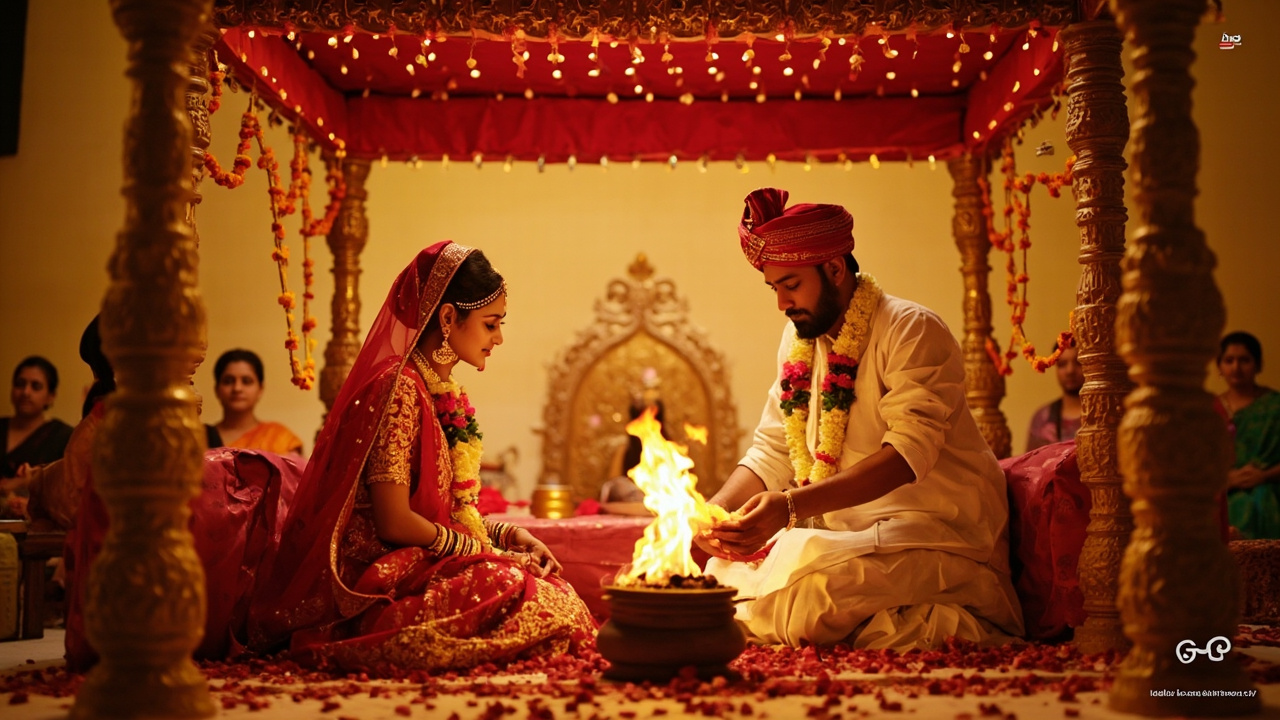
The core Hindu wedding rituals happen at the mandap — a sacred canopy under which the couple, the priest, family members, and the sacred fire gather. The mandap is symbolic: it represents the universe, with the four pillars pointing to the four directions and the canopy supported by Brahma above. The rituals inside are performed in Sanskrit, often by a purohit (priest), and can last between one and three hours.
1. Kanyadaan — Giving Away the Bride
Kanyadaan literally means “the gift of the maiden.” The bride’s father (or a senior male relative, often the uncle) places the bride’s hand into the groom’s hand, symbolically entrusting his daughter to the groom. In some traditions, the groom’s right hand is poured with water from a small vessel while the bride’s hand rests on top. Vedic mantras ask the gods to bless the union and grant the bride a long, happy married life.
2. Panigrahana — Holding of Hands
The groom takes the bride’s right hand in his own, and the priest recites mantras. Panigrahana is a formal declaration of intent — the groom pledges to take the bride as his equal partner in dharma, artha, and kama. This is the moment the couple is, in the eyes of tradition, committed.
3. Vivaha-Homa — The Sacred Fire Ritual
The sacred fire, or Agni, is the divine witness of every Hindu wedding. Lamps and a small fire pit (the havan kund) are placed at the center of the mandap. The priest lights the fire, and the couple, along with the groom’s sister or another female relative, makes offerings of ghee, herbs, rice, and twigs into the flame. Each offering is accompanied by a mantra asking Agni to carry the couple’s prayers to the gods.
4. Laja-Homa — The Offering of Puffed Rice
The bride’s brother (or a young male relative) places puffed rice (laja) in the bride’s hands, and the bride offers it into the sacred fire — sometimes with her hair loosened, symbolizing the giving of herself into the marriage. The act is meant to invoke prosperity, fertility, and the blessings of the ancestors.
5. Saptapadi — The Seven Sacred Steps
If there is one ritual that defines a Hindu wedding, it is the Saptapadi — the seven steps taken together around the sacred fire. After each step, the bride’s foot is pressed gently into a small mound of rice or a stone placed inside the mandap, and a vow is recited. The seven vows (one with each step) form the heart of the marital commitment:
- First step: For the fulfillment of the first duty of married life — walking together in righteousness and supporting each other’s dharma.
- Second step: For strength — to face life’s challenges together and protect one another.
- Third step: For prosperity — to share resources responsibly and grow in abundance.
- Fourth step: For happiness — to bring joy to each other and to the family.
- Fifth step: For progeny — to raise children in love, with the blessings of the ancestors.
- Sixth step: For health and long life — to care for each other through every season.
- Seventh step: For friendship and loyalty — to remain companions, confidants, and partners for life.
At the end of the seventh step, the couple is considered officially married in the eyes of Hindu law and tradition. The Saptapadi is so important that the marriage is not considered complete until it is done — even if all other rituals are performed.
6. Mangalya Dharanam — Tying the Sacred Thread
The groom ties the Mangalsutra — a sacred necklace of black beads and a gold pendant — around the bride’s neck, in a ritual called Mangalya Dharanam. The groom’s scarf is also tied to the bride’s sash, symbolizing the union. In South Indian weddings, this takes the form of a Thali or Mangalsutra tied with rice and turmeric. The Mangalsutra is worn for the rest of the bride’s life as a daily reminder of the sacred bond.
7. Sindoor and Aashirvad
The groom applies sindoor (vermilion) in the parting of the bride’s hair, completing her visual identity as a married Hindu woman. Elders and family members then step forward to offer Aashirvad — blessings in the form of rice, flower petals, and well-wishes. The bride touches the feet of elders, a traditional sign of respect. The couple is now considered fully married, and the rest of the day is celebration.
Post-Wedding Rituals
The Hindu wedding rituals do not end with the marriage itself. Several important ceremonies follow.
Vidaai — The Bride’s Farewell
Vidaai is the emotional moment when the bride leaves her parental home to join her husband’s family. Family members often throw rice, coins, or flower petals as a blessing for prosperity. The bride’s mother, sisters, and friends cry — this is one of the most photographed and heartfelt moments of a Hindu wedding. Tradition holds that the bride should not look back at her parents’ house until she has reached her new home, so that her future is turned forward, not behind.
Griha Pravesh — Entering the New Home
When the bride arrives at her new home for the first time, she is welcomed with a traditional Griha Pravesh ceremony. In many traditions, she tips a small brass pot (or kicks a measuring pot of rice) at the threshold to symbolize prosperity entering the home. A small aarti is performed, the couple’s feet are washed, and the bride is introduced to the family deities and kitchen. The first time the bride enters the kitchen and the first time she lights the household stove are both considered auspicious.
Reception and Reception Feast
Modern Hindu weddings usually conclude with a reception, where the couple hosts friends, extended family, and the wider community. The reception often includes a sit-down meal, music, and speeches.
Grahashanti and Pagri
In some regional traditions, the groom receives a pagri (turban-tying ceremony) at the bride’s home, and Grahashanti rituals may be performed to bless the new household. A small Satyanarayan Puja is often held in the new home within a few days or weeks of the wedding.
The Spiritual Symbolism Behind Hindu Wedding Rituals
Every ritual in a Hindu wedding carries meaning that goes well beyond what is visible. Here are some of the deeper symbols that run through the entire ceremony:
- The sacred fire (Agni) is the divine witness. Agni sees, hears, and carries the couple’s vows to the gods. Whatever is offered into the fire is bound by the universe itself.
- Red attire and sindoor symbolize the energy, fertility, and auspiciousness of the bride. Red is the color of Shakti — divine feminine power — and the bride is honored as a form of the goddess Lakshmi entering the new home.
- The mangalsutra is a daily reminder of the sacred bond. The black beads are believed to absorb negative energy and protect the couple.
- The seven steps (Saptapadi) cover the seven directions, the seven vows, the seven chakras, and the seven stages of life — a complete map of a marriage lived fully.
- The four pillars of the mandap represent the four purusharthas — dharma, artha, kama, and moksha — and the couple is meant to pursue all four together.
- Offering of puffed rice (laja) symbolizes letting go of the past and trusting the future — a small but powerful metaphor for the leap of faith marriage requires.
Regional Variations in Hindu Wedding Rituals
India is a vast country, and Hindu wedding rituals vary considerably by region, language, and community. The Vedic core — the mandap, the fire, the saptapadi, the mangalsutra — is shared almost everywhere, but the customs around it can be quite different.
North Indian Weddings (Punjabi, Rajasthani, UP, Bihar)
North Indian weddings are typically the most elaborate, with multi-day events including Mehndi, Sangeet, Baraat (groom’s procession on a horse), Milni (formal welcome of the two families), and the main ceremony. The bride traditionally wears a red lehenga, and the groom wears a sherwani and turban.
South Indian Weddings (Tamil, Telugu, Kannada, Malayalam)
South Indian Hindu weddings are typically shorter and more austere, focused tightly on the Vedic rituals. The bride wears a Kanjivaram silk saree, the groom wears a veshti and angavastram, and the central ritual is the tying of the Thali (the mangalsutra equivalent). The Oonjal ceremony, where the couple is gently swung on a decorated swing, is unique to South India.
Bengali Weddings
Bengali Hindu weddings feature the Gaye Holud (turmeric ceremony), the Subho Dristi (the moment the bride and groom first see each other), and the Saptapadi adapted with seven concentric rings drawn on the floor rather than a fire. The bride wears a traditional red and white Bengali saree with intricate alpona designs on the floor.
Maharashtrian Weddings
Maharashtrian Hindu weddings include the Sakhar Puda (exchange of sugar and gifts), the Antarpat ceremony (where a cloth is held between the couple before they first see each other), and the unique Vaakacharan or Kanyadaan. The bride wears a traditional nauvari saree tied in a distinctive style.
Gujarati and Marwari Weddings
Gujarati and Marwari weddings include the Chorusu (stepping on a small grinding stone), the Madhupark ceremony, and the Hasta Melap (hand-tying). The bride wears a panetar saree (red and white) and the groom wears a traditional sherwani.
Common Questions About Hindu Wedding Rituals
How long does a typical Hindu wedding last?
The main ceremony at the mandap usually lasts between 90 minutes and three hours, depending on the number of mantras, the priest’s pace, and the regional rituals included. The full wedding — from Roka to Reception — typically stretches across two to five days.
Why is fire (Agni) so central to a Hindu wedding?
Agni, the fire god, is the divine witness and messenger in Vedic tradition. Whatever is offered into Agni is witnessed by the universe itself, and Agni is believed to carry the couple’s vows to the gods. That is why almost every important moment of the ceremony involves the sacred fire.
Is a Hindu wedding legally binding?
Yes, in India, Hindu marriages are governed by the Hindu Marriage Act of 1955, which makes the marriage legally valid once the Saptapadi is performed. The Act also covers divorce, maintenance, and inheritance. Most modern Hindu couples also sign a civil registration document in addition to the religious ceremony.
Why does the bride wear red?
Red is the color of Shakti, fertility, prosperity, and marital bliss in Hindu tradition. The bride wearing red is a visual symbol that she carries the auspicious energy of the goddess Lakshmi into the new home.
Can Hindu weddings be inter-caste or inter-religious today?
Yes. The Special Marriage Act of 1954 in India allows inter-caste and inter-religious marriages, and modern Hindu families have increasingly accepted interfaith and inter-cultural weddings, often blending rituals from both traditions. The Vedic core — mandap, fire, saptapadi, mangalsutra — can be adapted to honor both backgrounds.
What is the role of the priest (purohit)?
The purohit is the religious officiant who recites the Vedic mantras, performs the offerings, and guides the couple through each step. The priest’s role is not just mechanical — they are the link between the human ceremony and the cosmic order. A well-trained priest is considered essential to the spiritual completeness of the wedding.
Why is the Mangalsutra so important?
The Mangalsutra is the most visible symbol of a Hindu marriage. Worn around the bride’s neck for the rest of her life, it represents the sacred, lifelong bond with her husband. The black beads are believed to ward off evil, and the gold pendant represents the union itself.
Are Hindu weddings only between Hindus?
Not exclusively. While the rituals described here are traditionally Hindu, the underlying values — sacred commitment, family blessing, divine witness — are universal. Many couples blend Hindu wedding rituals with elements of other traditions in modern interfaith ceremonies.
Conclusion: A Sacred Bond, Witnessed by the Universe
Hindu wedding rituals are, at their heart, a deeply spiritual answer to one of life’s most important questions: how do two people commit to a shared life? From the engagement to the Saptapadi, from the sacred fire to the Mangalsutra, every step is designed to transform a personal choice into a cosmic commitment — witnessed by Agni, blessed by the gods, and supported by the family.
If you are planning a Hindu wedding, take time to learn the meaning of each ritual, not just the steps. The ceremony is at its most beautiful when both the bride and the groom — and their families — understand the symbolism, because that is when the rituals stop being performance and become genuine prayer.
Whether you are a Hindu bride or groom preparing for your wedding, a guest attending one, or simply curious about the tradition, may this guide help you see the depth behind every step, every offering, and every vow.
Related Articles
Continue exploring our Hinduism FAQ series:
- How to Do Puja at Home: A Complete Step-by-Step Guide for Beginners
- What is the Significance of Bindi and Tilak on the Forehead?
- Why is the Cow Sacred in Hinduism? The Spiritual and Practical Reasons
- What is the Meaning of Sanatana Dharma?
- What Is the Status of Women in Hinduism?
- Why Do Hindus Cremate the Dead? Hindu Funeral Rites Explained