What is Namaste? Meaning, Origin & Spiritual Significance
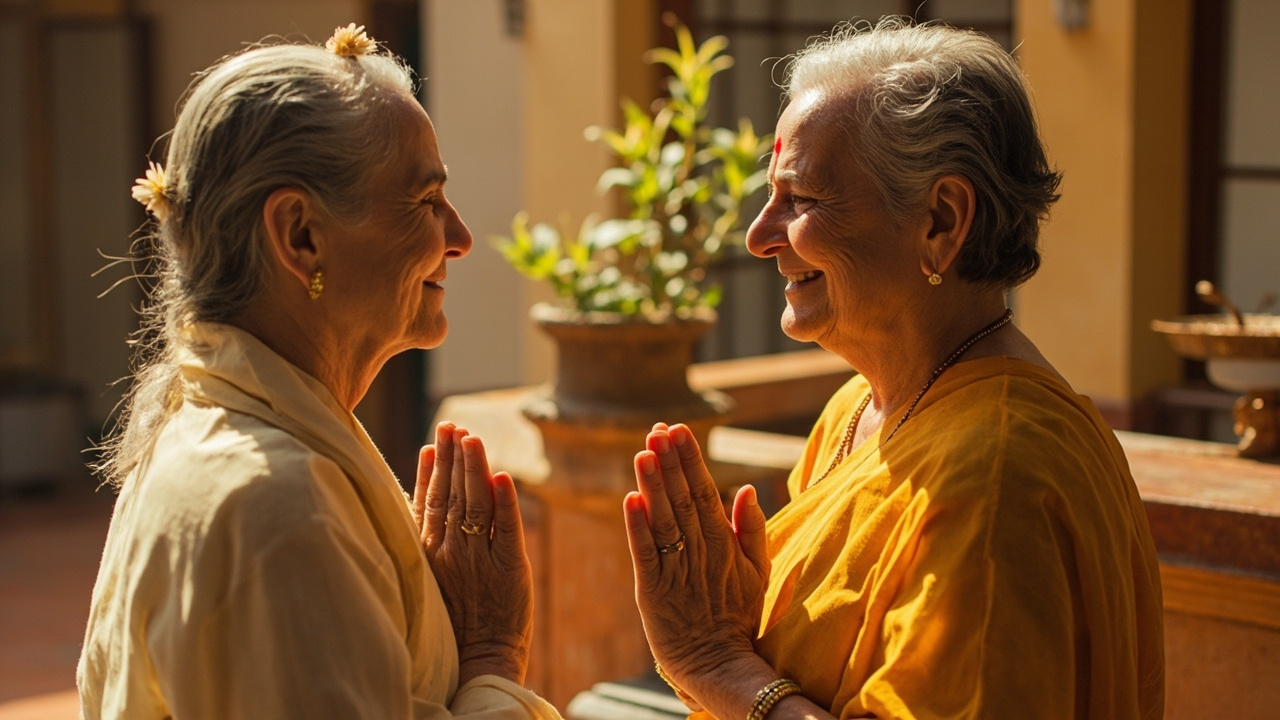
When two people press their palms together at the centre of the chest, bow their heads slightly, and say “Namaste”, they are doing more than exchanging a greeting. They are acknowledging, in one of the oldest gestures in human history, the divine spark that lives in every human being. Far more than the Indian equivalent of “hello”, namaste is a quiet spiritual act — a recognition of shared divinity between the one who greets and the one who is greeted.
If you have ever wondered “what is namaste?”, this guide walks you through its meaning, its roots in Vedic India, the difference between namaste, namaskar and pranam, the science behind folded hands, and the etiquette that surrounds this gesture across Hindu, Jain, Buddhist and Sikh households. By the end, you’ll know exactly when to use it, how to perform it correctly, and why it still matters in a modern world that has mostly forgotten how to greet each other with reverence.
What Does Namaste Actually Mean?
The word Namaste (नमस्ते) comes straight from Sanskrit. Break it down and you get two roots:
“Namah” — a verb meaning “to bow, to salute, to pay homage.” The same root appears in Namaskara (नमस्कार), Pranama (प्रणाम) and the famous Sanskrit prayer Om Namah Shivaya (“I bow to Shiva”).
“Te” — a pronoun meaning “to you.”
Put them together and namaste literally means “I bow to you.” But the Sanskrit tradition rarely stops at the surface. The most widely taught full form of namaste unpacks it as:
“I bow to the divine in you” — or, more elaborately, “The divine in me honours the divine in you.”
That second reading is the one that has stayed alive across centuries, because it carries a profound teaching inside a single greeting: that every human being — young or old, friend or stranger — carries within them the same divine essence (called Atman) that you yourself carry.
For a deeper look at how this idea fits into Hindu philosophy, see our article on Advaita vs Dvaita Vedanta.
The Origin of Namaste — From the Vedas to Today’s Living Rooms
Namaste is not a modern courtesy invented for yoga studios in the West. Its roots go back to the oldest scriptures of Hinduism.
The Rigveda
The Rigveda, the most ancient Hindu scripture (composed roughly 1500–1200 BCE, older than the Iliad), contains hymns that explicitly teach the gesture of bowing with folded hands. Rigveda 8.75.10 and 10.19.4 both describe a devotee pressing the hands together as a sign of surrender and reverence before the divine — a ritual gesture that we still perform today.
The Upanishads and Later Hindu Thought
In the Brihadaranyaka Upanishad (1.3.28), the great teacher Yajnavalkya tells his wife Maitreyi that the Self (Atman) dwells in every creature. This philosophical claim — that the same divine Self lives in all of us — is the conceptual soil in which the namaste gesture was planted. You bow to the person because the same Atman lives in them that lives in you.
From Temple to Living Room
By the time of the Manusmriti and the later Dharmashastras (roughly 200 BCE – 300 CE), folded-hand greeting had become codified for daily social life: how to greet elders, teachers (gurus), guests and deities was laid out in detail. By the early centuries CE the gesture was in everyday use across the subcontinent — and it has remained so, with regional variations, for almost two thousand years.
You can trace other ancient gestures of respect in our piece on why Hindus touch elders’ feet.
The Spiritual Meaning of “I Bow to the Divine in You”
This is the heart of namaste, and the reason it has survived so long.
When a Hindu greets another with folded hands, the gesture carries three spiritual messages at once:
1. Recognition of shared divinity
The greeter says, in effect: “I see the divine in you.” This is more than politeness. It is a reminder that the person in front of you is not just a stranger, a customer, or an opponent — they are a soul, just as you are.
2. Humility (the bowing of the head)
The slight bow that accompanies folded hands is not a bow to another human being; it is a bow through them to the divine. The ego shrinks so the larger Self can be acknowledged.
3. Equality at the level of the soul
Because the same Atman lives in everyone, the gesture does not care about social rank. A king and a labourer greet each other with the same hands, the same bow, the same word — Namaste. This is one of the few social gestures in the world that has, baked into it, a built-in statement that hierarchies of caste, class, or wealth do not extend to the soul.
Why Folding the Hands? The Subtle Body and the Five Elements
Why the palms pressed together at the chest? Hindu philosophy says the gesture is not arbitrary. The body is described in yogic texts as a landscape of subtle energy centres (chakras) and energy channels (nadis), and the position of the hands in namaste activates several of them at once.
The Anjali Mudra
The technical name for the hand position in namaste is anjali mudra — literally “offering gesture.” Pressing the palms together at the heart centre (the Anahata chakra) is said to balance the left and right energy channels (ida and pingala nadis) and draw awareness to the heart.
Pancha Bhuta Connection
Symbolically, the fingertips of the right hand represent the five elements (pancha bhuta):
1. Thumb — Fire (Agni)
Will, transformation, energy.
2. Index finger — Air (Vayu)
Movement, breath, thought.
3. Middle finger — Space (Akasha)
Openness, the cosmos, the void.
4. Ring finger — Earth (Prithvi)
Stability, patience, endurance.
5. Little finger — Water (Jala)
Fluidity, love, compassion.
Pressing the palms together symbolically reunites these five elements within you, aligning the body and mind for the moment of greeting. It is, in effect, a small meditation folded into a social gesture.
Namaste, Namaskar, Pranam — What’s the Difference?
This is one of the most frequently asked questions about the greeting, because travellers hear all three within five minutes of arriving in India.
Namaste (नमस्ते)
The most common, used as a general greeting across India. Slightly casual, friendly. Appropriate for everyone — peers, strangers, elders.
Namaskar (नमस्कार) / Namaskaram / Namaskara
A more respectful form of the same root. Namaskar in Hindi; Namaskaram in Telugu; Namaskara in Kannada. Often translated as “salutations to you”. Used in more formal settings — entering a temple, greeting an elder, or as a sign-off in letters.
Pranam / Pranam (प्रणाम)
This is the deepest bow — the most respectful. Pranam literally means “I prostrate (my ego) before you.” It is reserved for teachers (gurus), parents, elders, and deities. The gesture often includes a deeper bow or even touching the feet of the person.
Vanakkam (வணக்கம்) — Tamil Note
In Tamil Nadu the greeting takes a different language root, vanakkam, but the gesture — palms together at the chest, slight bow — is exactly the same as namaste. The spirit is identical: “I bow to you.”
Other regional variants
Across the subcontinent, equivalents include Sashtang Namaskar in formal worship (a full-body prostration), Pranami in Marwari, and Sat Sri Akal in Sikhism — though Sikh practice folds palms in a distinct way, expressing “Truth is Eternal.” Buddhists across the Himalayas greet each other with the same gesture, often saying “Namaskara”; Jains use Jai Jinendra alongside the same palm position.
When (and Where) Namaste Is Used — and When It Isn’t
Knowing what is namaste in theory is only half the picture. Knowing when to do it matters just as much.
When to use namaste
1. Greeting someone in person
Anywhere, any time. Walking into a shop, a friend’s house, an office, a temple.
2. Greeting elders, parents, and teachers
Even more respectful when accompanied by a touch of their feet (the practice of charan sparsh).
3. Starting and ending a yoga or meditation session
The class often says “Namaste” together as teacher and students bow to each other.
4. Concluding a prayer or puja
At the end of a home puja, the family often folds hands together and says namaste to the deity, to the priest, and to one another. See our guide on how to do puja at home step by step for the wider context.
5. At weddings, religious functions, and gatherings
Even at Hindu wedding rituals — the bride and groom greet elders with namaste.
When to skip namaste
There are very few situations where namaste is wrong, but two common-sense exceptions apply:
In professional/sport settings: A sportsman bowing with palms together to a rival on the field can be misread. A handshake or a simple nod is more typical.
Where hygiene or formality dictates: Some business or military contexts use the western handshake. Namaste is optional there, not required.
Namaste Outside India — From UN Pews to Yoga Studios
Since the early twentieth century, namaste has spread far beyond South Asia. Three milestones made it global:
1. Swami Vivekananda’s 1893 Parliament of the World’s Religions speech in Chicago ended with the now-famous “My brothers and sisters of America” and a folded-hands bow. Western audiences were introduced to the gesture for the first time on a global stage.
2. The 20th-century Indian independence movement, in which figures like Mahatma Gandhi popularised namaste as an alternative to the colonial handshake. Gandhi often wrote in letters that namaste was a more dignified, equal-footing greeting than the bow-and-scrape of old colonial etiquette.
3. The worldwide yoga boom of the late twentieth and twenty-first centuries. Yoga classes in nearly every country now open and close with “Namaste,” often without students realising the spiritual weight the word carries. For the full Hindu philosophical foundation that yoga sits upon, see our introduction to the Bhagavad Gita.
Today the gesture also appears as a respectful way to convey “thank you” or “very welcome” — particularly in service encounters, and increasingly in global diplomacy where dignitaries greet each other with folded hands instead of handshakes.
Common Misconceptions About Namaste
A few clarifications that clear up the most popular myths:
“Namaste means ‘I bow to the light in you.’”
A popular internet quote that “the light in me bows to the light in you” is approximate — the Sanskrit root namah means to bow, not to light, and there is no word “light” in the original. The phrase above is a beautiful paraphrase, not a literal translation.
“You have to be Hindu to say namaste.”
Not at all. The greeting is shared across Hindu, Jain, Buddhist, Sikh, and secular Indian households, and is offered freely to people of any background. It is a courtesy, not a doctrinal claim.
“Saying ‘namaste’ is religious worship.”
It is a greeting with spiritual depth — but using it does not require any belief commitment. Think of it as a gesture of respect, the way a Japanese bow carries centuries of etiquette without being religious.
“If someone says namaste to you, you must respond the same way.”
Yes, ideally. Returning the gesture with a smile and folded hands is the customary reply. A warm verbal “Namaste” alone is also acceptable.
How to Do Namaste the Right Way
Doing namaste properly is simple — once you know what to do with your hands, eyes, and head.
Step-by-step
1. Bring the hands together
Press the palms flat against each other at the centre of your chest, fingers pointing upward. Keep the elbows relaxed, not rigid.
2. Align the fingers
The fingers of both hands should line up. The chest is the natural hand position.
3. Lower the eyes
Many traditional greetings briefly close the eyes or look down — symbolising inward attention.
4. Slight bow
Bow the head and upper body slightly. A general rule: the deeper the respect owed (elder, guru, deity), the deeper the bow.
5. Say “Namaste”
Speak the word clearly, with a smile. In more formal situations you may say “Namaskar” or “Pranam” instead.
Common mistakes to avoid
Don’t snap your fingers into the position: The hands are brought together gently, not with a clap.
Don’t hold the hands at the throat or face: The chest is the natural hand position.
Don’t just touch finger-tips: The full palms should meet.
Don’t rush through it: The gesture is short but it should not be perfunctory.
Why Namaste Matters in the Modern Age
In a world where handshakes are skipped for hygiene reasons and greetings are reduced to emojis, namaste offers a beautiful alternative. It is:
Hygienic — no physical contact.
Equalising — no body-language dominance, no firm-grip competition, no hand-size anxiety.
Spiritually grounded — every greeting becomes a small reminder that the person in front of you is, at the level of the soul, a reflection of yourself.
Memorable — the gesture stays with people. They will remember meeting someone who greeted them this way.
That is, perhaps, the deepest answer to “what is namaste?” It is a small revolution made of two hands.
Frequently Asked Questions About Namaste
Why do Indians say namaste instead of shaking hands?
Because namaste carries centuries of spiritual meaning — recognition of shared divinity, equality, and humility — packed into a single gesture. The Indian subcontinent’s many faiths (Hindu, Jain, Sikh, Buddhist, and parts of Muslim practice) all find namaste a respectful greeting that doesn’t require physical contact. It is also considered more hygienic since there’s no skin-to-skin contact.
What does namaste literally mean in Sanskrit?
It splits into “namah” (to bow, to pay homage) and “te” (to you). The literal translation is therefore “I bow to you.” A fuller spiritual reading — “I bow to the divine in you” — captures the philosophical meaning that the gesture carried through Vedic and Upanishadic thought.
Is namaste only a religious greeting, or is it just a hello?
It is both. In daily life most people use namaste casually the way English speakers use hello. But the gesture has deep religious roots in the Vedas, Upanishads, and later Hindu, Jain and Buddhist tradition. Using it does not require any specific belief — it is a courteous, respectful greeting with a profound philosophical backstory.
Can anyone say namaste, or is it only for Hindus?
Anyone can say it. Namaste is shared across all Indian faiths and is offered freely to anyone, regardless of background. Yoga classes around the world say it as a default greeting; travellers and tourists use it to greet shopkeepers, hosts, and friends. The grace of the gesture is precisely that it crosses religious boundaries.
What is the difference between namaste and namaskar?
They share the same Sanskrit root, but namaskar is the more formal, more respectful form. Namaste is the everyday greeting, while namaskar is often used at temples, in formal letters, or when greeting elders with a deeper bow. The deeper form, pranam, is reserved for gurus, parents and deities.
Why do yoga classes end with namaste?
Yoga teachers and students end a class with namaste as a way of honouring each other — recognising that teacher and student each carry the same inner spark. The word namaste doubles as a thank-you and a recognition that the practice was a shared offering, not a one-way transaction. Many people also experience namaste as the closing of a brief meditation: hands together at the heart, eyes soft, breath settling.
What should I do if someone says namaste to me?
Smile, return the gesture — palms together at the chest, slight bow — and reply “Namaste”. If you are unfamiliar with the motion, a warm “Namaste” back with a smile and nod is also perfectly acceptable. Avoid crossing your arms, looking away, or rushing past — even a quick return namaste is considered polite.
If this article helped you understand the meaning of namaste, you may also enjoy our guide on understanding Moksha, which explores the deeper spiritual freedom namaste gestures towards.
Related Articles
- Why Do Hindus Touch Elders’ Feet? — the related tradition of charan sparsh, the deeper bow that often follows namaste.
- Hindu Wedding Rituals Explained — how namaste features at almost every stage of a Hindu wedding.
- How to Do Puja at Home: A Step-by-Step Guide — ending every puja with namaste to the deity.
- What Is the Bhagavad Gita? — the spiritual philosophy of Atman and divine Self that namaste gestures towards.
- Advaita vs Dvaita Vedanta — the two Vedantic schools that frame the “divine spark in all” teaching.
- Understanding Moksha: Liberation and Spiritual Freedom — the ultimate spiritual state that the gesture gestures towards.