Why is the Ganga Sacred? Hinduism’s Holiest River Explained
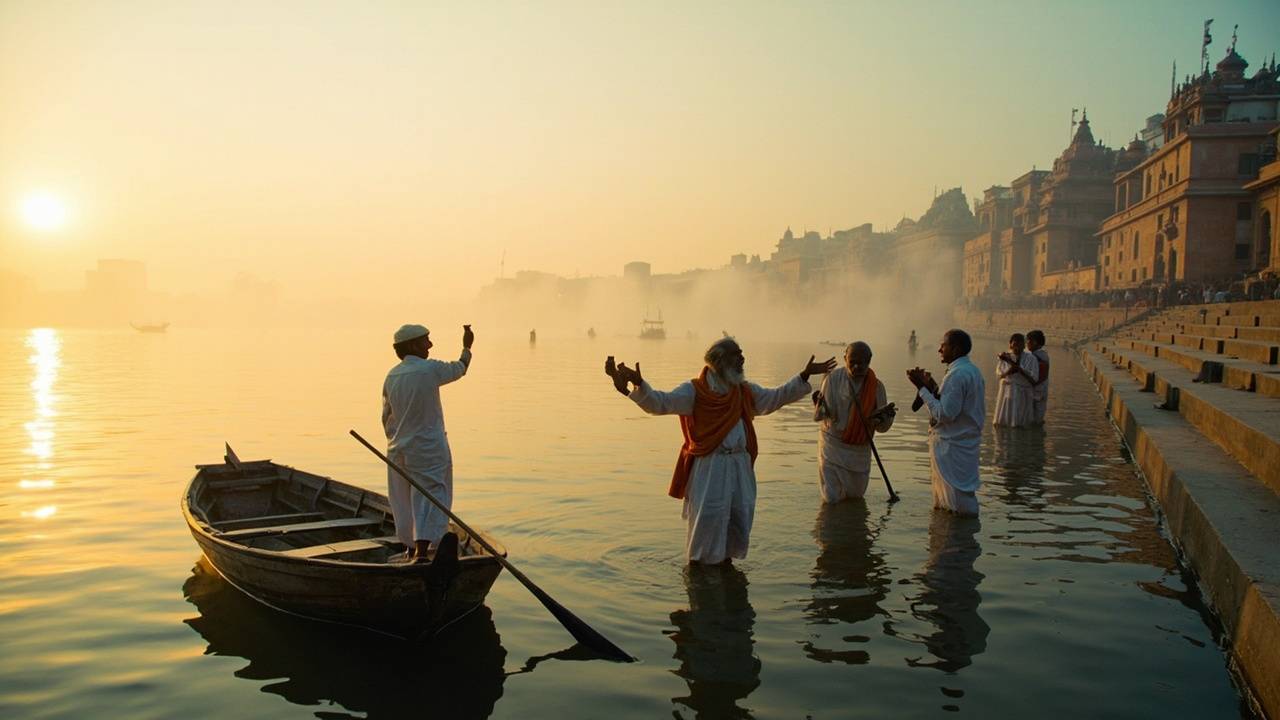
No river on earth is worshipped the way the Ganga is. Every day, before sunrise, thousands of Indians — pilgrims, sadhus, householders, and tourists alike — wade into the cold brown waters of the river to offer water to the sun, to their ancestors, and to the gods. They speak to her. They call her Ganga Ma — Mother Ganga. They carry her water in copper lotas across continents so a dying relative can sip it one last time. They immerse the ashes of the dead in her currents so the soul may, they believe, finally be free. And yet, to a modern eye, none of this is “necessary.” Rivers are water; the dead are gone; gods are not visible. So why is the Ganga sacred? The answer is older than Hinduism itself, stitched into the Vedas, dramatised in the epics, retold every evening at the ghats, and — surprisingly — even supported by some modern science.
The Name Itself: Ganga, Bhagirathi, and Alaknanda
What most of the world knows as the “Ganges” is, in Sanskrit, simply Ganga (गङ्गा). The name is so old that the Rigveda already uses it, in the Nadistuti Sukta (10.75), a hymn that praises the rivers as goddesses and lists Ganga alongside the Yamuna, Saraswati, and Sindhu (Indus). But the river we call Ganga is actually born twice. From the Gangotri Glacier at Gomukh (in Uttarakhand, ~3,900 m above sea level), the upper stream is called Bhagirathi — named after the legendary king Bhagiratha whose meditation brought Ganga down to earth. About 70 km downstream, at the five-fold confluence called Panch Prayag, the Bhagirathi meets the Alaknanda (which itself has gathered the Mandakini, Nandakini, Pindar, and Dhauliganga). Only from Devprayag, the first of the five Prayags, do the two merged streams officially become the Ganga.
From there she flows southeast across the Indo-Gangetic plain — through Rishikesh, Haridwar, into Uttar Pradesh, past Kanpur and Allahabad (now Prayagraj), down through Bihar (where she swallows the Gandak, Son, and Kosi), and into West Bengal, where she fans into the world’s largest delta before emptying into the Bay of Bengal through Bangladesh. Her main distributary in Bengal is called the Hooghly, while in Bangladesh the river is known as the Padma. “Ganga” the goddess, “Ganga” the river, and “Ganga Ma” the mother — these are not three separate ideas but one idea seen from three angles.
The Mythological Origin: How Ganga Came Down from Heaven
Why did the gods send a river to earth in the first place? The classical story, told in the Valmiki Ramayana (Bala Kanda) and the Mahabharata (Anuśāsana Parva), explains it through grief. The sixty-thousand sons of King Sagara had been reduced to ashes by the sage Kapila’s curse for disturbing his meditation. The ashes lay unburnt and un-mourned, and the only way their souls could be freed was for someone to bring Ganga — who then flowed only in Swarga, heaven — down to earth to wash over them.
Generation after generation of Sagara’s descendants tried and failed. Finally, in the line of Dilipa, came Bhagiratha. He performed such severe tapasya (austerity, often translated as penance but more accurately as “intense inner heat”) that Brahma agreed to let Ganga descend. But the river’s fall, unchecked, would have smashed through the earth and into the underworld (Patala), drowning everything. So Bhagiratha prayed to Lord Shiva, who caught Ganga in his matted locks (jata) and broke her fall. She wandered for years in Shiva’s hair until he released her in seven streams — three flowing east (to the Bay of Bengal, becoming the Ganga, Yamuna, and Saraswati of the terrestrial world), three west (lost in legend), and one following Bhagiratha back to the ashes of his ancestors at what is now Ganga Sagar at the river’s mouth.
Once on earth, Ganga was not always gentle. The sage Jahnu, annoyed when she disturbed his sacrificial fire, drank her whole in a single sip. The gods pleaded, and Jahnu released her through his ear — earning Ganga the additional name Jahnavi, “daughter of Jahnu.” This is why, even today, the river is described as a goddess who must be approached with respect, not just a water body to be used.
The Scriptural Status: Ganga in the Vedas, Epics, and Puranas
Scripturally, Ganga has no equal among rivers. The Rigveda already calls her a goddess and her waters “purifying.” The Mahabharata (Vana Parva) declares that simply remembering Ganga destroys all sins, and the Padma Purana goes further, claiming that her waters are so holy that even the dust carried by her wind purifies whatever it touches. The Bhagavata Purana (Fifth Canto) tells the story of Bali and how Ganga flows through the underworld — the same river, three planes.
To understand how this works theologically, recall the Hindu concept of karma (the law of cause and effect) and moksha (liberation from the cycle of rebirth). If the soul is bound by the residue of its actions, then any ritual that can burn off that residue — without forcing the soul to live through the consequences in another life — accelerates liberation. Ganga’s water is treated, in this framework, as a physical substance carrying enough tattva (spiritual essence) to discharge that residue. This is why immersion of ashes (asti visarjan) in the Ganga is believed to help the recently deceased complete their journey; their account is, in effect, wiped clean.
In Vedantic philosophy, the Ganga is also used as a metaphor for the ultimate — Brahman itself. Adi Shankaracharya wrote in his commentary on the Vishnu Sahasranama that just as a river is nothing apart from its water, the world is nothing apart from Brahman. The visible Ganga is therefore a murti (form) of the formless.
The Science Behind the Sacred: What Makes Ganga’s Water Different
For centuries, defenders of the faith have pointed to an empirical observation: Ganga water seems to remain unusually fresh. Pilgrims often carry it home in sealed bottles and drink it days or weeks later without it spoiling. By the late 19th century, British bacteriologists like Ernest Hankin were already reporting that cholera bacteria died faster in Ganga water than in laboratory broth. The phenomenon was never fully explained until the early 2000s, when researchers at the Institute of Microbial Technology (Chandigarh) identified a high concentration of bacteriophages — viruses that specifically kill bacteria — in the river’s upper stretches.
Three other factors contribute. First, the river picks up a fine, clay-rich sediment from the young Himalayas called namarupeeya that has mild antibacterial properties and helps suspended organic matter settle out. Second, dissolved oxygen levels in the Ganga are unusually high (5–8 mg/L) for a river of its size because of its swift upper gradient, which oxidises pollutants. Third, the lower reaches host a diverse microbial ecosystem that, like a healthy gut, outcompetes incoming pathogens. None of this makes the river magically sterile — the lower Ganga in Bengal is heavily polluted by untreated sewage, industrial waste, and post-cremation remains — but it does help explain why, for centuries, Indians treated the water as safe to drink at its source and during the dry season.
Whether one calls this “self-purifying” by design or by geology, the practical effect reinforced the spiritual belief. People observed that the river did not decay quickly, and they built a theology around that observation.
Major Pilgrimage Sites on the Ganga
Because the Ganga is sacred in her entirety, every city on her banks is, in principle, a place of pilgrimage. But seven sites, called the Sapta Mukti Tirtha (Seven Salvation Pilgrimage Sites), are considered most potent:
Gangotri, at the river’s source, where pilgrims trek to Gomukh to see where the Bhagirathi emerges from beneath the Gangotri Glacier.
Rishikesh, the “place of sages,” where the Ganga enters the plains. Famous for yoga ashrams, the evening Ganga Aarti at Triveni Ghat, and the iconic suspension bridge over the river.
Haridwar, literally “Gate of God,” where the river exits the mountains at Har Ki Pauri. The Kumbh Mela (held every 12 years, rotating between Haridwar, Prayagraj, Ujjain, and Nashik) draws tens of millions of pilgrims to bathe here at the exact moment when, astrologically, Jupiter enters Aquarius.
Allahabad (Prayagraj), where the Ganga meets the Yamuna and the mythical Saraswati at the Triveni Sangam. This is the holiest confluence in Hinduism. The 2019 Kumbh here is detailed in our article on the Kumbh Mela pilgrimage.
Varanasi (Kashi), perhaps the holiest city in Hinduism. The entire city sits on the western bank of the Ganga, oriented toward the rising sun. To die in Kashi and have one’s ashes released into the river is considered one of the surest paths to moksha.
Ganga Sagar, at the Bay of Bengal, where the river finally meets the sea — and where, legend holds, Bhagiratha’s sixty-thousand ancestors were finally freed.
Badrinath, in the upper Himalayas, technically on the Alaknanda (a tributary), but treated as part of the greater Ganga pilgrimage circuit because the Alaknanda becomes the Ganga at Devprayag.
Rituals Performed in the Ganga
Several specific rites are performed in the Ganga that no other river supports in the same way:
Ashnan (ritual bath). Submerging the body three times while chanting a sankalpa (intention) at sunrise is believed to absolve sins accumulated in the current and previous births. The most auspicious bathing dates are Makara Sankranti (January 14), Vasant Panchami, Chaitra Purnima (full moon of March–April), and the main Kumbh days.
Tarpan. A water-offering to the ancestors, performed by holding water in the cupped right palm and letting it fall through the fingers while reciting the names of the deceased. Most Hindus perform this at the Ganga at least once in their lives.
Asti Visarjan (immersion of ashes). After cremation (see our guide to Hindu funeral rites), the bone fragments and ash are carried — often by family members — to the nearest Ganga and released into the current, ideally at Haridwar, Varanasi, or Prayagraj. For those who cannot travel, ashes are sometimes sent by post to religious charities who immerse them on the family’s behalf.
Ganga Aarti. Every evening at sunset, especially at Har Ki Pauri (Haridwar) and Dashashwamedh Ghat (Varanasi), priests perform a synchronised fire ritual: large brass lamps are moved in circular arcs while devotional songs (bhajans) are sung. The ritual, although only formalised in its current form in the 20th century, has become one of the most-photographed expressions of Hindu devotion in the world.
Ganga and the Modern World: Pollution, Conservation, and Cultural Identity
The greatest tension in the modern story of the Ganga is between her sanctity and her state. The river that supports nearly half a billion Indians as a drinking source, irrigation channel, and sacred site also receives, by some estimates, more than 3 billion litres of untreated sewage every day, along with industrial effluents from leather tanneries, distilleries, and chemical plants along her banks. By the 1980s the pollution had become severe enough that the central government launched the Ganga Action Plan in 1986 — the first major river-cleanup programme in India — followed by Namami Gange in 2014, a ₹20,000-crore (over $2.4 billion) umbrella programme.
Conservation is also framed, increasingly, as a moral duty. Hindu environmental ethics — rooted in the principle that dharma includes care for all beings — provide a scriptural basis for keeping the Ganga clean. Several religious leaders have publicly declared pollution of the river to be a sin comparable to matricide. At the same time, the practical challenges are enormous: rapid urbanisation, climate change reducing Himalayan glacier mass (the source of the river’s perennial flow), and the sheer population pressure along the Ganga basin.
Culturally, the Ganga is also a symbol of Indian unity. Unlike many other rivers, she flows through almost every major linguistic and cultural region of northern India — Garhwali, Kumaoni, Haryanvi, UP, Bihari, Bengali — and is invoked identically across all of them. The Ganga is, in a sense, the most successful pan-Indian brand ever built, and she was built long before the modern state existed.
Frequently Asked Questions
Why is Ganga called “Ganga Ma” (Mother)?
Because, like a mother, she is believed to nourish, purify, and forgive. The term Ma in Hinduism is not just a familial role but an acknowledgement that the entity in question is the source of life itself. The Ganga feeds the Indo-Gangetic plain (the most agriculturally productive region in South Asia), and in theology she also feeds the soul’s journey toward moksha. Calling her “Ma” is therefore a statement of dependence and gratitude, not a literal claim of maternity.
Does Ganga water really self-purify?
Yes, but only at the source and in the upper reaches. Independent scientific studies have confirmed that Ganga water contains high levels of bacteriophages and dissolved oxygen that suppress bacterial growth, and that suspended clay particles bind organic matter and settle it out. However, by the time the river reaches Kanpur, Allahabad, and especially the lower delta, this property is overwhelmed by sewage and industrial waste. The water is then no longer safe to drink untreated — and yet pilgrims still treat it as spiritually potent, because the theological claim is about the river’s essence, not its momentary chemistry.
Can you take ashes to the Ganga if you cannot go in person?
Yes. Most major Indian cities have Hindu religious trusts that collect ashes and send them to authorised agents in Haridwar, Varanasi, or Prayagraj for immersion. Some families send the ashes by post in sealed steel containers with the death certificate and a written request. There are also online portals operated by the Uttar Pradesh government and by private organisations that arrange asti visarjan by proxy. The ritual intention matters more than physical presence.
What is the difference between Ganga, Bhagirathi, and Alaknanda?
The Bhagirathi is the upper stream that emerges at Gomukh from the Gangotri Glacier. The Alaknanda is a slightly larger tributary that originates at the Satopanth Glacier near Badrinath. They merge at Devprayag (the first of the Panch Prayag). Only from Devprayag downstream is the river called Ganga. Theologically, Bhagirathi represents the human effort (Bhagiratha’s tapasya) and Alaknanda represents divine grace (it is named after the Alakshmi-free aspect of Vishnu); together they form the Ganga, the unity of effort and grace.
Where do the Ganga’s waters actually begin?
At Gomukh, the snout of the Gangotri Glacier, at roughly 3,900 m elevation in the Uttarakhand Himalayas. The glacier itself is fed by snowfall on the Chaukhamba massif. Hydrologists estimate that nearly 70% of the Ganga’s summer flow originates from glacial melt and snowmelt in the upper catchment, which is why climate change — by reducing glacial mass — is now considered a long-term threat to the river’s flow.
Why is Varanasi so important on the Ganga?
Varanasi (also called Kashi and Banaras) is one of the oldest continuously inhabited cities in the world, and the only major city in India that faces east toward the rising sun across a river. According to the Garuda Purana, dying in Kashi guarantees moksha, regardless of the sins accumulated in that life. The city is also home to more than 80 ghats (stone-stepped embankments), and the daily life of the city — bathing, cremation, study, art, and ritual — is organised around the Ganga.
What is the Kumbh Mela connection to the Ganga?
The Kumbh Mela is held at four sites — Haridwar (on the Ganga), Prayagraj (at the Ganga–Yamuna confluence), Ujjain (on the Shipra), and Nashik (on the Godavari) — every twelve years, rotating. The astrological trigger is when Jupiter enters specific zodiac signs associated with each river. At Haridwar and Prayagraj, the central rite is bathing in the Ganga at the appointed moment, when, mythology holds, the river turns to amrita (nectar). See our detailed article on the Kumbh Mela pilgrimage for the full story.
Can non-Hindus bathe in the Ganga?
Yes. The river is open to all, and there is no scriptural restriction against people of any faith (or none) entering her waters. Foreign visitors regularly attend the Ganga Aarti at Haridwar and Varanasi and are welcome to participate. Some ghat-side temples restrict entry into the inner sanctum to Hindus, but the ghats themselves and the river itself are not restricted.
Conclusion
So why is the Ganga sacred? Three answers can be given, and all three are true at once. Mythologically, she is a goddess who descended from heaven at Bhagiratha’s request, broke on Shiva’s locks, and wandered Jahnu’s ear before settling on earth to liberate the ancestors. Scripturally, she is the holiest of rivers, named in the Rigveda, dramatised in the epics, and praised across the Puranas as a force that purifies and liberates. Empirically, her upper waters behave unusually well — they stay fresher longer than comparable rivers, due to bacteriophages and high dissolved oxygen — which is exactly the kind of observation that, in an oral tradition, gets woven into theology over centuries. The Ganga is sacred because, for at least three thousand years, Indians have found her to be so — in their dreams, in their scriptures, and even, occasionally, in their test tubes.
Related Articles
- Kumbh Mela: What It Is, Why It Happens, and What Happens There
- Understanding Moksha: Liberation and Spiritual Freedom
- What is Karma? The Law of Cause and Effect
- The Main Scriptures of Hinduism: Vedas, Upanishads, Puranas, and Itihasas
- What is the Bhagavad Gita? The Hindu Scripture of Life’s Dilemma
- Hinduism and Environmental Conservation: Ancient Roots of Modern Ecology
- Why Do Hindus Cremate the Dead? Hindu Funeral Rites Explained