Why Do Hindus Remove Shoes in Temples? Meaning Behind the Ancient Tradition
If you have ever walked up to a Hindu temple in India and seen a long row of sandals, slippers, and sneakers lined up neatly along the outer wall, you have witnessed one of the most consistent and ancient practices in Sanatana Dharma: removing footwear before entering the deity’s home. Visitors notice it immediately. Many non-Hindu travellers, first-time visitors, and even some Hindus who grew up outside India find themselves quietly asking the same question — why exactly is this done? Is it just hygiene? Is it a rule? Is it cultural, spiritual, or something else entirely?
The short answer is that it is all three at once. Removing footwear is woven into Hindu scripture, supported by centuries of ritual science, and embodied in stories of Krishna, Rama, and the great rishis. This article walks through those layers — the verses, the meanings, the practical exceptions, and a simple visitor’s guide — so that the next time you approach a temple threshold, you know exactly what you are standing in front of, and why you leave your shoes behind.
1. The First Thing Visitors Notice — And Why
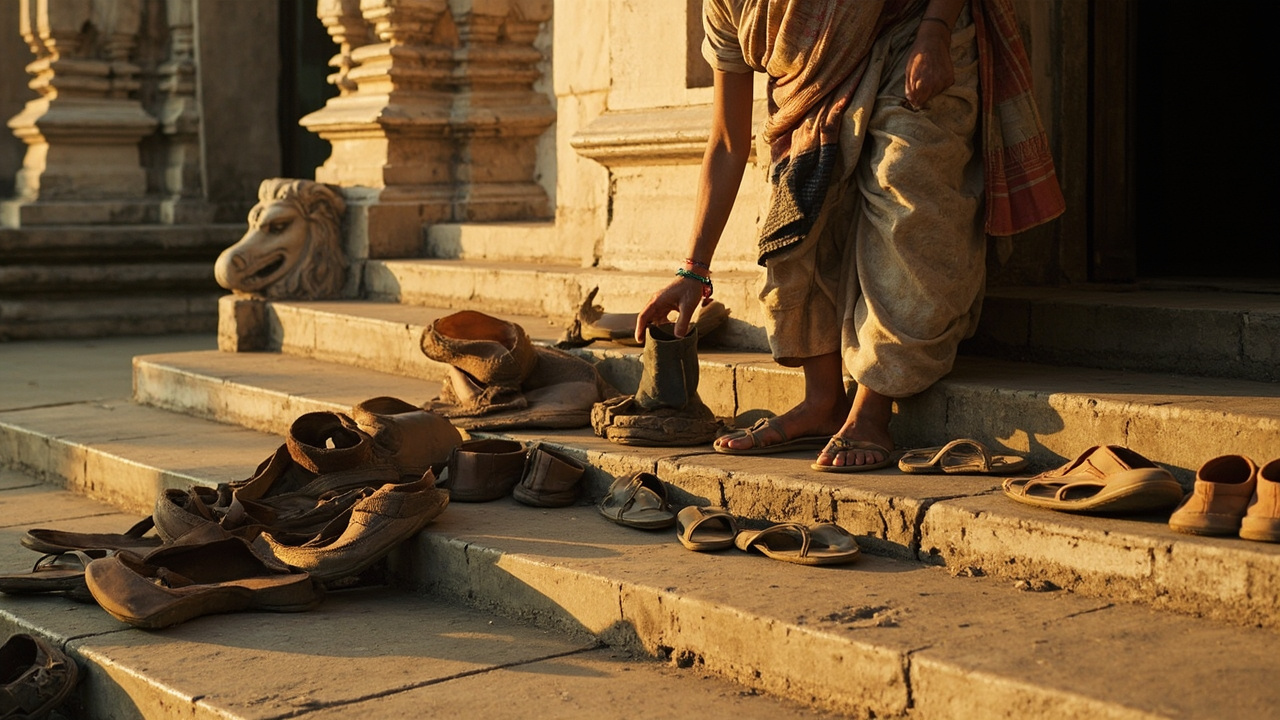
Walk into almost any functioning temple in India — be it a vast South Indian gopuram, a North Indian marble mandir, a roadside Devi shrine in Bengal, a Shiva temple in Karnataka, or a Hanuman mandir in Gujarat — and the very first instruction a devotee receives, often without a word being spoken, is to remove footwear. There is a designated threshold, a low doorway, or an iron gate marking the boundary. Beyond it, the floor is bare stone or cool marble. Outside, in a controlled row on the temple steps, you will see leather chappals, rubber slippers, branded sneakers, and small children’s shoes waiting patiently for their owners.
The custom is so consistent across regions that it has become one of the most recognisable markers of a Hindu place of worship — alongside the ringing of the bell, the aroma of camphor, and the chant of aarti. But unlike the bell or the camphor, removing footwear is something every individual must do for themselves. It is the first physical act of devotion a visitor performs.
2. What Hindu Scriptures Say About Removing Footwear
Hindu texts treat temple premises as the dwelling place of the deity — a sacred body of the divine. Just as one would not enter a king’s court wearing dusty sandals, one does not enter the deity’s residence with shoes that have walked over dust, dirt, or impure ground. Several authoritative works codify this.
Garuda Purana
The Garuda Purana, one of the eighteen Mahapuranas, contains an extensive section on Prachara (temple conduct). It instructs devotees to wash their feet, leave footwear outside, and enter the sanctum only after offering a brief prayer. The text describes the temple as the vigraha — the body — of the deity, and entering it with soiled feet is treated as a sign of disrespect.
Devi Bhagavata Purana and Agni Purana
The Devi Bhagavata and the Agni Purana extend the rule: barefoot entry is required up to the garbhagriha (inner sanctum), and in some traditions up to the pradakshina path (circumambulation). Wearing footwear inside is described as one of the ten aparadhas (offences against the deity) — an act that requires prayaschitta (ritual atonement) before further darshana.
The Smriti Literature and the Agama Tradition
The Dharmasindhu and other Smriti compendiums repeat the rule and tie it to mala-tyaga — the removal of impurity. Temple-specific Agama texts (such as the Vaikhanasa and Pancharatra Agamas) provide exact ritual protocols: where to leave footwear, the orientation the shoes should be placed, and what to do if the slippers fall upside-down (it is considered inauspicious, and the devotee is asked to mentally offer a small prayer to avert the ill effect).
3. The Spiritual Meaning — Prana, the Threshold, and Humility
Beneath the scriptural command sits a deeper spiritual logic. Three ideas show up again and again in the writings of the rishis and the saints.
The Idea of Prana and the Sanctified Field
Hindu cosmology understands the temple as a prana-pradhana kshetra — a field where life-energy is intensified. Removing footwear is a way of directly connecting the devotee’s body (through the charan, the feet, which are considered a sacred channel of pranic energy) to the consecrated ground. Shoes, made of leather or rubber, are treated as insulators — they block the natural flow of subtle energy between the devotee and the temple’s purified atmosphere.
The Threshold as a Line Between Worlds
Every major temple has a clearly demarcated threshold — a step, a sill, or a doorway. Crossing it symbolises stepping out of the world of ordinary activity (vyavaharika) and into the world of pure consciousness (paramarthika). The act of bending down to remove footwear — and therefore lowering oneself — is part of that crossing. It forces the body into a momentary posture of humility and presence.
Humility Before the Divine
The gesture is also a lesson in namrata — humility. Footwear is the most external covering of the body. Setting it aside signals that the devotee brings nothing between themselves and the deity. The same idea underpins the more familiar Indian gestures of touching the elders’ feet (charan sparsh) and saying namaste — all are physical acts of humility, of acknowledging that the self is smaller than the one before you.
4. Stories From Hindu Texts: Krishna, Rama, and the Barefoot Tradition
The practice is reinforced by some of the most loved stories in the Hindu tradition.
Krishna and Sudama
When the impoverished Brahmin scholar Sudama visited his childhood friend Krishna at Dwarka, he hesitated at the palace gate. Krishna, who recognised him, ran out barefoot, fell at Sudama’s feet (the reverse of the usual — the king at the sage’s feet), and led him inside. Krishna’s bare feet on the palace floor of the Lord of Dwarka set the highest possible precedent: the divine itself walks barefoot when greeting a guest of dharma.
Rama at Rishyamuka
When Rama, Sita, and Lakshmana first approached the forest of Dandaka, they paused at the ashram of sages such as Atri and Anasuya. In the Ramayana, Valmiki repeatedly describes Rama removing his footwear before stepping onto the ashram grounds. The act of removing sandals in the forest ashram and the temple ashram is the same gesture: respect for consecrated space.
Sita at the Fire Altar
During the trial by fire described in the Yuddha Kanda of the Ramayana, Sita is described as approaching Agni (the fire-god) barefoot, having removed her sandals at the boundary. The Valmiki Ramayana treats this as essential to the validity of the test. The connection between bare feet and sacred fire remains a common motif in Hindu ritual.
5. What Science Suggests — Grounding, Energy, and Microbes
Modern research on earthing — the practice of making direct skin-to-soil contact — has proposed mechanisms that resonate, though they do not prove, the Hindu framing.
Grounding and the Body’s Electrical Circuit
The human body is electrically conductive. Walking barefoot on stone, soil, or marble allows the free electrons of the earth’s surface to flow into the body, a process some researchers associate with reduced inflammation, better sleep, and improved circulation. Most temple floors are precisely this kind of bare stone or cool marble — not carpet, not wood. The barefoot practice is, in this sense, a daily act of earthing performed millions of times across India every morning.
Shoes as Carriers of Outside Dirt
Hygiene is the most obvious practical reason. Shoes walked through streets, lavatories, animal areas, and muddy fields carry biological contamination. The inner sanctum, where food offerings and sacred water are prepared, benefits from being kept physically clean. The cluster of slippers outside a temple, in many villages, has for centuries been the boundary between the impure and the sacred.
Morphic Fields and the Subtle
Some scholars writing from a consciousness-studies perspective argue that consecrated spaces hold a particular informational or morphic signature, and that the human body absorbs this signal best when in direct contact with the floor. Whatever the science eventually concludes, the empirical observation across India is consistent: people who pray barefoot inside a temple report a noticeably different quality of attention than people who keep shoes on.
6. Where Shoes Are Placed — Pagdandi, Jhoothe, and Regional Variations
The terminology for shoe racks and shoe-free zones varies beautifully across India.
Pagdandi (Hindi Belt and Western India)
In much of the Hindi-speaking North, the temple compound has a pagdandi or juta-ghar (“shoe-house”) — a covered stand or shelf where sandals are left. Devotees often drop a small coin in a donation box as they deposit the footwear.
Jhoothe and Moji (South India)
In Tamil Nadu, Karnataka, Andhra Pradesh, and Kerala, the shoe-free zone is often called the jhoothe or jhula stand. In Telugu households it is the moji meda (“slipper stand”). You will sometimes see a small idol or lamp near the rack as a reminder that the act of placing footwear is itself a small ritual.
Bengal and the Northeast
In Bengal and parts of Odisha, the practice is identical but the vocabulary shifts — jutta (Bengali) or jootha. Many smaller village shrines keep a jhola (cloth bag) tied to a hook for personal slippers.
Marathi and Gujarati Households
In Maharashtrian and Gujarati homes with a private temple room (pooja ghar or puja-kholi), the threshold is often marked by a small wooden plank or brass strip. Removing footwear happens at exactly that line.
7. Exceptions — Where Shoes Are Permitted (or Required to Be On)
Like most Hindu practices, the rule is more nuanced than it first appears.
Medical Conditions
In most temples, devotees with open wounds on the feet, contagious skin conditions, or mobility constraints are given permission to wear clean socks or even remain on the outer porch. The principle of cleanliness and respect is preserved; the mechanical rule is relaxed when it would cause harm.
Swaminarayan Temples (Akshardham Tradition)
The BAPS Swaminarayan tradition generally asks visitors to enter barefoot but offers clean socks at the entrance for reasons of hygiene rather than exemption. The tradition maintains the rule while making the practice accessible.
Some Shiva and Shakti Temples With Specific Vows
At certain Tirtha temples — for instance, parts of Vaishno Devi, certain Sabarimala rituals, or specific Tantric shrines — devotees are asked to walk barefoot not just inside the temple but for the last kilometre of the climb. These vow-based extensions are tied to vrata (austerity) rather than to ordinary worship.
Western-Style Hindu Temples Abroad
Hindu temples in North America, the UK, and Australia often combine the Indian custom with Western building codes. Many have a clear shoe-drop zone just inside the main entrance, sometimes staffed by attendants, mirroring airport-style cloakrooms.
8. How to Remove Your Shoes Respectfully — A Visitor’s Guide
If this is your first or fifteenth visit, a small sequence makes the experience smooth.
Step 1: Pause at the Threshold
Step back from the outer door. Look for the line, the step, or the platform. The threshold is the silent marker — stop there.
Step 2: Place Both Shoes Together, Facing the Temple
Place the slippers parallel, toes pointing toward the temple. Placing them neatly is considered respectful; tossing them in a heap is considered a small discourtesy.
Step 3: Wash Hands and Rinse Feet If Water Is Provided
Many temples have a kumbha (brass pot) of water, a small tap, or a foot-washing platform near the entrance. A brief rinsing is part of the entry ritual — analogous to the achamana (sipping of water) before any other ritual act.
Step 4: Step Inside Without Dragging Feet
Step in softly. Do not drag your feet on the threshold. The threshold itself is sometimes treated as the seat of a presiding deity (such as Ganesha or Laksmi) and dragging feet over it is considered inauspicious.
Step 5: Find the Sanctum and Offer Your Greeting
Walk slowly to the garbhagriha (the inner sanctum). Stand with hands folded. Say namaste, close your eyes for a moment, and offer your silent prayer. Bow lightly, place an offering if the priest or temple allows, and complete your darshana.
Step 6: Circumambulation If Practised
Many temples follow clockwise circumambulation (pradakshina). Follow the crowd, keep to the inner side of the path, and avoid stepping on or over devotees who are prostrating.
Frequently Asked Questions
Is removing shoes mandatory in every Hindu temple?
In virtually all traditional Hindu temples it is mandatory. The only common exceptions are Western-styled Hindu temples that allow socks for health reasons, or specific sections of a temple complex that are not the main sanctum. The Garuda Purana, Devi Bhagavata, and the Agamas all treat footwear inside as a minor offence against the deity.
Can I wear socks inside a Hindu temple?
Most temples prefer bare feet. If you have a medical reason — cold weather, an open wound, a contagious skin condition — some temples will allow clean socks, especially at Swaminarayan and BAPS-style complexes. Ask the priest or attendant at the entrance; do not assume.
What should I do if I forget and walk in with shoes?
Return to the threshold as soon as you notice, remove the shoes, and offer a brief mental apology. Avoid walking further in. If your shoes have already entered near the sanctum, place them outside, rinse your feet if water is available, and quietly continue. Most priests will simply ask you to remove them in future.
Where exactly should I leave my shoes?
Use the temple’s designated shoe rack or pagdandi. Outside small village shrines without a rack, place them neatly together just outside the threshold, toes facing the shrine. Do not leave them blocking the doorway.
Do all religions require removing shoes in sacred spaces?
Many do. Mosques around the world require it (often called wudu — the wash before prayer). Sikh Gurdwaras and Buddhist temples in much of East Asia also expect barefoot or sock-clad entry. The Hindu practice is one of the oldest continuous examples of this rule.
What if the shoe rack is full or unattended?
Place your footwear neatly beside the rack. Do not leave them in a busy doorway where people may trip. If you carry valuables in the shoes (some devotees carry spare socks or small offerings), secure them in the bag you carry inside.
Why do some temples have so many different rules for footwear?
Because Hindu temple architecture follows specific scriptural lineages (Vaikhanasa, Shaiva, Shakta, Vaishnava, etc.), and each has detailed Agama instructions. The core rule — barefoot inside the sanctum — is universal. Peripheral customs (socks, extra washing steps, slippers at the pradakshina) vary by sampradaya.
Related Articles
- Why Do We Ring Bells in Temples? Hindu Meaning of the Ghanta
- What is Namaste? Meaning, Origin and Spiritual Significance
- Why Do Hindus Touch Elders’ Feet? The Sacred Tradition of Charan Sparsh Explained
- How to Do Puja at Home: A Step-by-Step Guide
- Diwali — Deeper Spiritual Significance
- Kumbh Mela — What and Why It Matters